Angles in Isosceles Triangles WORKSHEET
Suitable for Grades: 7th Grade, 8th Grade
CCSS: 7.G.B.5, 8.G.A.5
CCSS Description: Use facts about supplementary, complementary, vertical, and adjacent angles in a multi-step problem to write and solve simple equations for an unknown angle in a figure.
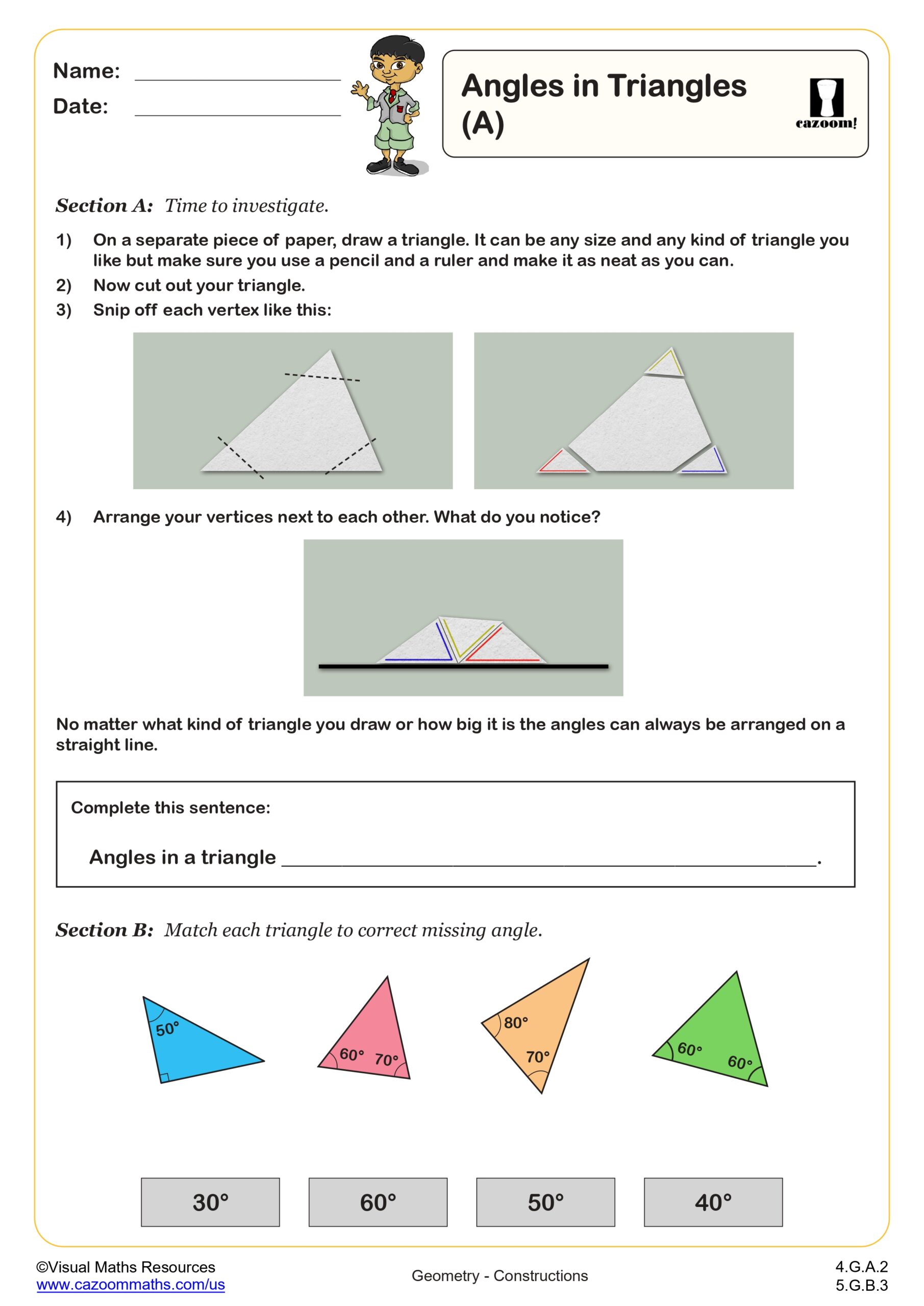
Use informal arguments to establish facts about the angle sum and exterior angle of triangles, about the angles created when parallel lines are cut by a transversal, and the angle-angle criterion for similarity of triangles. For example, arrange three copies of the same triangle so that the sum of the three angles appears to form a line, and give an argument in terms of transversals why this is so.
Use informal arguments to establish facts about the angle sum and exterior angle of triangles, about the angles created when parallel lines are cut by a transversal, and the angle-angle criterion for similarity of triangles. For example, arrange three copies of the same triangle so that the sum of the three angles appears to form a line, and give an argument in terms of transversals why this is so.
Angles in Isosceles Triangles WORKSHEET DESCRIPTION
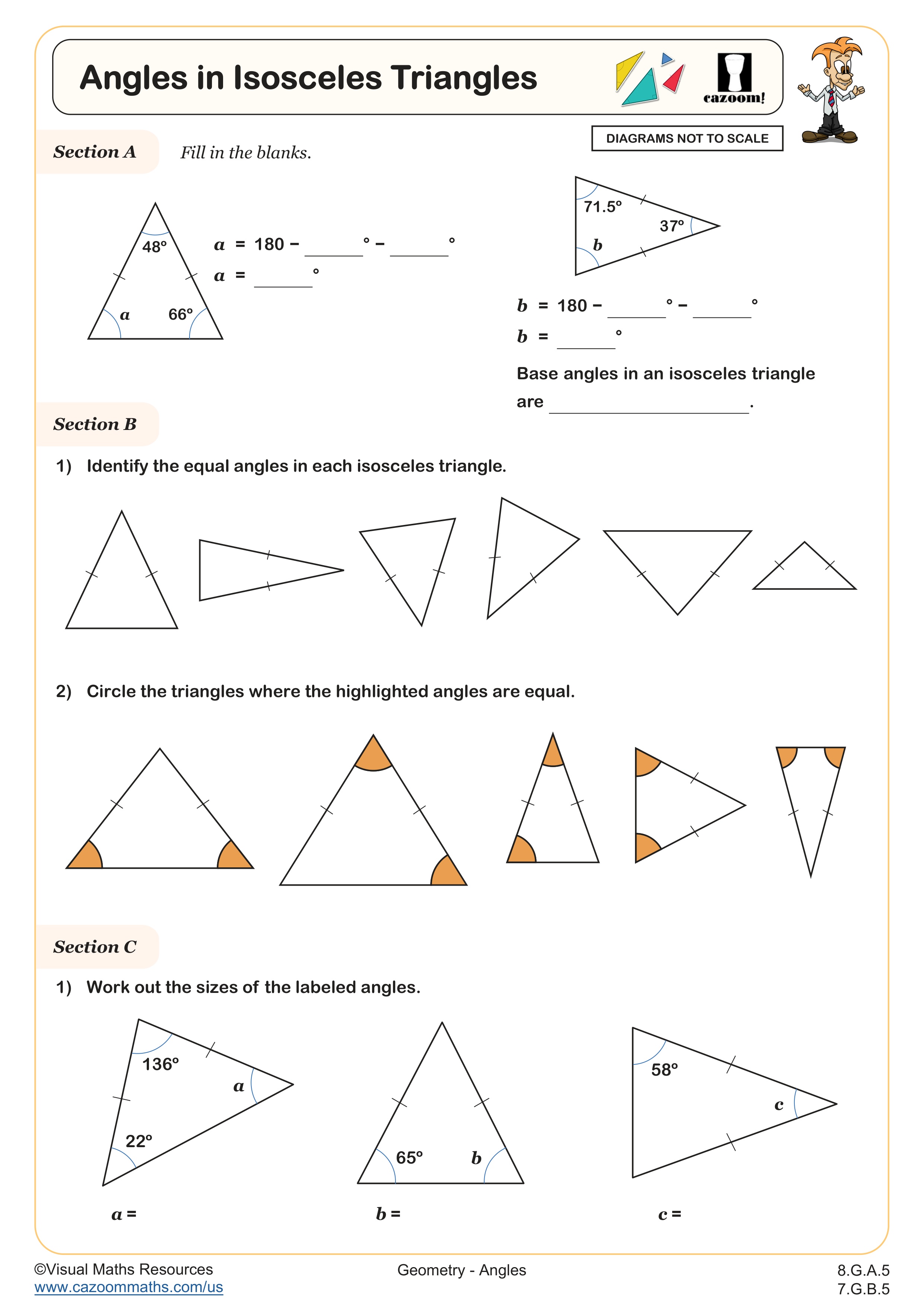
This worksheet on Angles in Isosceles Triangles is designed to develop students’ understanding of angle properties through a progression of reasoning and problem-solving tasks.
In Section A, students explore the property that base angles in an isosceles triangle are equal through a discovery activity, using the fact that angles in a triangle sum to 180°.
Section B builds on this by using examples and non-examples. Learners are prompted to identify pairs of equal angles and determine whether specific angles are equal within a range of isosceles triangle diagrams.
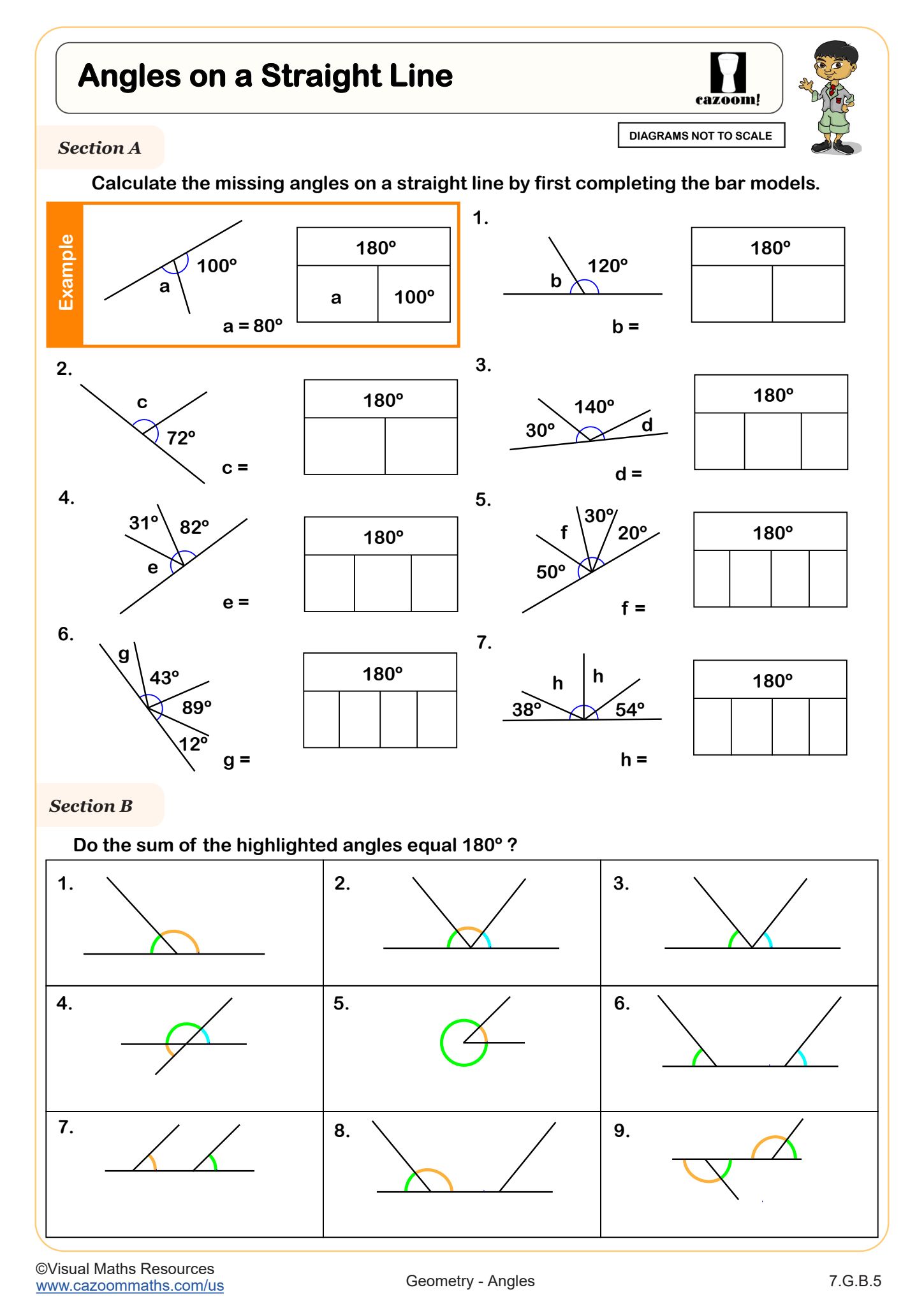
In Section C, students calculate missing angles in a series of increasingly challenging questions. They will work out fifteen angles in total, applying their understanding of isosceles triangles as well as other angle rules, such as angles on a straight line and angles around a point.
In Section A, students explore the property that base angles in an isosceles triangle are equal through a discovery activity, using the fact that angles in a triangle sum to 180°.
Section B builds on this by using examples and non-examples. Learners are prompted to identify pairs of equal angles and determine whether specific angles are equal within a range of isosceles triangle diagrams.
In Section C, students calculate missing angles in a series of increasingly challenging questions. They will work out fifteen angles in total, applying their understanding of isosceles triangles as well as other angle rules, such as angles on a straight line and angles around a point.
All worksheets are created by the team of experienced teachers at Cazoom Math.
RELATED TO Angles in Isosceles Triangles WORKSHEET
Frequently Asked Questions
This worksheet is designed for 8th grade students who are ready to explore the angle properties of isosceles triangles. The progression from discovery activities to calculating missing angles makes it well-suited for students at this level who have already mastered basic angle concepts like the triangle angle sum.