Equivalent Ratios WORKSHEET
Suitable for Grades: 6th Grade, 7th Grade
CCSS: 6.RP.A.3, 7.RP.A.2
CCSS Description: Use ratio and rate reasoning to solve real-world and mathematical problems, e.g., by reasoning about tables of equivalent ratios, tape diagrams, double number line diagrams, or equations. a. Make tables of equivalent ratios relating quantities with whole-number measurements, find missing values in the tables, and plot the pairs of values on the coordinate plane. Use tables to compare ratios. b. Solve unit rate problems including those involving unit pricing and constant speed. For example, if it took 7 hours to mow 4 lawns, then at that rate, how many lawns could be mowed in 35 hours? At what rate were lawns being mowed? c. Find a percent of a quantity as a rate per 100 (e.g., 30% of a quantity means 30/100 times the quantity); solve problems involving finding the whole, given a part and the percent. d. Use ratio reasoning to convert measurement units; manipulate and transform units appropriately when multiplying or dividing quantities.
Recognize and represent proportional relationships between quantities. a. Decide whether two quantities are in a proportional relationship, e.g., by testing for equivalent ratios in a table or graphing on a coordinate plane and observing whether the graph is a straight line through the origin. b. Identify the constant of proportionality (unit rate) in tables, graphs, equations, diagrams, and verbal descriptions of proportional relationships. c. Represent proportional relationships by equations. For example, if total cost t is proportional to the number n of items purchased at a constant price p, the relationship between the total cost and the number of items can be expressed as t = pn. d. Explain what a point (x, y) on the graph of a proportional relationship means in terms of the situation, with special attention to the points (0, 0) and (1, r) where r is the unit rate.
Recognize and represent proportional relationships between quantities. a. Decide whether two quantities are in a proportional relationship, e.g., by testing for equivalent ratios in a table or graphing on a coordinate plane and observing whether the graph is a straight line through the origin. b. Identify the constant of proportionality (unit rate) in tables, graphs, equations, diagrams, and verbal descriptions of proportional relationships. c. Represent proportional relationships by equations. For example, if total cost t is proportional to the number n of items purchased at a constant price p, the relationship between the total cost and the number of items can be expressed as t = pn. d. Explain what a point (x, y) on the graph of a proportional relationship means in terms of the situation, with special attention to the points (0, 0) and (1, r) where r is the unit rate.
Equivalent Ratios WORKSHEET DESCRIPTION
This worksheet focuses on the concept of equivalent ratios.
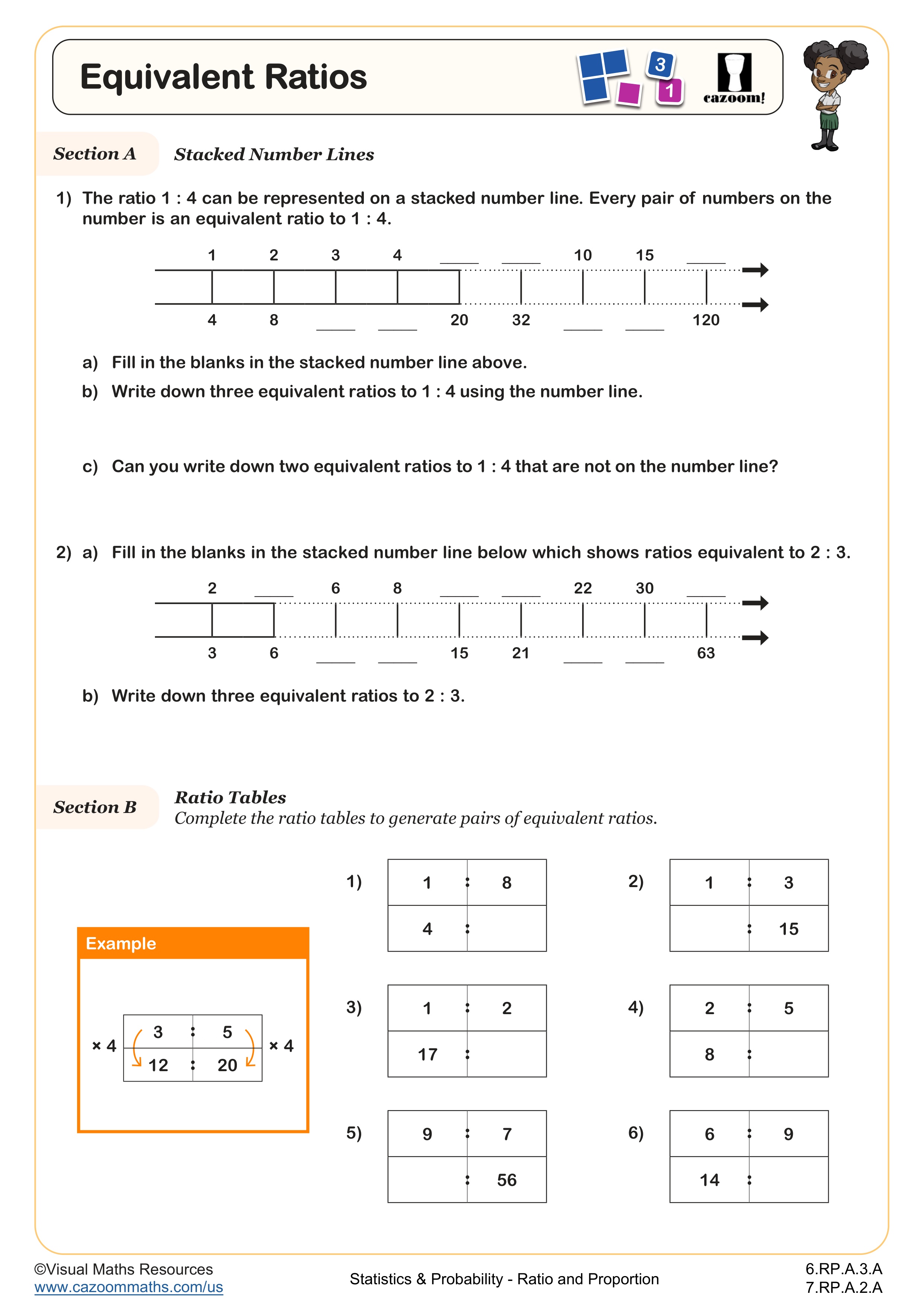
Section A introduces equivalent ratios using a stacked number line. Students must fill in the missing numbers on the number lines to create equivalent ratios, write down equivalent ratios from the number lines, and generate new ones not shown in the diagrams.
In Section B, the focus shifts to using ratio tables to find equivalent ratios. An example is provided showing how to multiply both parts of a ratio by the same number to find an equivalent pair; reinforcing the principle of multiplying or dividing both sides of a ratio by the same factor.
Section C requires students to identify and group sets of equivalent ratios from a list. This section challenges students to simplify or compare a variety of ratios.
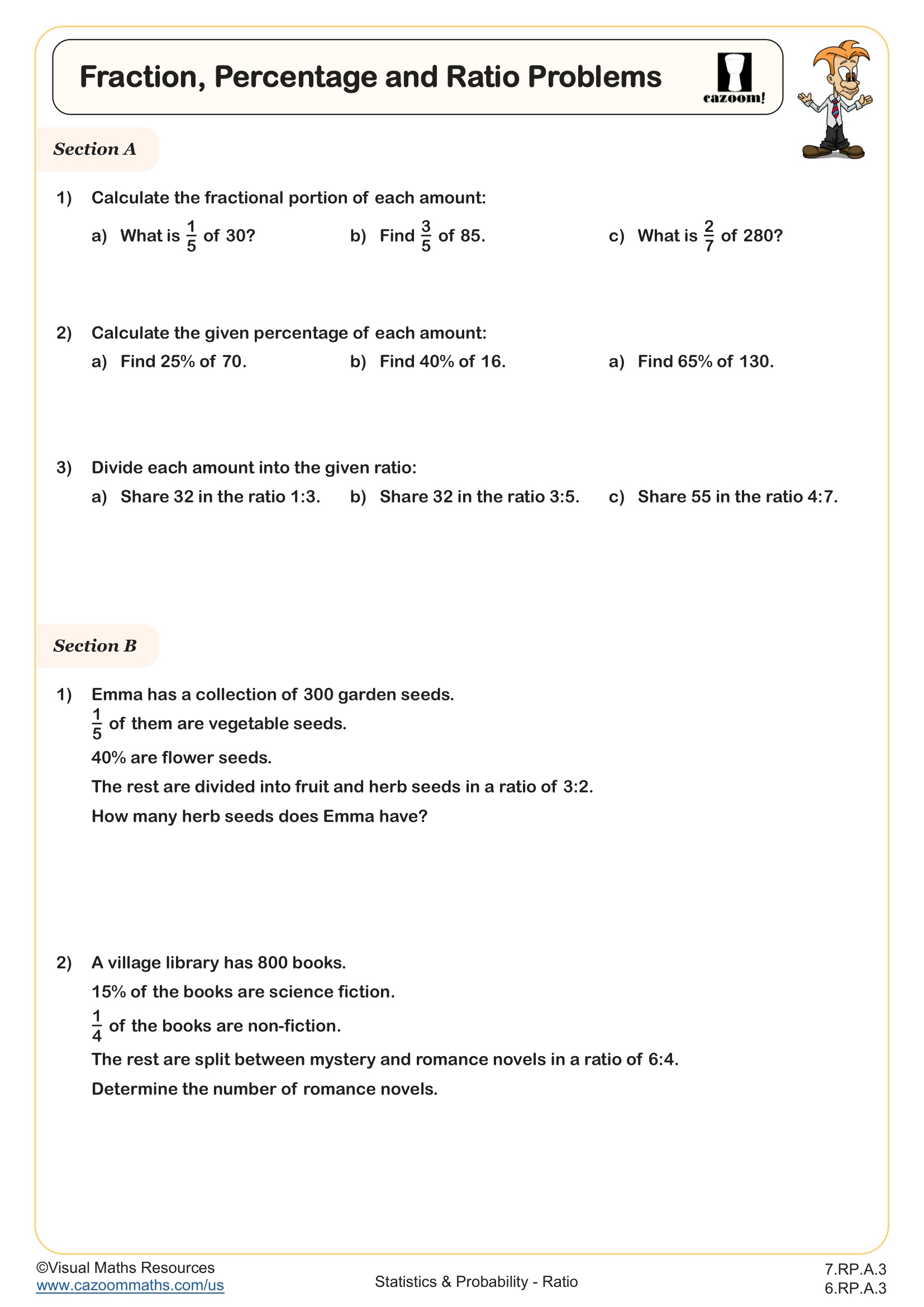
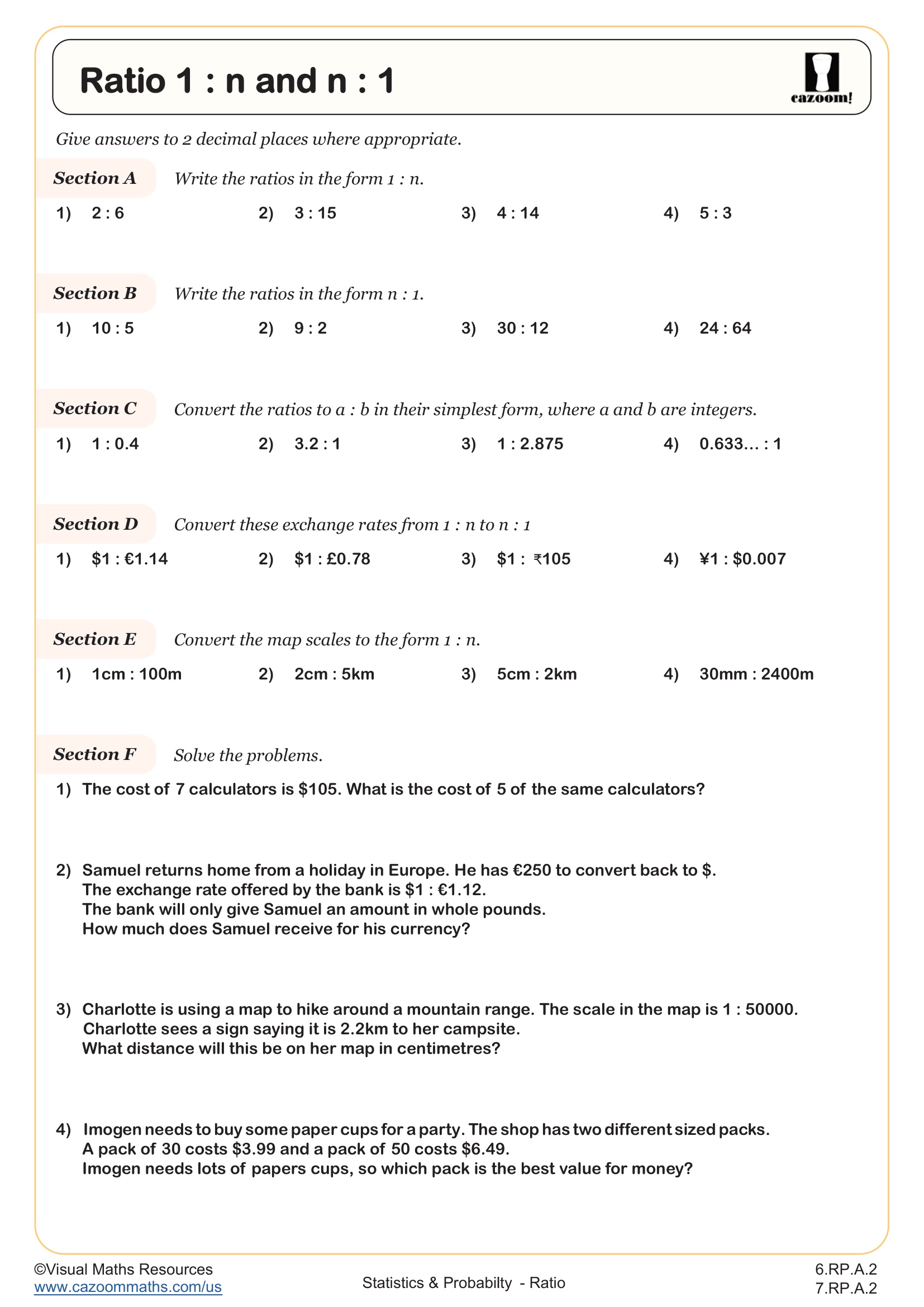
The final section applies the concept of equivalent ratios to word problems.
Section A introduces equivalent ratios using a stacked number line. Students must fill in the missing numbers on the number lines to create equivalent ratios, write down equivalent ratios from the number lines, and generate new ones not shown in the diagrams.
In Section B, the focus shifts to using ratio tables to find equivalent ratios. An example is provided showing how to multiply both parts of a ratio by the same number to find an equivalent pair; reinforcing the principle of multiplying or dividing both sides of a ratio by the same factor.
Section C requires students to identify and group sets of equivalent ratios from a list. This section challenges students to simplify or compare a variety of ratios.
The final section applies the concept of equivalent ratios to word problems.
All worksheets are created by the team of experienced teachers at Cazoom Math.
RELATED TO Equivalent Ratios WORKSHEET
Frequently Asked Questions
This worksheet is designed for 6th and 7th grade students who are learning about ratios. The progression from visual number lines to ratio tables and word problems makes it suitable for students at different stages of understanding this fundamental ratio concept.