Back to:
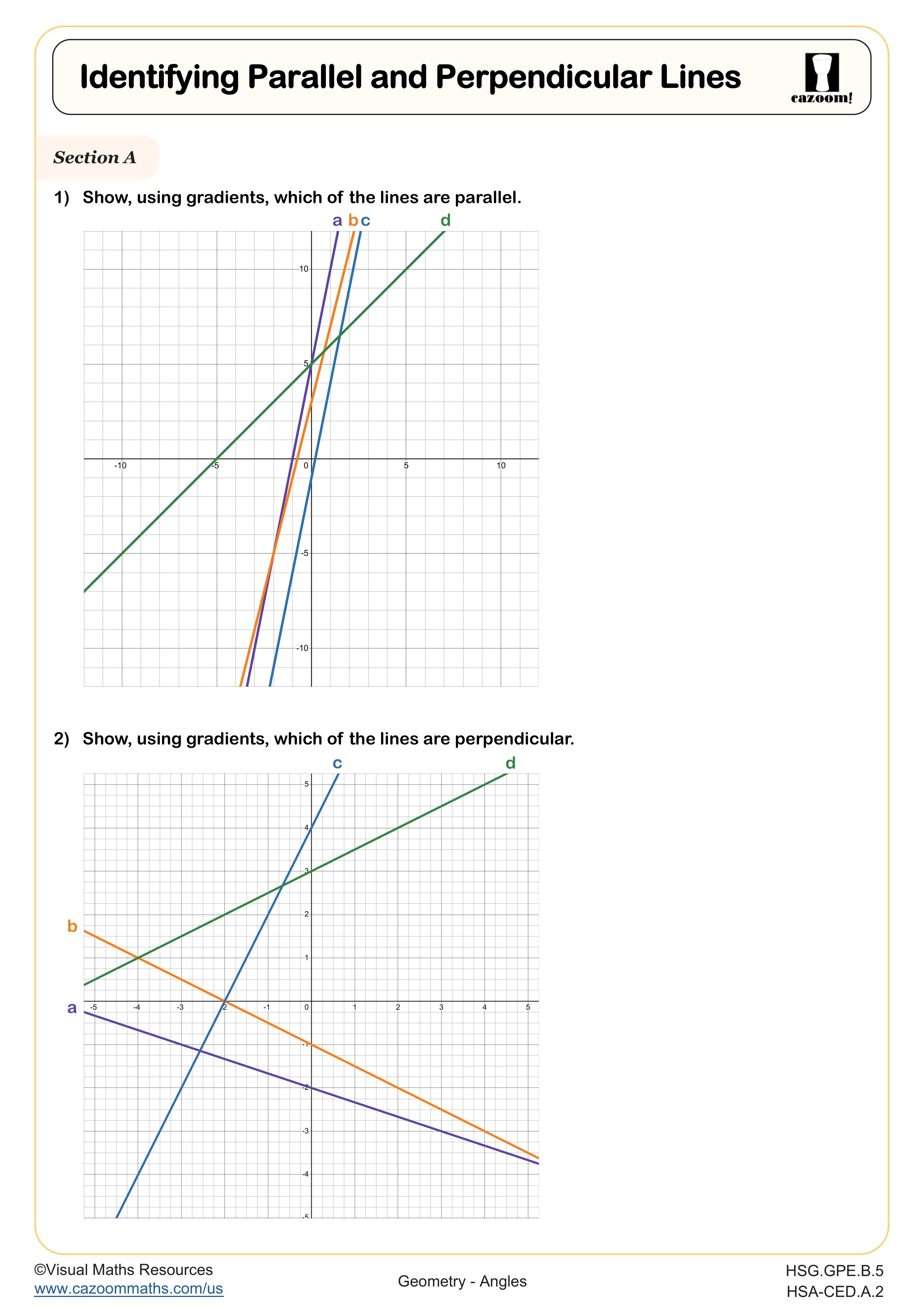
Identifying Parallel and Perpendicular Lines WORKSHEET
Suitable for Grades: Geometry, IM 2
CCSS: HSA.CED.A.2, HSG.GPE.B.5
CCSS Description: Create equations in two or more variables to represent relationships between quantities; graph equations on coordinate axes with labels and scales.
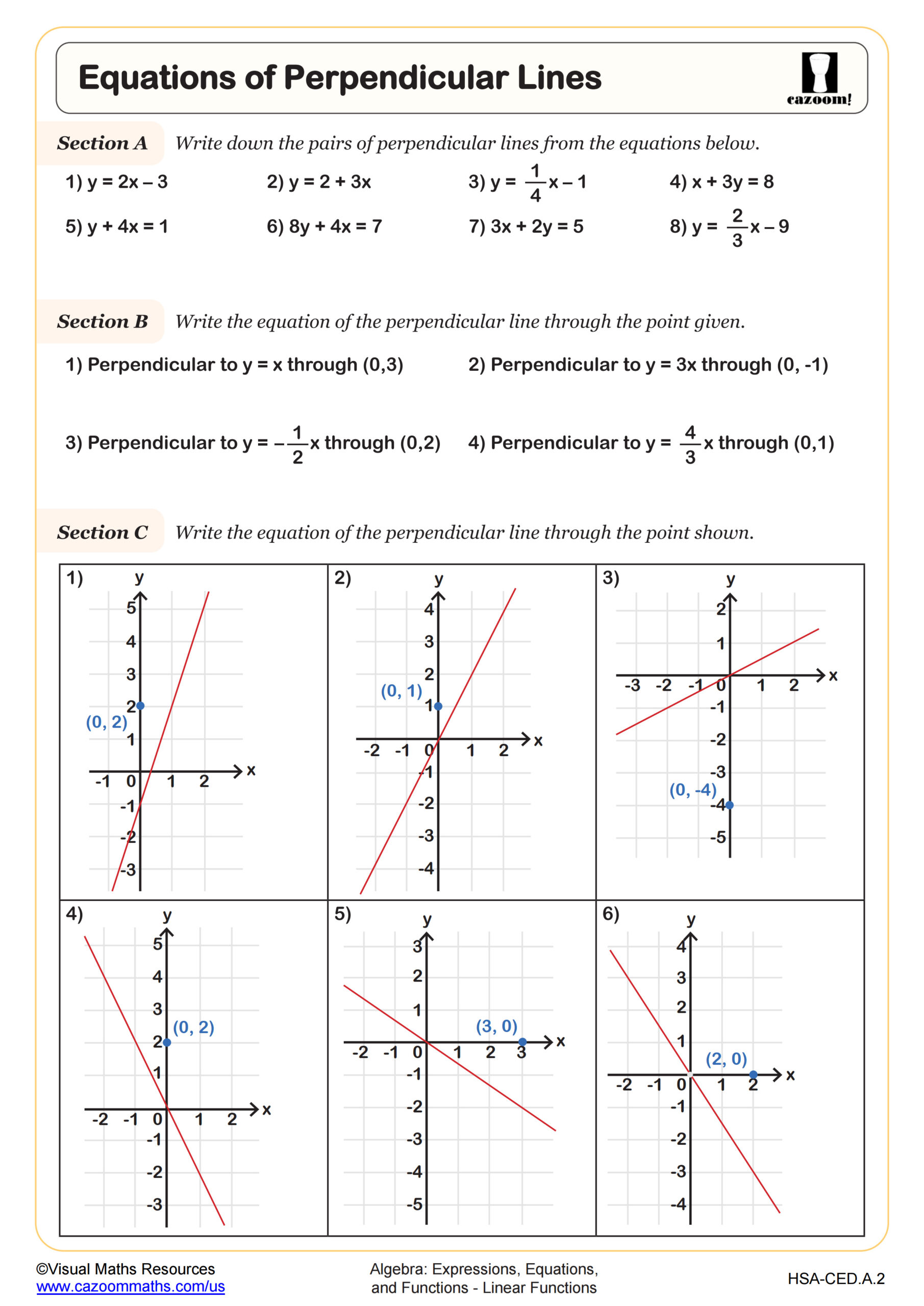
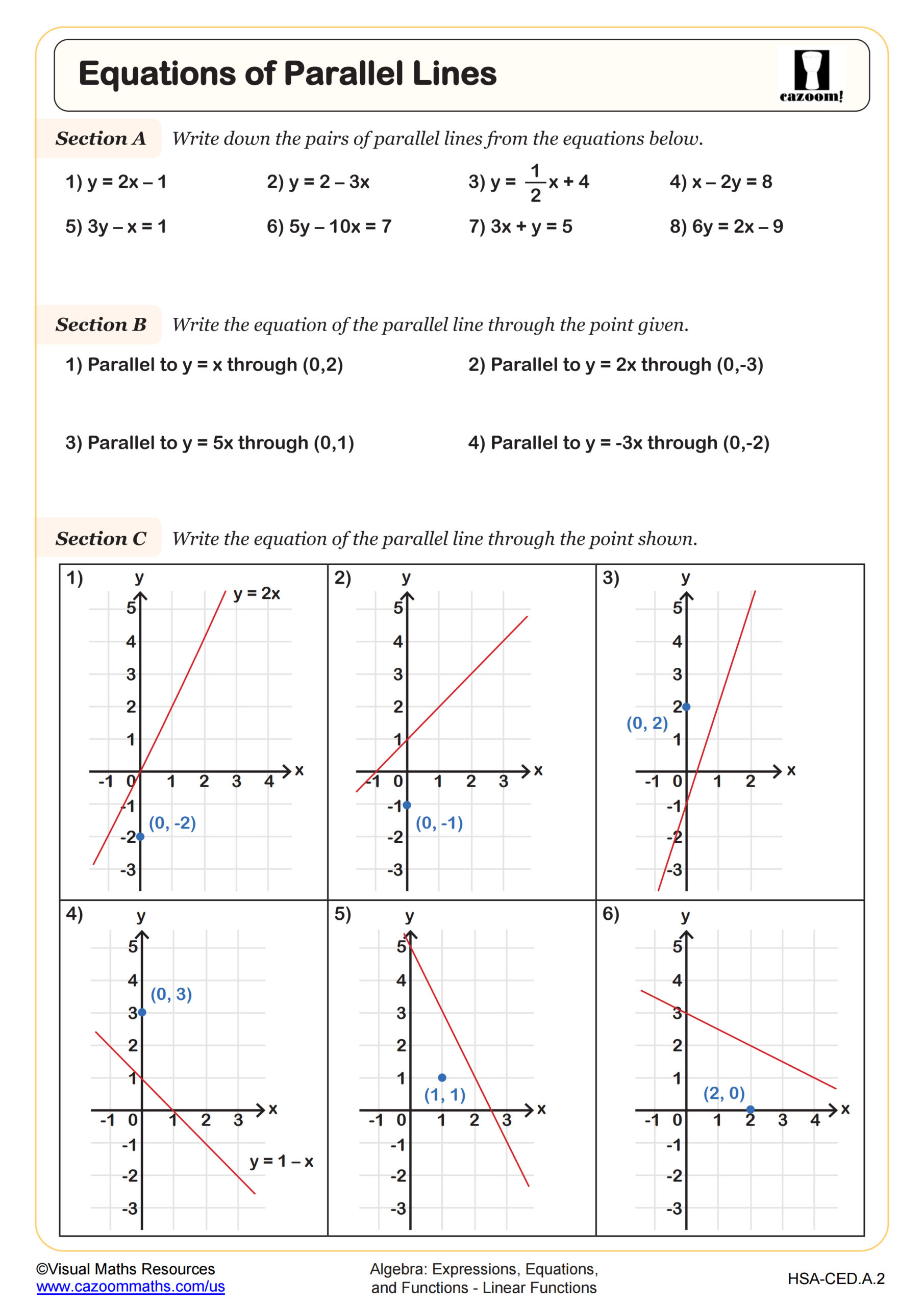
Prove the slope criteria for parallel and perpendicular lines and use them to solve geometric problems (e.g., find the equation of a line parallel or perpendicular to a given line that passes through a given point).
Prove the slope criteria for parallel and perpendicular lines and use them to solve geometric problems (e.g., find the equation of a line parallel or perpendicular to a given line that passes through a given point).
Identifying Parallel and Perpendicular Lines WORKSHEET DESCRIPTION
This worksheet is structured to introduce and build fluency in rationalising the denominator.
Section A begins with a multiplication grid to practise simplifying products of numbers and surds, laying the groundwork for later sections.
Section B is a fill the gaps task prompting learners to think deeply about the process.
In Section C, pupils are required to rationalise the denominators of 14 fractions, simplifying their answers where appropriate. The section is scaffolded by increasing difficulty.
Section D presents two worded problems that involve rationalising in a real-world context. These require students to interpret the question, identify the surds, and apply rationalisation as part of a broader problem-solving process. These problems apply previous skills in a more abstract or applied context, consolidating learning and encouraging deeper understanding.
Section A begins with a multiplication grid to practise simplifying products of numbers and surds, laying the groundwork for later sections.
Section B is a fill the gaps task prompting learners to think deeply about the process.
In Section C, pupils are required to rationalise the denominators of 14 fractions, simplifying their answers where appropriate. The section is scaffolded by increasing difficulty.
Section D presents two worded problems that involve rationalising in a real-world context. These require students to interpret the question, identify the surds, and apply rationalisation as part of a broader problem-solving process. These problems apply previous skills in a more abstract or applied context, consolidating learning and encouraging deeper understanding.
All worksheets are created by the team of experienced teachers at Cazoom Math.
RELATED TO Identifying Parallel and Perpendicular Lines WORKSHEET
Frequently Asked Questions
This worksheet is designed for IM 2 and Geometry students who are ready to tackle more advanced algebraic concepts. The scaffolded approach in Section C with increasing difficulty makes it suitable for building skills progressively at these grade levels.