1st Grade Adding 2 Digit Numbers to 1000 Worksheets
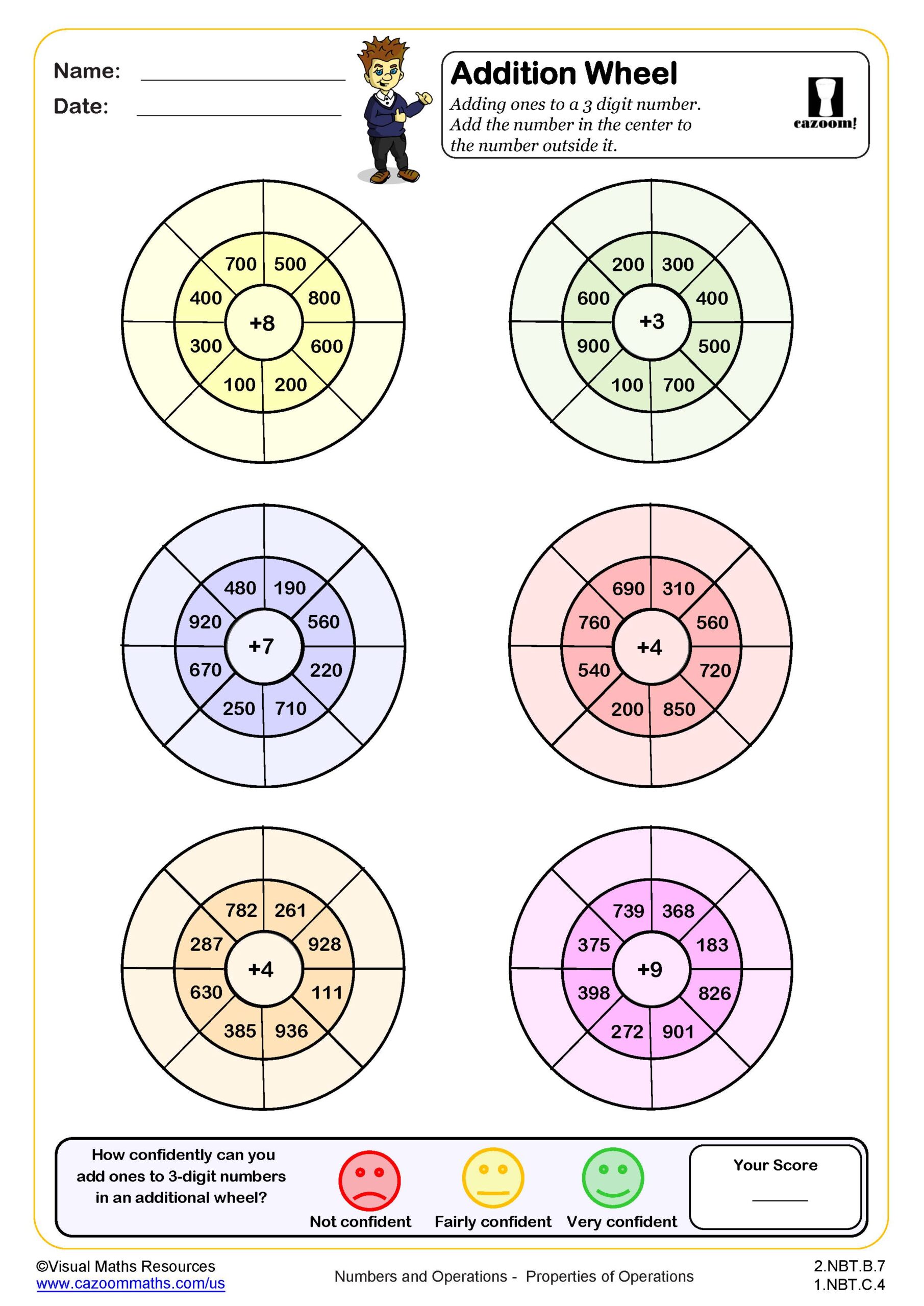
All worksheets are created by the team of experienced teachers at Cazoom Math.
What Skills Do Students Practice When Adding 2 Digit Numbers to 1000?
Students develop multiple interconnected skills when adding 2 digit numbers to values reaching 1000, including place value recognition, mental addition strategies, and understanding how numbers compose and decompose. The worksheets focus primarily on adding ones to three-digit numbers, which reinforces the concept that each digit position operates independently when no regrouping occurs. This foundational understanding prepares students for more complex addition requiring carrying across place values.
Teachers often observe that students who initially count on their fingers for these problems make a significant leap when they recognize patterns in adding to the ones place. A common error occurs when students add the ones digit to all three places, writing 325 + 4 = 729 instead of 329. Providing visual supports like addition wheels helps students see which digit changes and which remain constant, building the spatial reasoning needed for vertical addition algorithms introduced in later grades.
Is Adding Numbers to 1000 Appropriate for 1st Grade Students?
According to Common Core State Standards, 1st grade students work primarily with addition and subtraction within 100, making problems reaching 1000 an enrichment opportunity rather than a core expectation. However, when limited to adding single digits to three-digit numbers without regrouping, this skill becomes accessible to advanced 1st graders and provides valuable place value practice. The key is focusing on problems where students add ones to the ones place, avoiding the complexity of carrying that typically appears in 2nd and 3rd grade curricula.
This topic builds directly on kindergarten counting to 100 and 1st grade work with tens and ones. Students who confidently identify the ones, tens, and hundreds places find these problems surprisingly manageable, often performing better than expected because the larger numbers feel more grown-up and engaging. The practice establishes a strong foundation for 2nd grade standards requiring fluent addition within 1000, giving students a head start on regrouping concepts they'll encounter next year.
How Do Addition Wheels Help Students Learn Addition Facts?
Addition wheels present problems in a circular format where a center number connects to surrounding numbers that students add to it. This visual structure helps students recognize patterns and practice multiple related problems efficiently, building fluency through repetition with variation. The wheel format particularly supports adding ones to three-digit numbers because students can quickly see how the same addend affects different starting numbers, reinforcing the concept that adding to the ones place only changes that specific digit.
This skill connects directly to real-world applications like tracking inventory or counting collections. When a store has 245 items and receives 6 more, or a student has 137 trading cards and earns 8 additional ones, understanding how to add without recalculating the entire quantity saves time and reduces errors. In STEM contexts, this place value understanding becomes fundamental for computer science concepts where binary and decimal number systems require precise digit-position awareness, preparing students for computational thinking skills they'll develop throughout their education.
How Can Teachers Use These Worksheets Most Effectively?
These worksheets work best when students have already mastered basic addition facts within 20 and can identify place values in three-digit numbers. Teachers should introduce the addition wheel format with a quick demonstration, showing students that they add the center number to each surrounding number and write answers in the outer ring. The visual structure reduces cognitive load, allowing students to focus on the addition process rather than decoding problem formats, which makes these particularly effective for students who struggle with traditional vertical or horizontal problem layouts.
Many teachers use these worksheets during math centers or stations, pairing students so they can check each other's work using the answer keys before submitting final versions. The format also works well for morning work or early finisher activities since students can complete problems independently once they understand the wheel structure. For intervention purposes, teachers can have struggling students use base-ten blocks alongside the worksheet, physically adding ones cubes to hundreds flats and tens rods to visualize why only the ones digit changes, creating a concrete-to-abstract learning progression.