1st Grade Measurement and Data Worksheets
All worksheets are created by the team of experienced teachers at Cazoom Math.
What skills do measuring worksheets for 1st grade help students develop?
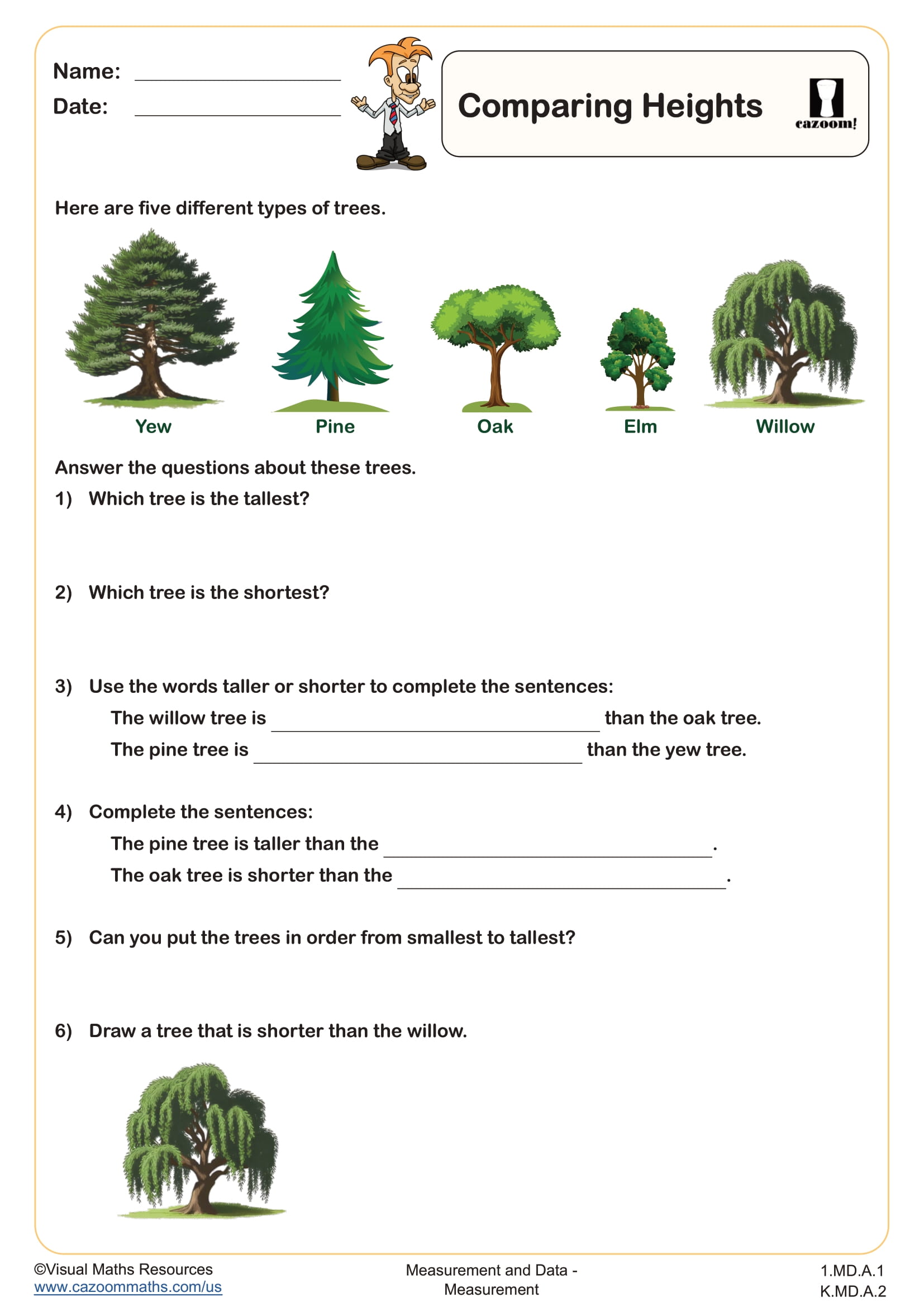
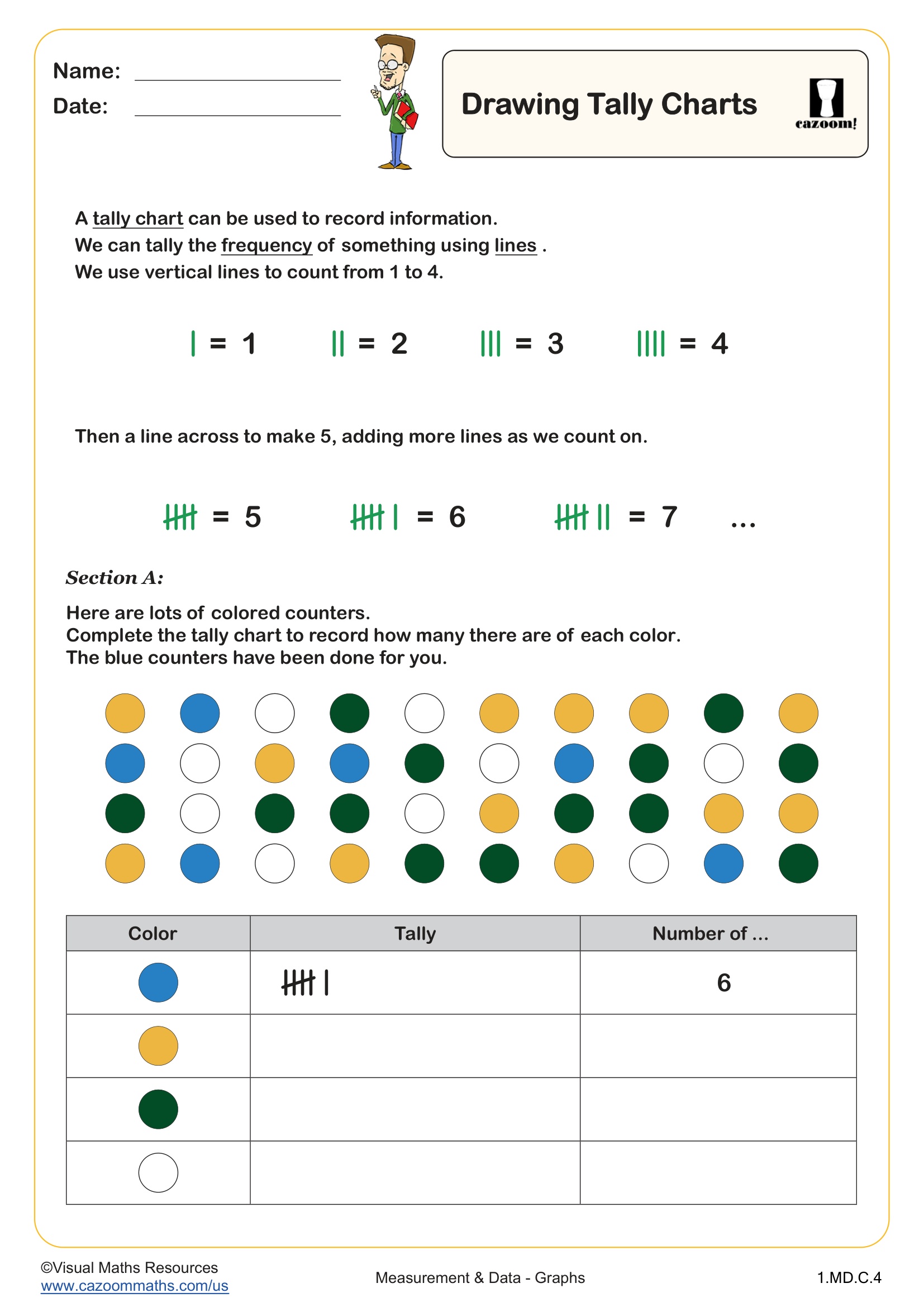
Measuring worksheets for 1st grade target specific Common Core standards including 1.MD.1 through 1.MD.4, focusing on comparing lengths using non-standard units, telling time to the hour and half-hour, identifying coins and their values, and organizing data into simple charts and graphs. Students learn to use everyday objects like paper clips, blocks, and crayons as measuring tools while developing vocabulary for comparative language.
Teachers frequently observe that students struggle with the concept that measurement units must be consistent and placed end-to-end without gaps. Many first grade learners will count overlapping units or leave spaces between objects, leading to inaccurate measurements that require direct instruction and repeated practice to correct.
How do 1st grade measurement skills prepare students for future math learning?
First grade measurement activities establish the foundation for more complex mathematical concepts students will encounter in later grades, including standard measurement units, fractions, and algebraic thinking. Students who master basic measurement comparison and data organization in first grade show greater success with multiplication and division concepts in third grade, as they understand the relationship between units and quantities.
The progression from non-standard to standard units mirrors how students develop number sense, moving from concrete manipulatives to abstract thinking. Teachers notice that students who struggle with measurement concepts in first grade often have difficulty with place value and multi-step word problems in subsequent grades, making early intervention crucial for long-term mathematical success.
What common mistakes do students make when learning to tell time in first grade?
Students commonly confuse the hour and minute hands when learning to read analog clocks, often reading 3:30 as 6:15 because they focus on where the minute hand points rather than understanding its relationship to the numbers. Many first grade learners also struggle with the concept that the hour hand moves gradually between numbers, expecting it to point directly at the 3 when the time is 3:30.
Teachers find success using digital and analog clocks side by side, helping students connect the visual representation of 3:30 on a digital display with the analog clock positions. Practice with moveable clock hands allows students to manipulate time settings while reinforcing that time telling requires reading both hands together, not independently.
How can teachers use these worksheets to support different learning styles in first grade?
Teachers can differentiate measurement worksheet activities by providing physical manipulatives alongside the paper exercises, allowing kinesthetic learners to measure actual objects before recording answers. Visual learners benefit from worksheets that include clear illustrations and step-by-step measurement demonstrations, while auditory learners respond well to verbal explanations of the measurement process during worksheet completion.
Many educators find success pairing worksheet activities with hands-on measurement centers, where students measure classroom objects using the same non-standard units featured on their papers. This multi-sensory approach helps reinforce measurement concepts across different learning preferences while building confidence in students who might struggle with abstract representations alone.