1st Grade Time Worksheets
All worksheets are created by the team of experienced teachers at Cazoom Math.
What Time Concepts Should 1st Graders Focus On?
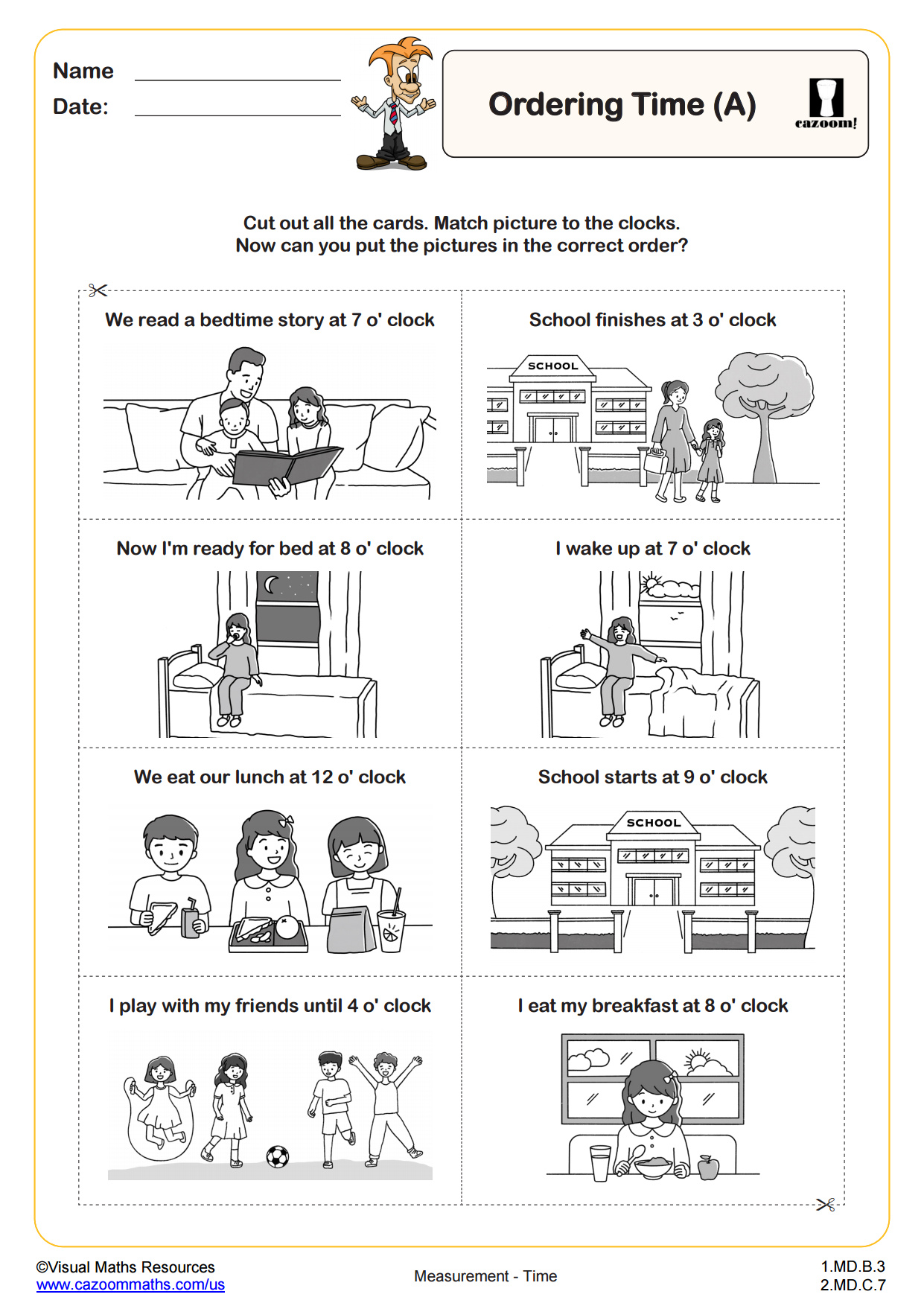
First graders work on telling time to the hour and half-hour using both analog and digital clocks, understanding the difference between hour and minute hands, and sequencing daily events in chronological order. The Common Core State Standards (1.MD.B.3) expect students to tell and write time in hours and half-hours using analog and digital clocks, building the foundation for more precise time-telling in 2nd grade.
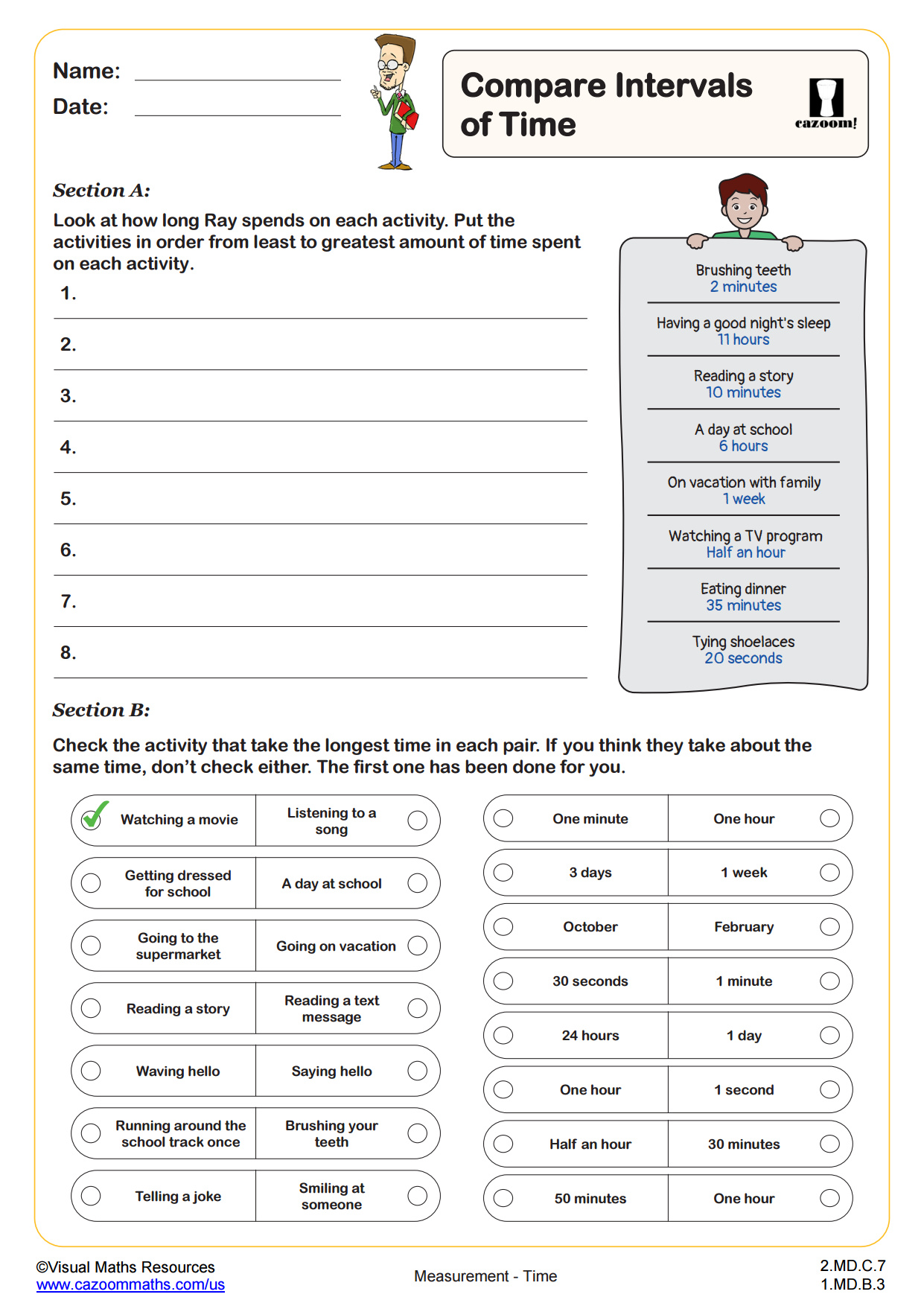
Students often struggle with distinguishing which hand represents hours versus minutes, especially when the hour hand sits between two numbers at half-past times. Teachers frequently notice that placing the analog clock beside a digital display helps students verify their answers and understand how both formats represent the same moment. Worksheets that include comparing time intervals, like determining whether breakfast or lunch comes first, reinforce sequencing skills that connect directly to students' lived experiences.
How Does 1st Grade Time Learning Build on Kindergarten Skills?
In kindergarten, students learn to describe when events happen using basic time vocabulary like morning, afternoon, evening, yesterday, today, and tomorrow. First grade advances these skills by introducing actual clock reading and more precise time measurements, moving from general time awareness to specific hour and half-hour recognition. This progression aligns with students' developing number sense and their ability to count by fives and tens.
By the end of 1st grade, students should comfortably tell time to the nearest hour and half-hour, preparing them for 2nd grade work with five-minute intervals and eventually one-minute precision. Teachers often find that students who master skip counting by fives transition more smoothly to reading minutes on an analog clock. This foundational time work also supports scheduling awareness needed for following classroom routines, understanding recess times, and managing homework expectations as students progress through elementary school.
Why Is Ordering Time Important for Young Learners?
Ordering time involves sequencing events chronologically and understanding that certain activities happen before or after others throughout the day. This skill requires students to apply logical thinking about temporal relationships, recognizing patterns in daily routines and understanding cause-and-effect sequences. Students learn to use comparative language like earlier, later, before, after, first, next, and last when describing when events occur.
Real-world applications appear constantly in elementary classrooms, from following multi-step directions to understanding schedules for specials like art, music, or PE. Many teachers notice that students who struggle with ordering time also have difficulty with multi-step word problems later, since both require tracking sequences and relationships between events. In STEM contexts, understanding time order becomes essential for scientific observation, recording experiment steps, coding sequences in computer science, and following engineering design processes where steps must occur in specific orders.
How Can Teachers Use These Time Worksheets Effectively?
These time worksheets offer structured practice with visual clock representations and interval comparisons that help students recognize patterns and develop fluency with time concepts. The answer keys allow for quick assessment of student understanding and help identify which students need additional support with specific skills like reading analog clocks versus sequencing events. Teachers can use these worksheets during whole-group instruction to model thinking strategies before releasing students to independent practice.
Many teachers incorporate these worksheets into morning work routines, math centers, or intervention sessions for students who need extra practice distinguishing hour and minute hands. The worksheets also work well for homework assignments since the clear visual format helps parents support learning at home without confusion. Pairing students during worksheet completion encourages mathematical conversation, with stronger students explaining their reasoning to peers, which deepens understanding for both partners while building academic vocabulary around time concepts.