1st Grade Understanding the Difference Worksheets
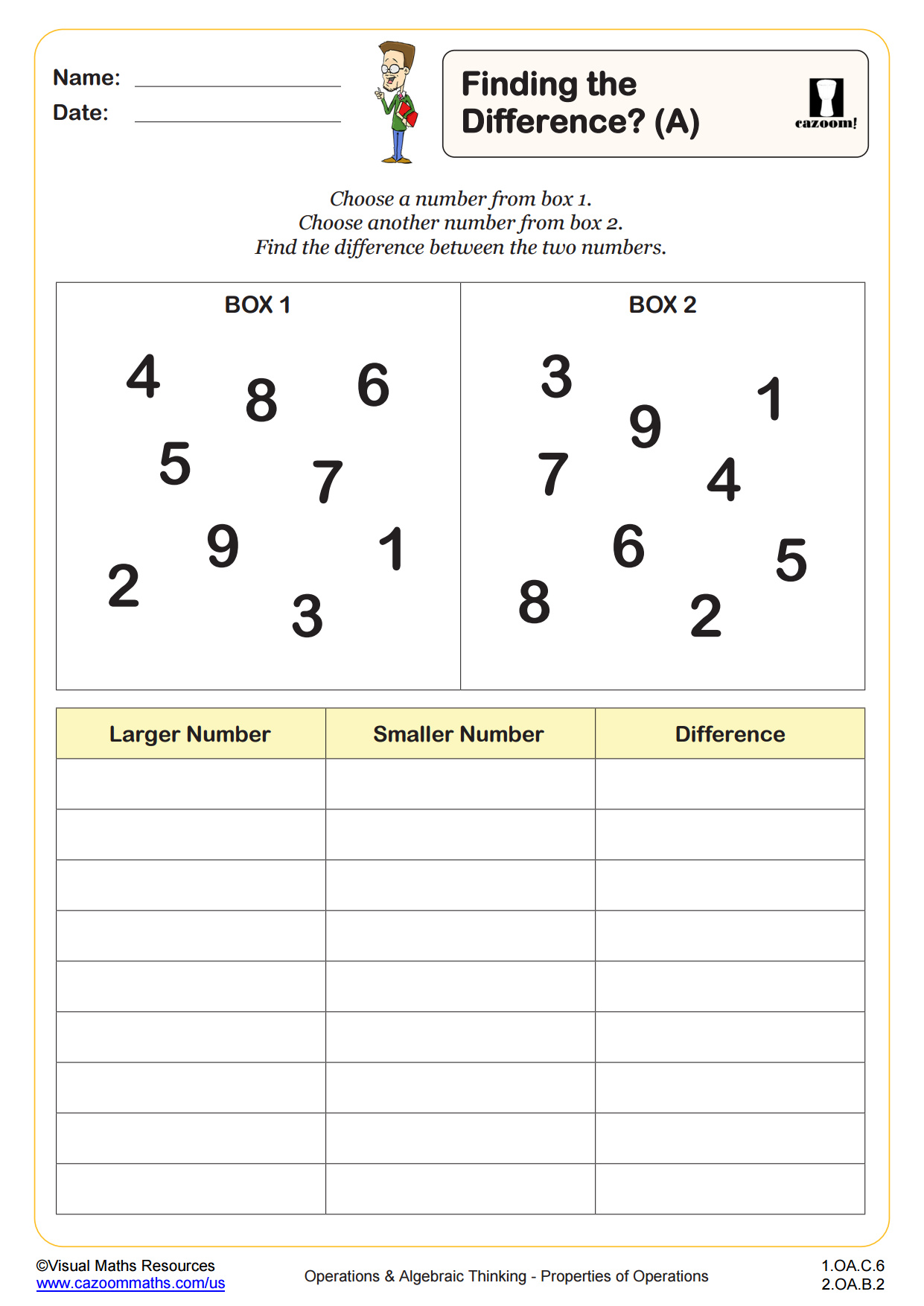
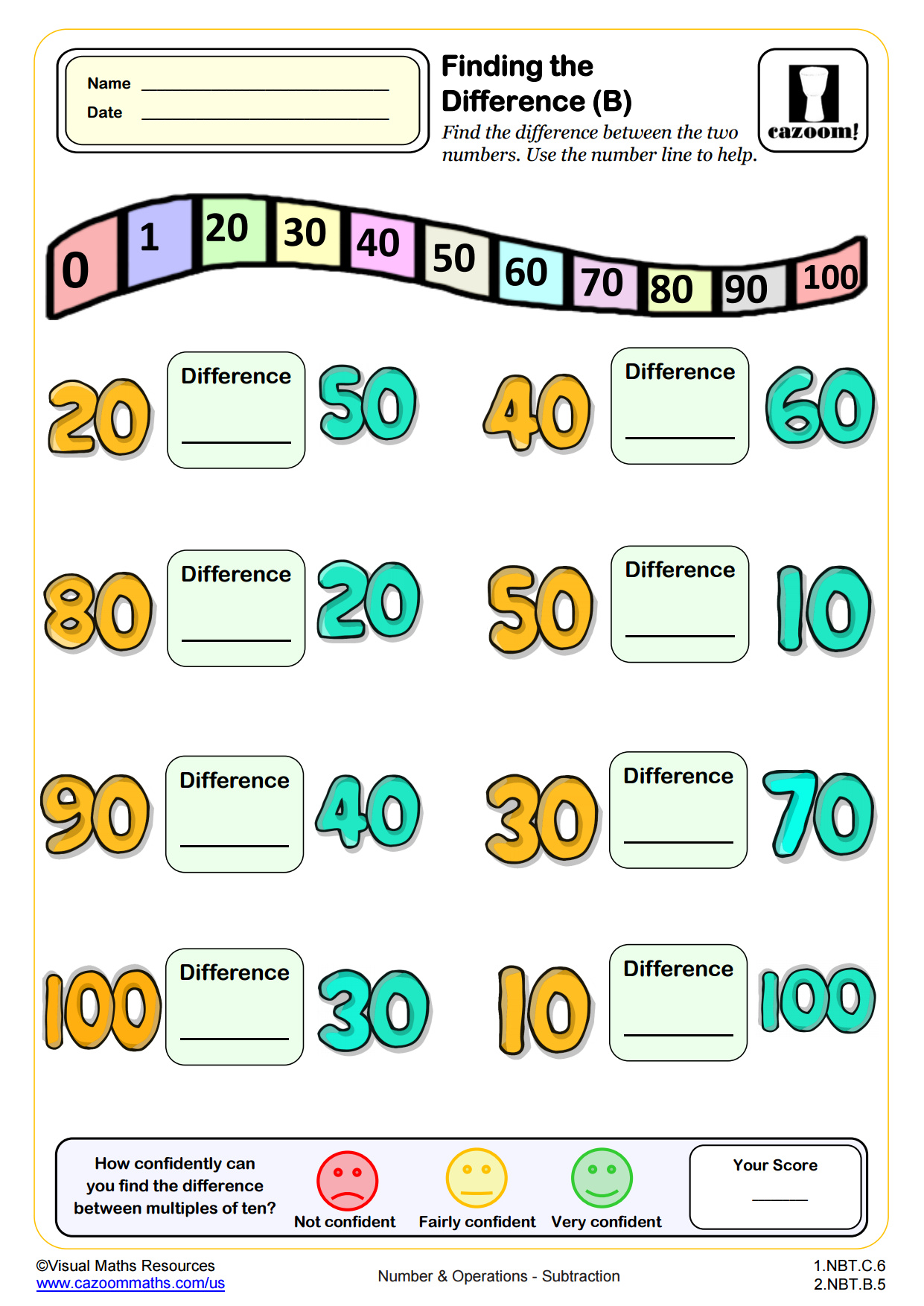
All worksheets are created by the team of experienced teachers at Cazoom Math.
What Does 'Finding the Difference' Mean in 1st Grade Math?
Finding the difference means determining how far apart two numbers are, which forms the conceptual foundation for subtraction. In 1st grade, this typically involves comparing two quantities and identifying how many more one has than the other, aligning with Common Core standard 1.OA.A.1. Students learn that the difference can represent the answer to questions like "How many more apples does Sam have than Maria?" or "How many fewer pencils are in the red box?"
A common mistake occurs when students confuse "difference" with simply taking away objects they can see. Teachers frequently observe students struggling when the problem doesn't involve a removal action, such as comparing the heights of two towers or the number of stickers two children own. The worksheets address this by presenting difference problems in various contexts, helping students recognize that subtraction isn't always about things disappearing but often about comparison.
What Should 1st Graders Know About Understanding the Difference?
By the end of 1st grade, students should confidently find the difference between numbers within 20, using strategies like counting on, counting back, or making ten. They should recognize difference problems in word problems and choose subtraction as the appropriate operation. Students are expected to understand that the difference represents a relationship between two quantities, not just a calculation procedure, and should be able to explain their thinking using drawings, number lines, or manipulatives.
This skill builds directly on kindergarten work with comparing groups using terms like "more" and "fewer." Understanding the difference prepares students for 2nd grade multi-digit subtraction and later work with absolute value, distance on a number line, and even algebraic thinking. Teachers notice that students who develop strong conceptual understanding of difference in 1st grade navigate place value subtraction with greater confidence because they understand what the operation actually represents.
How Do Students Use Number Lines to Find the Difference?
A number line provides a visual model that helps students see the difference as a distance between two numbers. Students place both numbers on the line and count the spaces or jumps between them, which reinforces that subtraction measures the gap between quantities. This strategy works particularly well for students who struggle with abstract symbols because it transforms the problem into something they can literally see and count. Teachers often introduce this method after students have worked with concrete objects but before expecting fluency with fact families.
Number lines connect directly to measurement concepts students encounter throughout STEM learning. When engineers measure the difference between expected and actual results, or when scientists compare data points, they're using the same conceptual understanding 1st graders develop. In everyday life, children use this skill when comparing ages ("I'm three years older than my brother"), measuring growth on a height chart, or determining how many more days until their birthday.
How Can Teachers Use These Understanding the Difference Worksheets?
These worksheets provide structured practice that moves students from concrete comparisons to more abstract difference problems. The problems incorporate visual representations and word problem contexts that require students to identify when finding the difference is needed, not just execute calculations. Answer keys allow teachers to quickly identify which students grasp the concept versus those still relying on memorization without understanding, making it easier to target instruction where students actually need support.
Many teachers use these worksheets during math centers while working with small intervention groups, since students can complete them independently and check their own work against the answer key. They work well as targeted homework when a student needs extra practice recognizing difference situations, or as pre-assessment tools before introducing formal subtraction algorithms. Some teachers assign one worksheet as guided practice during whole-group instruction, then use the second for independent application, allowing students to demonstrate mastery with similar but not identical problems.