2nd Grade Addition with Visual Aids Worksheets
All worksheets are created by the team of experienced teachers at Cazoom Math.
How Do Visual Aids Help Students Learn Addition?
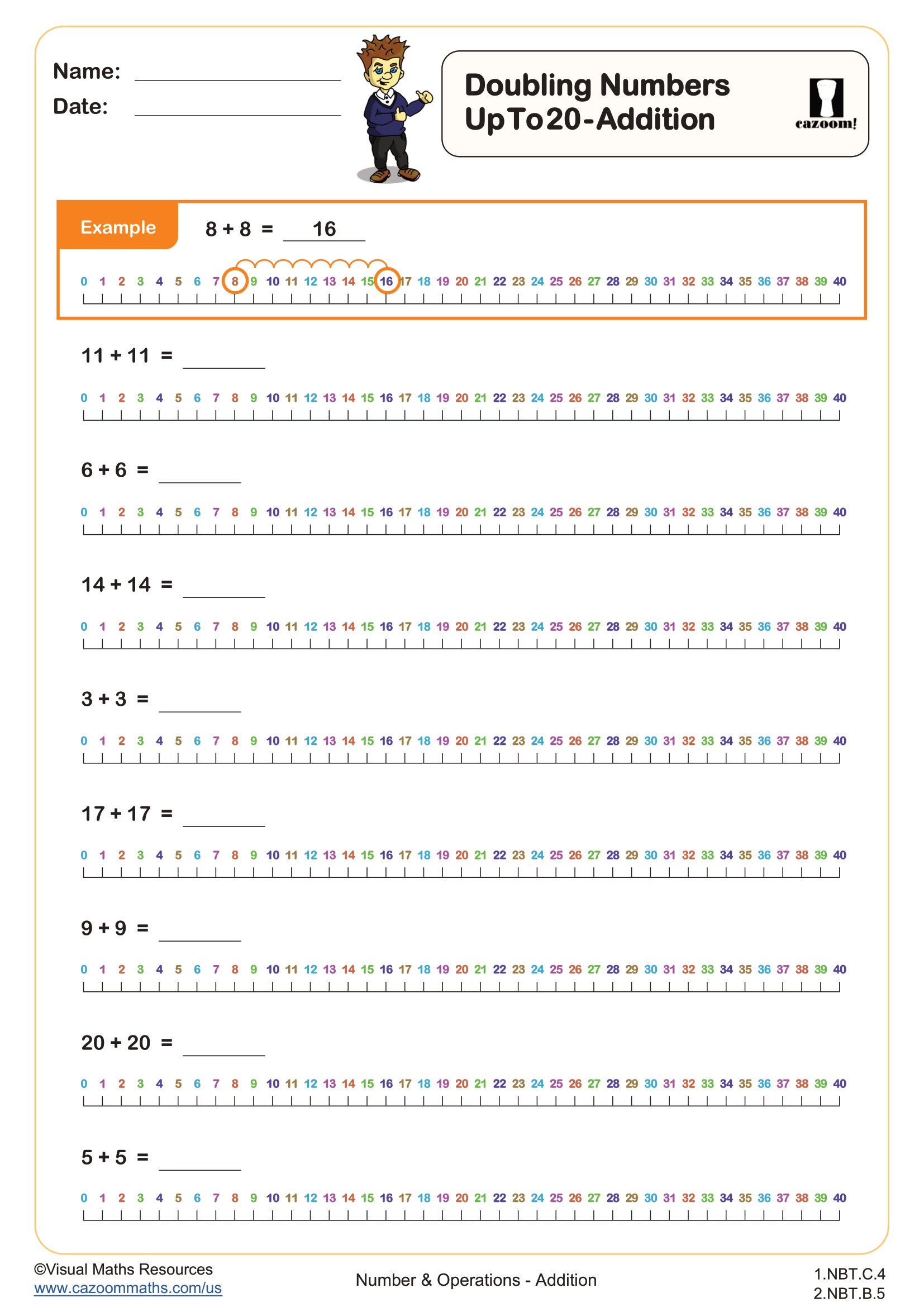
Visual aids translate abstract addition problems into concrete representations that second graders can see and manipulate mentally. Pictures of objects, ten frames, and number lines give students multiple entry points for solving problems, supporting the Common Core emphasis on making sense of problems and persevering in solving them. When students see eight apples plus eight apples drawn out, they build visual memory that supports mental math development.
Many students make the connection between doubling and skip counting when they work with visual models consistently. Teachers notice that students who draw their own pictures initially begin to visualize these representations mentally after several weeks of practice, marking a critical transition toward abstract thinking. Visual aids also help identify calculation errors quickly since students can count individual items to verify their answers.
What Should 2nd Graders Know About Addition with Visual Aids?
By second grade, students should use visual aids strategically rather than counting every individual object. They should recognize groups of five and ten instantly through subitizing, use ten frames to see how numbers relate to benchmark numbers, and apply doubling facts fluently up to 20. The Common Core State Standards expect second graders to add within 100 using concrete models, drawings, and mental strategies by the end of the year.
This work builds directly on first grade counting and basic addition facts. Students who mastered making ten in first grade find ten frames particularly useful for solving harder problems. The visual strategies learned in second grade become the foundation for place value understanding in third grade, where students tackle three-digit addition and need to visualize what hundreds, tens, and ones actually represent.
Why Is Doubling an Important Addition Strategy?
Doubling serves as a gateway to understanding multiplication and provides a reliable mental math strategy that students can apply throughout elementary school. When students recognize that 7 + 7 = 14, they build a fact they can use to solve near-doubles like 7 + 8 (just one more than 14). Visual representations make the symmetry of doubling obvious, helping students see why this strategy works and building number sense that extends far beyond memorization.
Doubling appears constantly in real-world contexts that second graders encounter. When sharing snacks equally between two friends, building symmetrical block towers, or calculating the total number of shoes for a group of people, students apply doubling naturally. These practical applications strengthen understanding and help students recognize mathematics as a tool for solving everyday problems, supporting early STEM reasoning and problem-solving habits.
How Can Teachers Use These Worksheets Most Effectively?
The worksheets provide structured practice that moves students from visual support toward independent calculation. Teachers can use the visual models as discussion prompts, asking students to explain what they notice about the pictures before solving problems. The consistent format allows students to focus on mathematical thinking rather than decoding new worksheet layouts, while the included answer keys enable quick formative assessment to identify which students still need concrete manipulatives.
These materials work well for differentiated math centers, with visual aid worksheets supporting students who need additional scaffolding while others work on related problems with less support. Many teachers use them for morning work to activate prior knowledge or as homework that families can support without advanced math knowledge. The worksheets also serve intervention programs effectively, giving struggling students the repeated visual practice they need to build confidence before transitioning to abstract problems.