2nd Grade Foundations of Multiplication Worksheets
All worksheets are created by the team of experienced teachers at Cazoom Math.
What Is the Relationship Between Repeated Addition and Multiplication?
Repeated addition serves as the bridge between addition skills students already know and the multiplication concepts they'll formally learn in 3rd grade. When students see 5 + 5 + 5, they're adding three groups of five, which translates to 3 × 5 in multiplication notation. This connection helps students understand multiplication as a shortcut for adding equal groups rather than just memorizing facts.
Many teachers notice students initially count each object individually rather than recognizing the groups. The breakthrough happens when students start circling or boxing groups to visualize "4 groups of 2" instead of counting eight separate items. This visual grouping strategy reduces counting errors and prepares students for array models they'll encounter later.
What Should 2nd Graders Know About Multiplication Foundations?
According to Common Core State Standards (2.OA.C.4), 2nd grade students should work with equal groups of objects to gain foundations for multiplication. They should recognize situations involving equal groups, such as rows of chairs or groups of students, and use repeated addition to find totals. Students aren't expected to memorize multiplication tables yet, but rather develop the conceptual understanding of "groups of."
This foundation builds directly on 1st grade addition fluency and prepares students for 3rd grade multiplication and division standards. Students who understand repeated addition in 2nd grade transition more smoothly to multiplication facts because they comprehend why 4 × 3 equals 12, not just that it does. This conceptual grounding reduces the memorization burden and helps students apply multiplication to word problems more effectively.
How Does Repeated Addition Connect to Real-World Situations?
Repeated addition appears constantly in everyday scenarios that students naturally encounter. When setting the table with 4 plates, each needing 3 utensils, students use repeated addition (3 + 3 + 3 + 3) to determine they need 12 utensils total. The same pattern emerges when counting wheels on cars, legs on animals, or items packaged in equal groups at the grocery store.
This foundational skill connects directly to STEM fields where grouping and scaling matter. Engineers calculate materials needed for multiple identical components, biologists count organisms in equal sample areas, and computer scientists use repeated operations in coding loops. Students who recognize these patterns early develop stronger problem-solving skills because they see mathematics as a tool for organizing and understanding quantity in the physical world.
How Can Teachers Use These Worksheets in the Classroom?
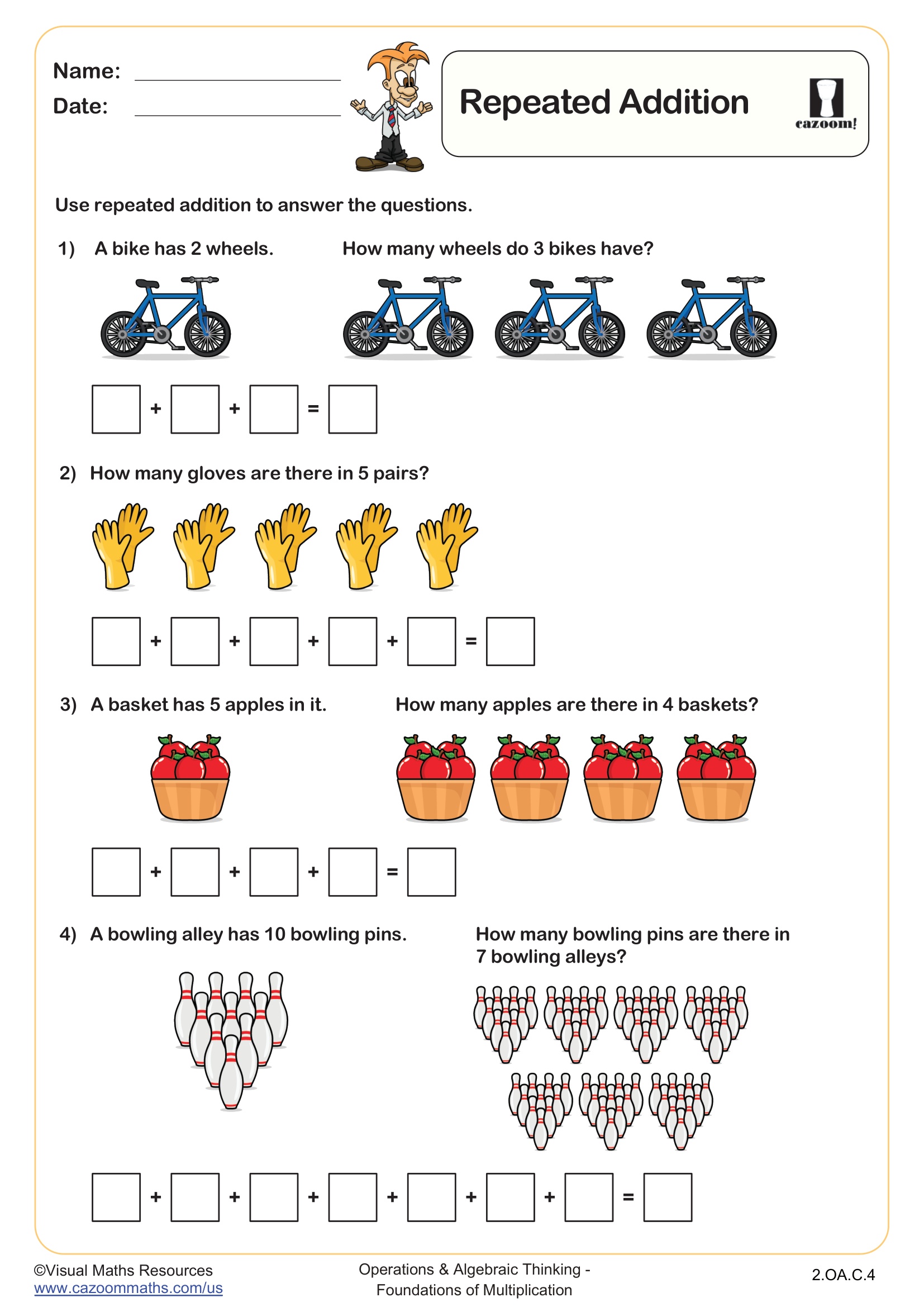
The worksheets provide structured practice that moves students from concrete counting to recognizing patterns in equal groups. Visual representations on the pages help students connect the repeated addition equations to actual quantities, reinforcing the "groups of" concept. The answer keys allow teachers to quickly identify which students understand grouping versus those still relying on one-by-one counting.
These materials work effectively during math centers where students practice independently after whole-group instruction. Teachers use them for formative assessment to determine readiness for 3rd grade multiplication, as intervention for students who struggle with skip counting, or as enrichment when some students finish classwork early. The worksheets also provide solid homework practice that parents can support without needing to teach new concepts, since repeated addition builds on addition skills students already have.