2nd Grade Fractions Worksheets
All worksheets are created by the team of experienced teachers at Cazoom Math.
What Are Fractions in 2nd Grade Math?
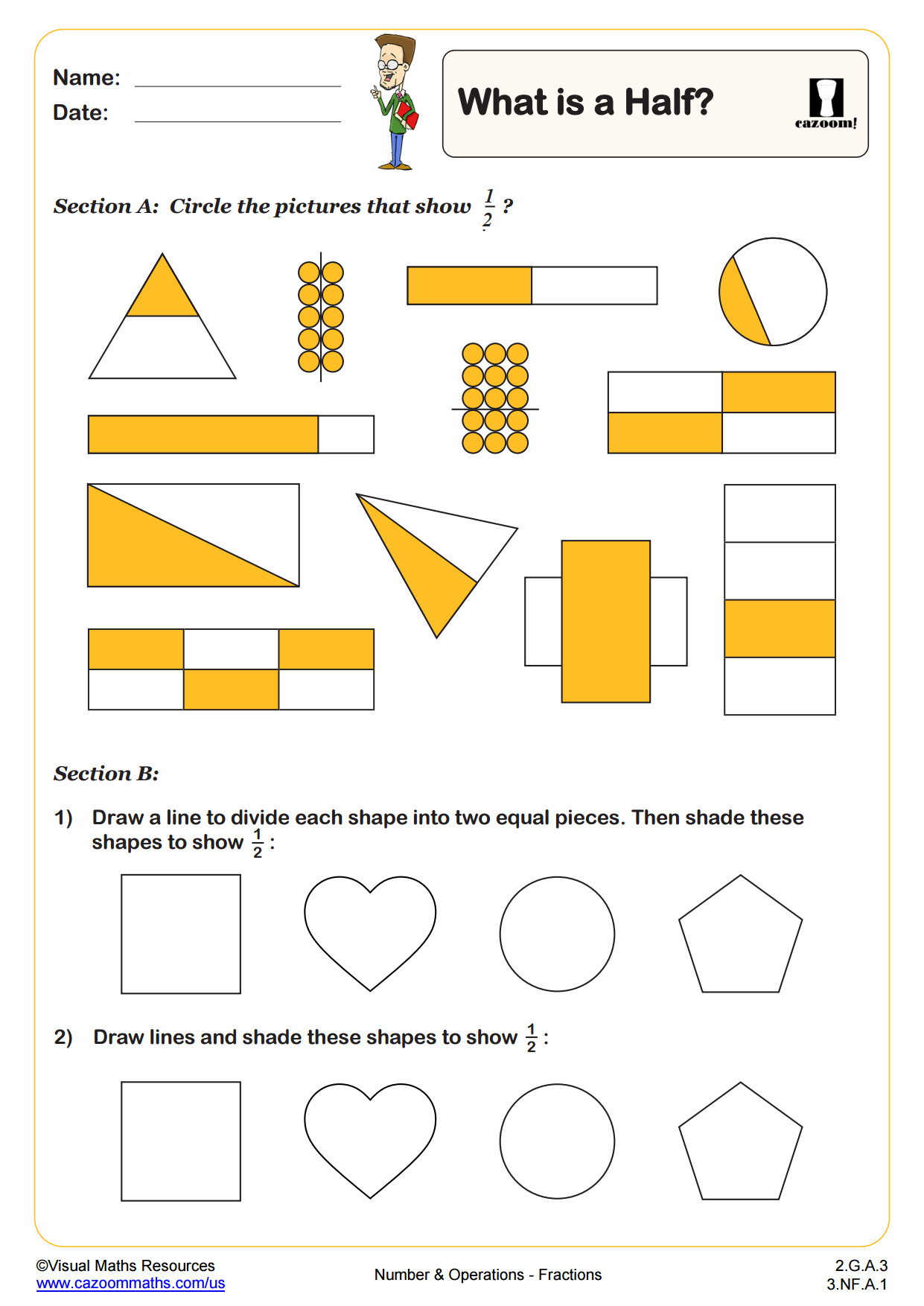
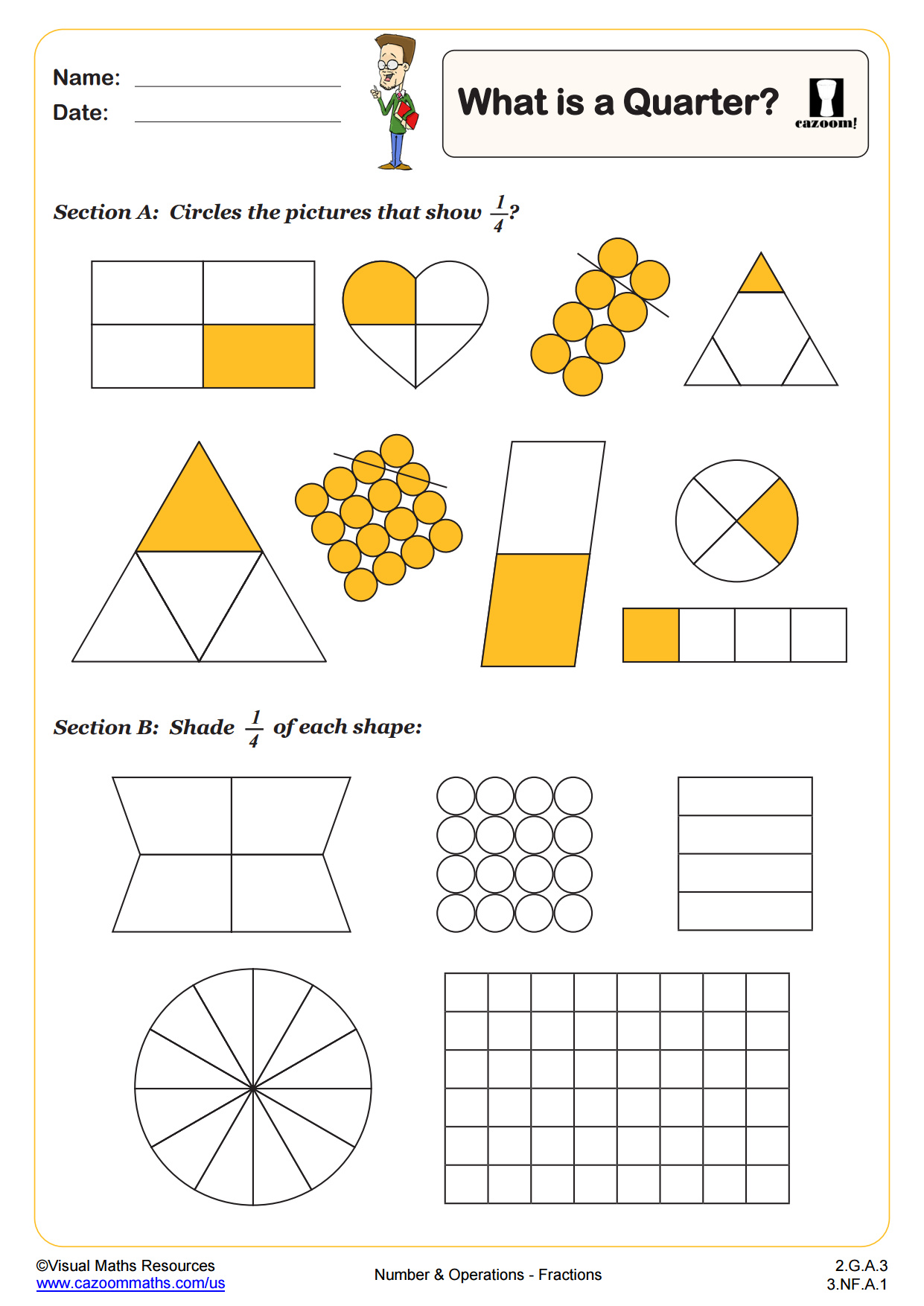
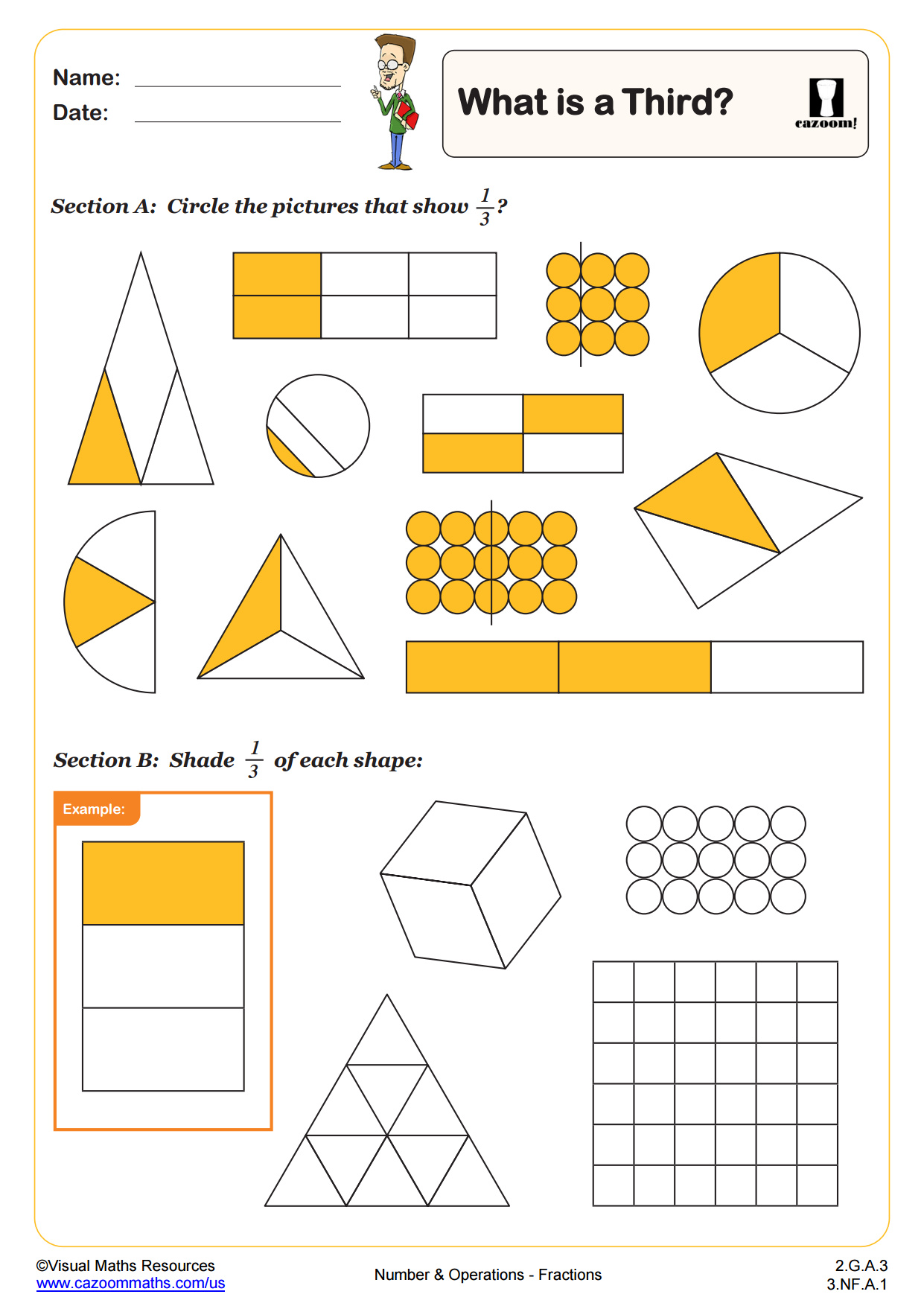
In second grade, fractions are introduced as equal parts of a whole, not yet as numerical expressions. Students learn to identify and create halves (2 equal parts), thirds (3 equal parts), and quarters (4 equal parts) using visual models like circles, rectangles, and everyday objects. The focus remains on understanding that each part must be exactly the same size for the division to be fair or equal.
Many students initially believe that any division creates fractions, leading to the misconception that cutting a shape into two different-sized pieces creates halves. Teachers address this by having students compare pieces directly, asking whether they would be happy receiving each piece if they were sharing with a friend. This fairness angle helps students internalize the equal parts requirement that defines fractions at this level.
What Should 2nd Graders Know About Fractions?
According to Common Core State Standards (2.G.A.3), second graders should partition circles and rectangles into two, three, or four equal shares and describe these shares using the words halves, thirds, and quarters. Students should recognize that equal shares of identical wholes don't have to have the same shape, meaning two halves of a rectangle can look different depending on whether you cut horizontally or vertically.
This foundational work in second grade builds directly on first grade experiences with equal and unequal groups. The visual and language skills developed here prepare students for third grade, when they'll begin writing fractions with numerators and denominators and placing fractions on number lines. Without solid understanding of equal parts now, students struggle with fraction equivalence and comparison later.
Why Do We Start With Halves, Thirds, and Quarters?
These three fractions represent the most common divisions students encounter in daily life and provide distinct learning opportunities. Halves offer a symmetrical, intuitive introduction since students naturally understand splitting something down the middle. Thirds challenge students to work with less obvious symmetry, while quarters connect to money (25 cents as one quarter of a dollar) and time (15 minutes as a quarter of an hour).
This real-world foundation matters beyond math class. In cooking, recipes frequently call for half or quarter measurements. In sports, games are divided into halves or quarters. Understanding these basic fractions helps students make sense of schedules, measurements, and shared resources throughout their day, connecting abstract math concepts to practical STEM applications they'll use when measuring ingredients, reading clocks, or dividing materials in science experiments.
How Can Teachers Use These Fraction Worksheets Effectively?
These worksheets provide structured practice with visual models that progress from identifying pre-divided shapes to having students create their own equal parts. The visual emphasis helps students build mental images of fractions before moving to abstract notation. Answer keys allow students to self-check their work or enable teachers to quickly review understanding during small group instruction.
Many teachers use these worksheets during math centers, pairing students so they can discuss whether parts are truly equal and justify their thinking to a partner. The worksheets work well as homework reinforcement after hands-on activities with fraction manipulatives or as quick formative assessments to identify which students need additional support with equal partitioning. Some teachers laminate copies for repeated use with dry-erase markers during intervention time, allowing struggling students extra practice without consuming paper.