2nd Grade Odd and Even Worksheets
All worksheets are created by the team of experienced teachers at Cazoom Math.
What Are Odd and Even Numbers?
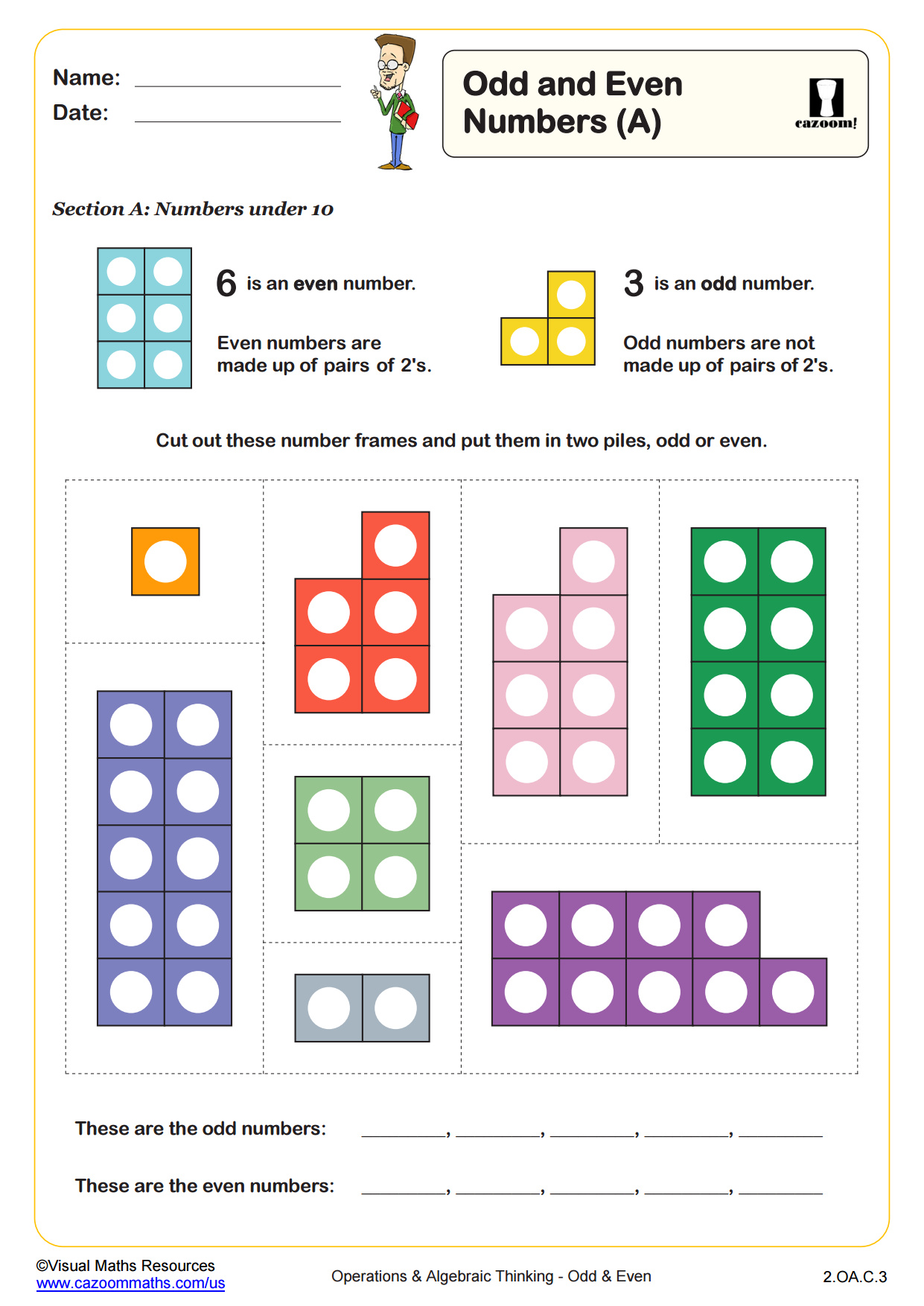
Odd and even numbers are classifications based on whether a number can be divided into two equal groups. Even numbers (2, 4, 6, 8, 10) can be split evenly into pairs with nothing left over, while odd numbers (1, 3, 5, 7, 9) always have one remaining when grouped by twos. This concept aligns with Common Core Standard 2.OA.C.3, which expects second graders to determine whether a group of objects has an odd or even number of members.
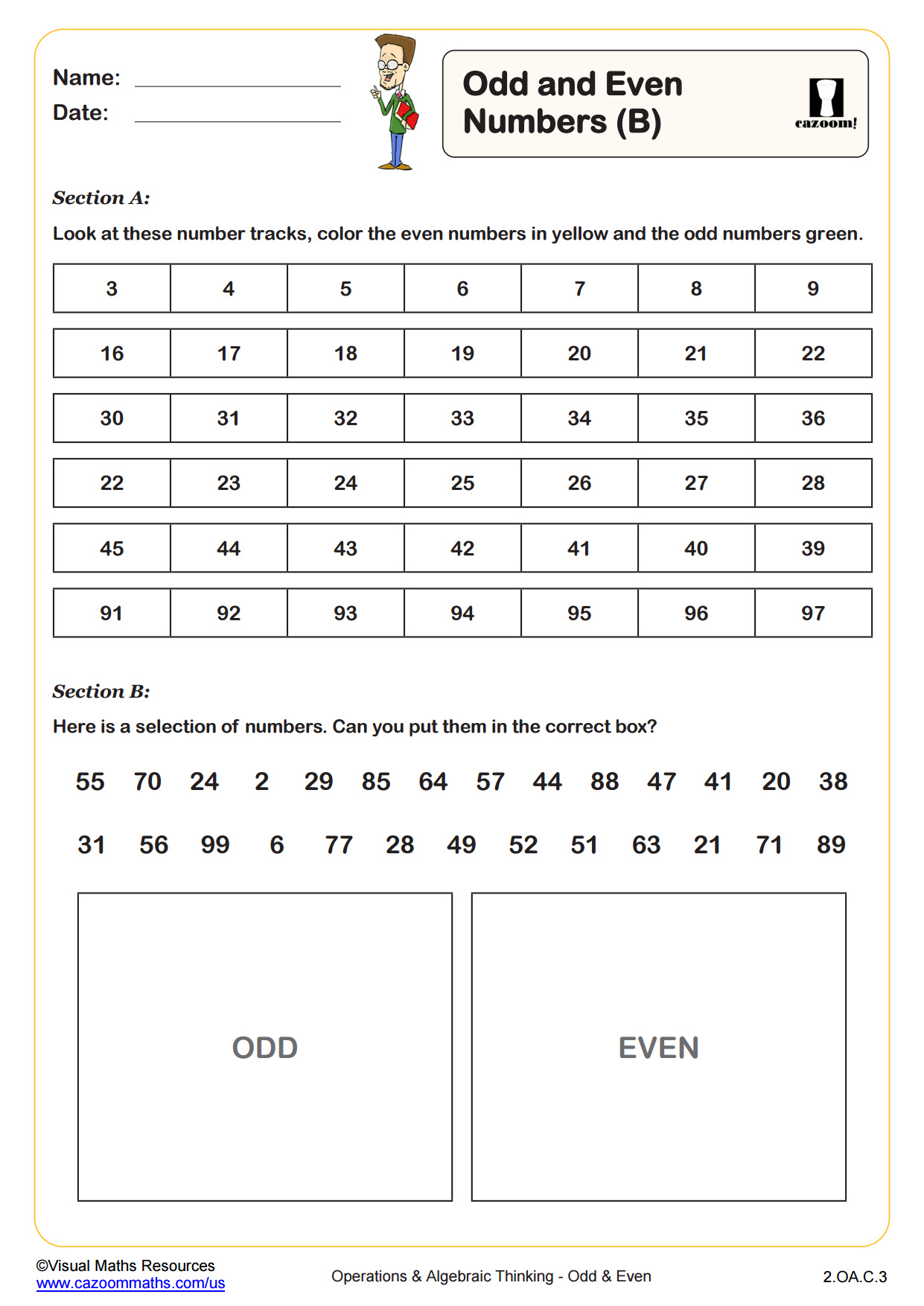
Students often struggle when they memorize which specific numbers are odd or even without understanding the pairing concept. Teachers frequently notice that students who learn to physically pair objects or draw circles around groups of two develop stronger understanding than those who simply memorize lists. The breakthrough typically happens when students recognize they can test any number by seeing if it ends in 0, 2, 4, 6, or 8 for even, or 1, 3, 5, 7, or 9 for odd.
What Should 2nd Graders Know About Odd and Even Numbers?
By the end of 2nd grade, students should confidently identify whether numbers up to 100 are odd or even using strategies like pairing, skip counting by twos, or recognizing digit patterns in the ones place. They should also understand that adding two even numbers always produces an even sum, and adding two odd numbers also produces an even sum. This foundational work with number patterns prepares students for more complex concepts in multiplication and division.
This topic builds directly on first grade counting and place value skills, where students learned to count objects and recognize number patterns. Teachers notice that students who mastered skip counting by twos in first grade transition more smoothly into odd and even classification. Looking ahead, understanding odd and even numbers supports third grade work with multiples, factors, and divisibility rules, making it a building block for algebraic thinking rather than an isolated skill.
How Do Students Use Pairing to Identify Odd and Even Numbers?
The pairing method involves grouping objects or drawing circles around sets of two to determine if a number is odd or even. Students draw lines connecting pairs of dots, circles, or other visual representations, then check whether all objects have a partner or one remains alone. This concrete approach helps students understand the mathematical definition rather than memorizing answers. Many teachers find that students confidently tackle larger numbers once they recognize that only the ones digit matters for determining odd or even status.
This pairing concept connects directly to real-world situations students encounter daily. Organizing students into pairs for partner activities, distributing items equally between two people, or arranging shoes in pairs all demonstrate odd and even applications. In computer science and coding, odd and even numbers determine branching logic and patterns, making this elementary skill relevant in STEM fields. Students often make the connection between this mathematical concept and fairness in everyday sharing situations.
How Can Teachers Use These Odd and Even Worksheets?
These worksheets provide structured practice that moves from visual representations to numerical identification, allowing students to develop both conceptual understanding and procedural fluency. The activities include circling pairs of objects, sorting numbers into odd and even categories, and identifying patterns in number sequences. The included answer keys allow students to self-check their work during math centers or enable quick grading during whole-group instruction.
Teachers effectively use these worksheets during small group intervention for students who need additional support with number patterns, as morning work to reinforce previous lessons, or as assessment tools to identify which students need reteaching. The worksheets work well for paired activities where one student solves while their partner checks using the answer key, promoting mathematical discussion. Many teachers assign these for homework because the clear format and answer keys help parents support their child's learning at home without needing extensive math knowledge themselves.