2nd Grade Position and Direction Worksheets
All worksheets are created by the team of experienced teachers at Cazoom Math.
What Skills Do Position and Direction Worksheets Target?
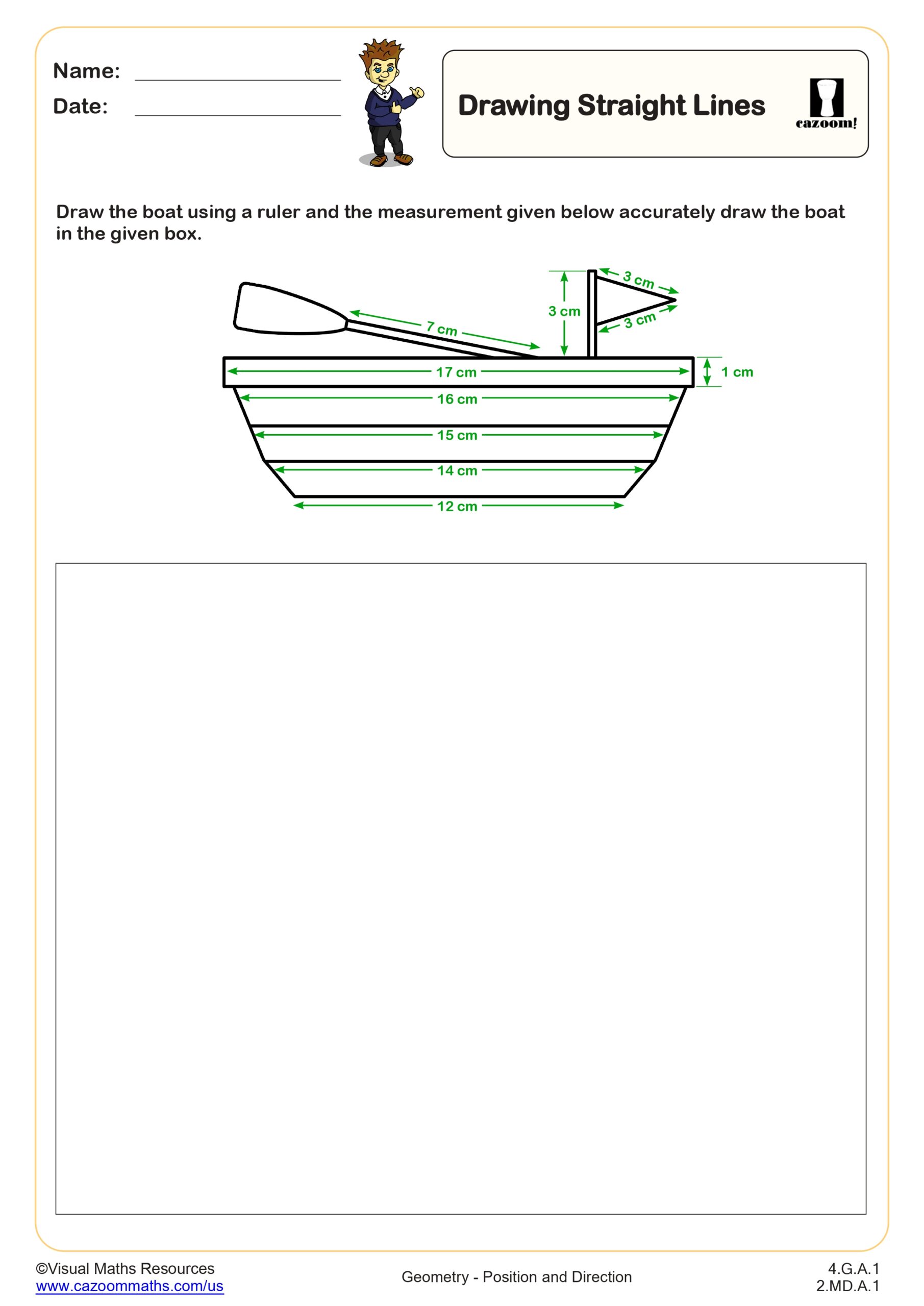
Position and direction worksheets for 2nd grade focus on spatial vocabulary (above, below, next to, between), left-right orientation, and basic line drawing skills. Students practice describing object locations using positional words, following directional instructions, and creating straight lines that connect points or form shapes. These skills align with Common Core Standard 2.G.A.1, which requires students to recognize and draw shapes with specific attributes.
Many teachers observe that students confuse relative position terms like "between" and "beside" when multiple objects appear in an arrangement. The breakthrough often happens when students physically manipulate objects on their desks before completing paper-based exercises, helping them internalize the vocabulary through hands-on experience. Drawing straight lines presents a motor skill challenge that improves significantly with practice and the introduction of tools like rulers or straight edges.
What Should 2nd Graders Know About Position and Direction?
By the end of 2nd grade, students should confidently use positional vocabulary to describe where objects are located in relation to each other and follow multi-step directional instructions. They should draw straight lines connecting two points and understand basic left-right orientation from their own perspective. Students are also expected to recognize that the same object can be described differently depending on the observer's viewpoint.
This learning builds directly on kindergarten and 1st grade work with positional words like "over" and "under" during story time and calendar activities. These 2nd grade skills prepare students for 3rd grade geometry, where they'll partition shapes into equal parts and work with coordinate grids. Map skills in social studies also depend heavily on this spatial reasoning foundation, making position and direction concepts valuable across multiple subject areas.
How Do Students Learn to Draw Straight Lines Accurately?
Drawing straight lines requires students to coordinate their hand movements while maintaining consistent direction between two points. Teachers introduce this skill by having students trace dotted lines, then progress to connecting dots without guides, and finally drawing lines to match specific lengths. Using a ruler or straight edge as a physical guide helps students understand what "straight" means and trains their hand-eye coordination for freehand drawing.
This seemingly simple skill connects to real-world applications in engineering and design. Architects draw straight lines to represent walls and boundaries in building plans, while graphic designers use straight lines to create clean layouts. In STEM activities, students use straight line drawing when recording data on graphs, creating diagrams of simple machines, or sketching observations during science experiments. The precision developed through line drawing practice transfers to technical drawing and geometry throughout elementary school.
How Can Teachers Use These Position and Direction Worksheets Effectively?
The position and direction worksheets provide structured practice that allows students to work independently while teachers monitor for common errors like reversed left-right orientation or wobbly line drawing. Answer keys enable quick assessment of whether students understand directional vocabulary and can execute the motor skills needed for straight line drawing. Teachers can use the worksheets to identify which students need additional support with pencil grip or spatial reasoning concepts.
These resources work well as morning work to reinforce previous lessons, as homework that parents can easily support, or as intervention materials for students who need extra practice with spatial concepts. Many teachers pair students during worksheet activities, having one student give directional instructions while the other follows them, which builds both speaking and listening skills. The worksheets also serve as quick assessments before moving into more complex geometry topics that assume students have mastered basic positional language and line drawing.