2nd Grade Time Worksheets
All worksheets are created by the team of experienced teachers at Cazoom Math.
Why is learning to tell time important in 2nd grade math?
Telling time connects measurement concepts with real-world application in ways few other 2nd grade topics can match. Students use time-telling skills multiple times each day to manage transitions, understand schedules, and participate in classroom routines, making it one of the most immediately practical math skills they learn. The Common Core State Standards expect 2nd graders to tell and write time to the nearest five minutes using both analog and digital clocks, establishing a foundation for more complex time calculations in later grades.
Beyond reading clocks, understanding time relationships helps students develop critical thinking about sequences and durations. Teachers often observe that students who master time concepts show improved ability to estimate and compare measurements in other contexts, such as length or capacity. The connection between telling time and skip counting by fives reinforces multiplication readiness, making time practice valuable for multiple mathematical pathways.
What should 2nd graders know about time by the end of the year?
By the end of 2nd grade, students should confidently tell time to the nearest five minutes on analog clocks and recognize equivalent digital representations. They should understand terms like quarter past, half past, and quarter to, connecting fraction language with clock positions. Students are also expected to solve simple word problems involving time intervals within the same hour, such as determining how many minutes pass between 2:15 and 2:40.
This builds directly on 1st grade work, where students learned to tell time to the hour and half hour. The precision required in 2nd grade represents a significant jump in both reading accuracy and conceptual understanding. These skills prepare students for 3rd grade expectations, where they'll measure time intervals in minutes, solve elapsed time problems that span multiple hours, and create and interpret scaled picture graphs with time data. Students who master 2nd grade time concepts transition more smoothly to these advanced applications.
How do students learn to compare time intervals?
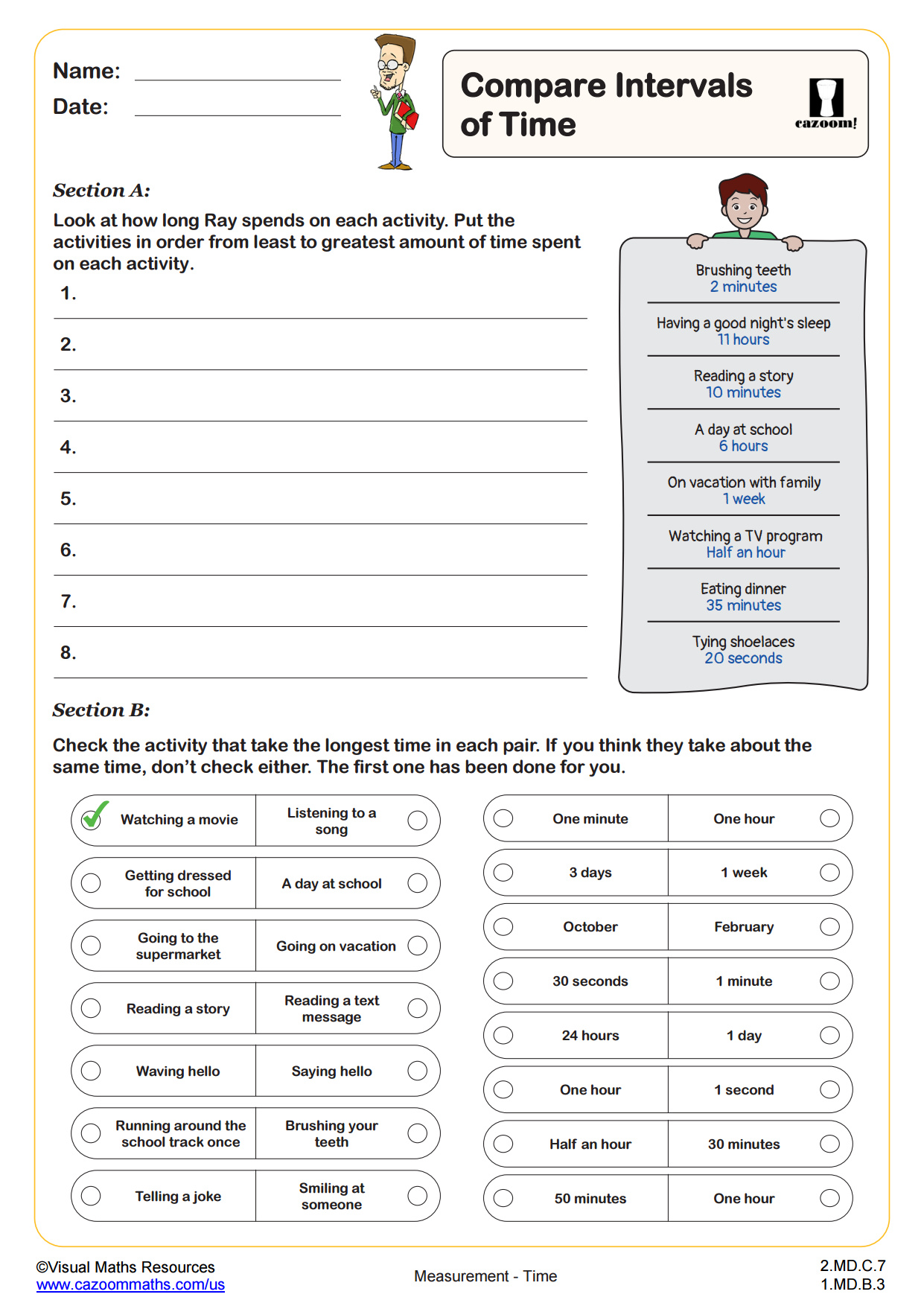
Comparing time intervals requires students to understand that time can be measured as a quantity, not just read as a point on a clock. Students learn to identify the duration of events by counting the minutes or hours between start and end times, then compare which activities take more or less time. Many students make the breakthrough when they connect this skill to comparing other measurements they've worked with, recognizing that comparing 15 minutes to 30 minutes uses the same reasoning as comparing 15 blocks to 30 blocks.
This skill appears constantly in STEM contexts and daily life. Scientists compare how long different processes take in experiments, engineers measure project timelines, and even young students compare recess length to class time. Understanding that a 45-minute art class is longer than a 30-minute music class helps students develop scheduling awareness and time management habits. These real-world connections make time intervals one of the most applicable measurement concepts students learn in elementary school.
How can teachers use these time worksheets effectively in the classroom?
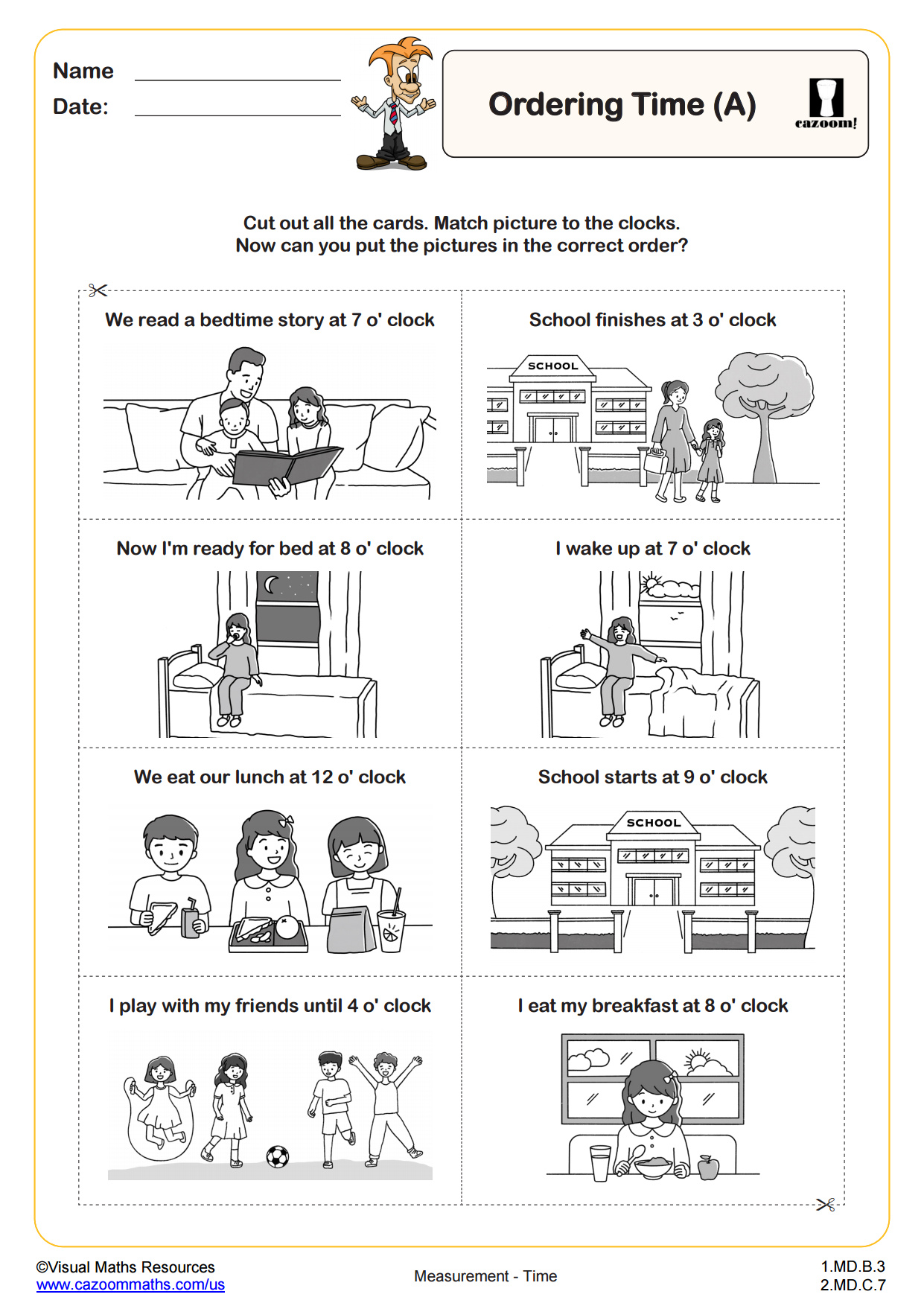
These worksheets provide structured practice that helps students move from concrete clock manipulatives to abstract time reasoning. The ordering activities scaffold student thinking by requiring them to sequence events chronologically, while the comparison problems push students to calculate and evaluate durations. Teachers can use the answer keys to quickly identify which students need additional support with specific time concepts versus those ready for extension challenges involving elapsed time across the hour.
Many teachers find these worksheets work well as warm-up activities during morning routines or as targeted intervention for students who struggle with time concepts during whole-class instruction. The worksheets also serve effectively as homework assignments because families can reference the answer keys to support their child's learning at home. For paired work, students can compare their reasoning about time sequences and intervals, explaining their thinking to build both conceptual understanding and mathematical vocabulary. The consistent format helps students focus on the mathematical reasoning rather than decoding unfamiliar directions.