3rd Grade Decimals Worksheets
All worksheets are created by the team of experienced teachers at Cazoom Math.
What Are Decimals and Why Do Third Graders Learn About Them?
Decimals are another way to represent numbers that fall between whole numbers, using a decimal point to show parts of a whole. Third graders typically begin with tenths, learning that 0.1 represents one-tenth, which connects directly to their fraction work. This introduction aligns with Common Core Standard 3.NF.A.2, where students work with fractions on number lines and begin recognizing equivalent representations.
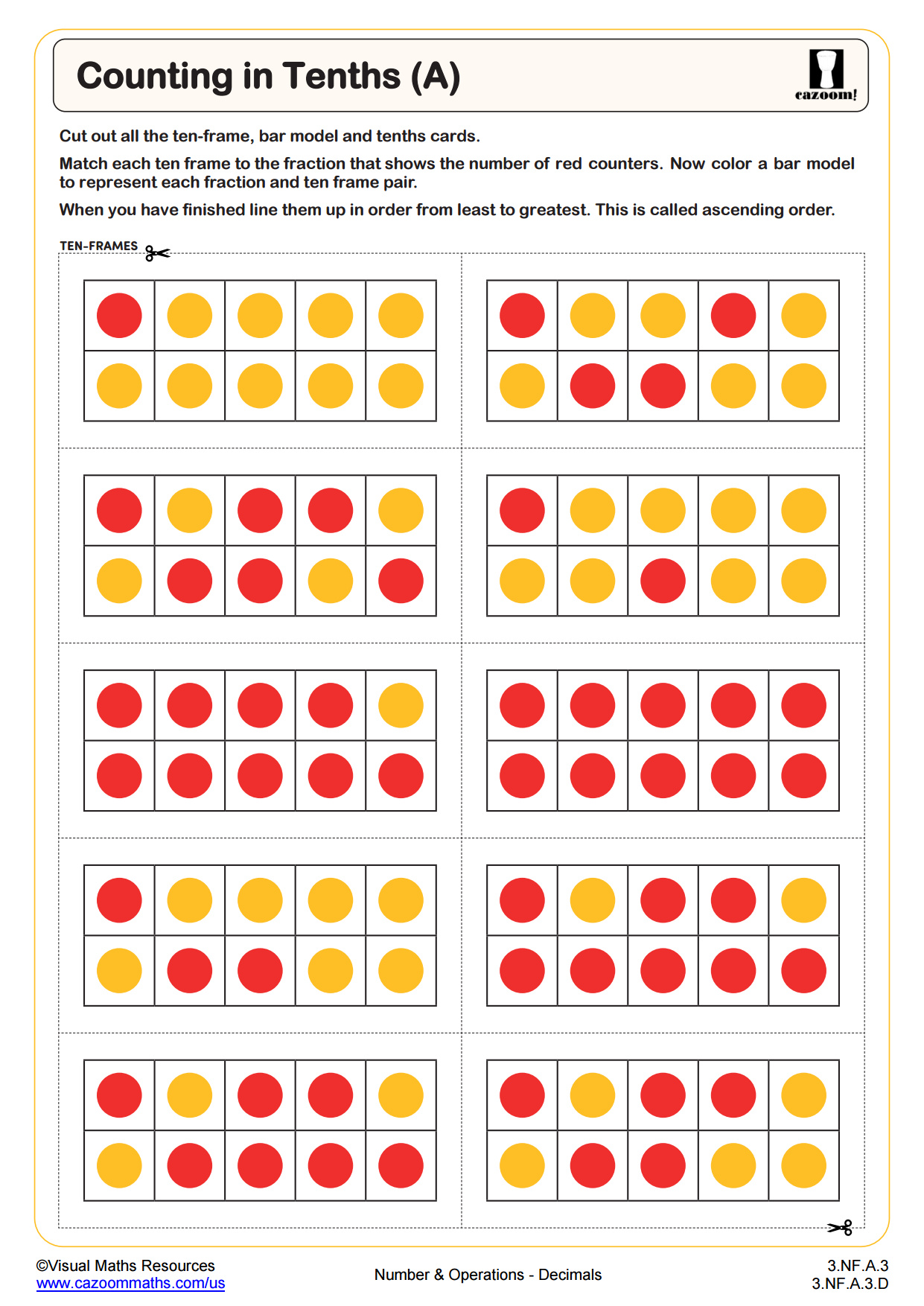
Students often confuse the decimal point with a period or comma at first, reading 0.3 as "zero point three" but thinking it means "zero and three" as separate numbers. Teachers find that having students shade grid paper showing tenths helps them see that 0.7 means seven out of ten equal parts are filled, creating a visual anchor for the abstract notation. This early exposure prevents later confusion when decimals appear in measurement contexts like meters and liters.
What Should 3rd Grade Students Know About Decimals?
By the end of third grade, students should recognize decimal notation for tenths and understand that numbers like 0.1, 0.2, and 0.3 represent positions on the number line between 0 and 1. They should be able to count forward and backward by tenths, writing the sequence correctly and placing decimals in order. Most state standards expect third graders to connect tenths to fractions, recognizing that 0.7 and 7/10 represent the same value.
This work builds on second grade place value understanding, where students worked with hundreds, tens, and ones moving from left to right. Now they extend that pattern to the right of the decimal point. In fourth grade, students will expand this knowledge to hundredths, perform decimal addition and subtraction, and compare decimals to two decimal places, making this introductory work with tenths a critical stepping stone in their mathematical development.
How Do Students Learn to Count in Tenths?
Counting in tenths involves recognizing the pattern of decimal numbers that increase or decrease by 0.1 each time: 0.1, 0.2, 0.3, and so on. Students learn that after 0.9 comes 1.0, which equals the whole number 1, then the pattern continues with 1.1, 1.2, 1.3. Teachers often use number lines marked in tenths to help students visualize these intervals and understand that the spacing between decimals remains consistent, just like counting by ones.
This skill connects directly to money, where students already understand that ten dimes make one dollar. When they recognize that $0.10, $0.20, and $0.30 follow the same pattern as 0.1, 0.2, and 0.3, decimals suddenly become practical rather than abstract. Scientists and engineers use tenths constantly when measuring in metric units, where 0.3 meters or 0.7 liters appear regularly in experiments and calculations.
How Can Teachers Use These Decimal Worksheets in the Classroom?
The worksheets provide structured practice with counting in tenths, allowing students to develop fluency with decimal notation and sequencing. Answer keys let teachers quickly check student understanding and identify who needs additional support versus who is ready for enrichment. The format works well for independent practice after whole-group instruction, giving students repetition with the skill while teachers work with small groups.
Many teachers use these worksheets during math centers, pairing them with manipulatives like base-ten blocks or decimal number lines so students can check their written work against physical models. The resources also work effectively as homework to reinforce classroom learning or as warm-up activities to maintain skills throughout the year. For students who finish early, the worksheets provide meaningful extension work while others complete initial tasks, keeping all learners engaged with grade-level content.