3rd Grade Division Worksheets
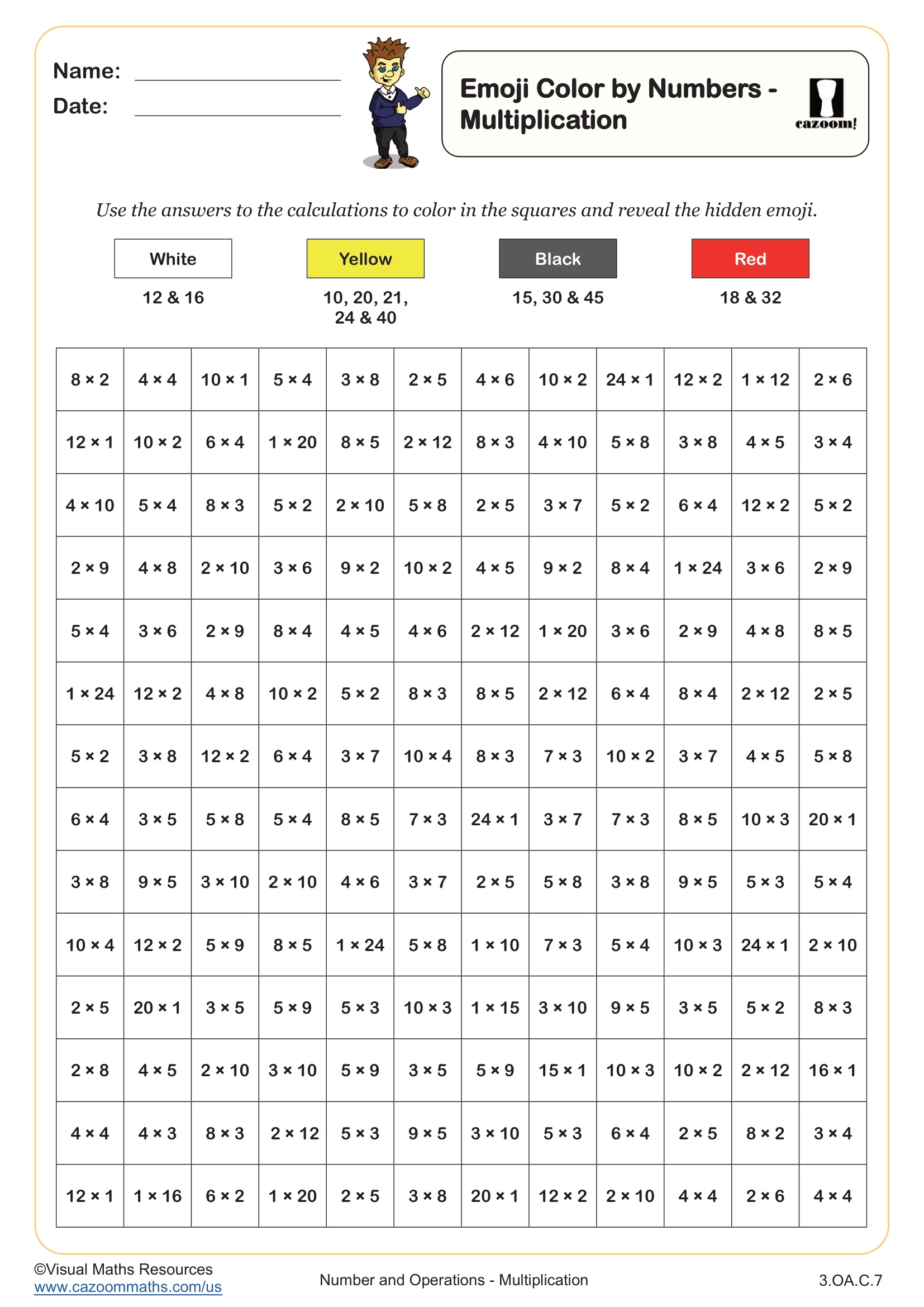
All worksheets are created by the team of experienced teachers at Cazoom Math.
What division skills should 3rd graders master?
Third graders work toward fluency with division facts through 100, focusing primarily on dividing within the 10s family (such as 45 ÷ 5 or 63 ÷ 9). According to Common Core State Standards (3.OA.C.7), students should understand division as an unknown-factor problem, recognizing that finding 32 ÷ 4 is the same as determining what number times 4 equals 32. Students also interpret whole-number quotients and use properties of operations to solve division problems.
Teachers often observe that students lose points on assessments when they confuse the dividend and divisor, writing equations backward or misinterpreting word problems. A common error occurs with problems like 24 ÷ 6, where students might write 6 × 4 = 24 but then incorrectly identify 6 as the answer instead of 4. Providing visual models like equal groups or arrays helps students connect the division notation to the actual sharing or grouping action.
How does 3rd grade division differ from 2nd grade?
In second grade, students encounter division informally through equal sharing activities and skip counting backward, but formal division instruction begins in third grade. Third graders move from physical manipulatives and drawings to more abstract strategies, learning standard division notation (÷) and applying division to solve word problems. Students develop automaticity with basic division facts and begin recognizing patterns, such as how dividing by 1 always gives the original number or dividing a number by itself always equals 1.
This foundation prepares students for fourth grade, where they'll divide multi-digit numbers and encounter remainders in more complex contexts. Many teachers find that students who struggle with division in third grade often haven't fully internalized their multiplication facts, since the two operations are inversely related. Consistent practice with both multiplication and division facts during third grade prevents significant gaps as students progress to more challenging division problems involving two-digit divisors and larger dividends.
What is the relationship between multiplication and division?
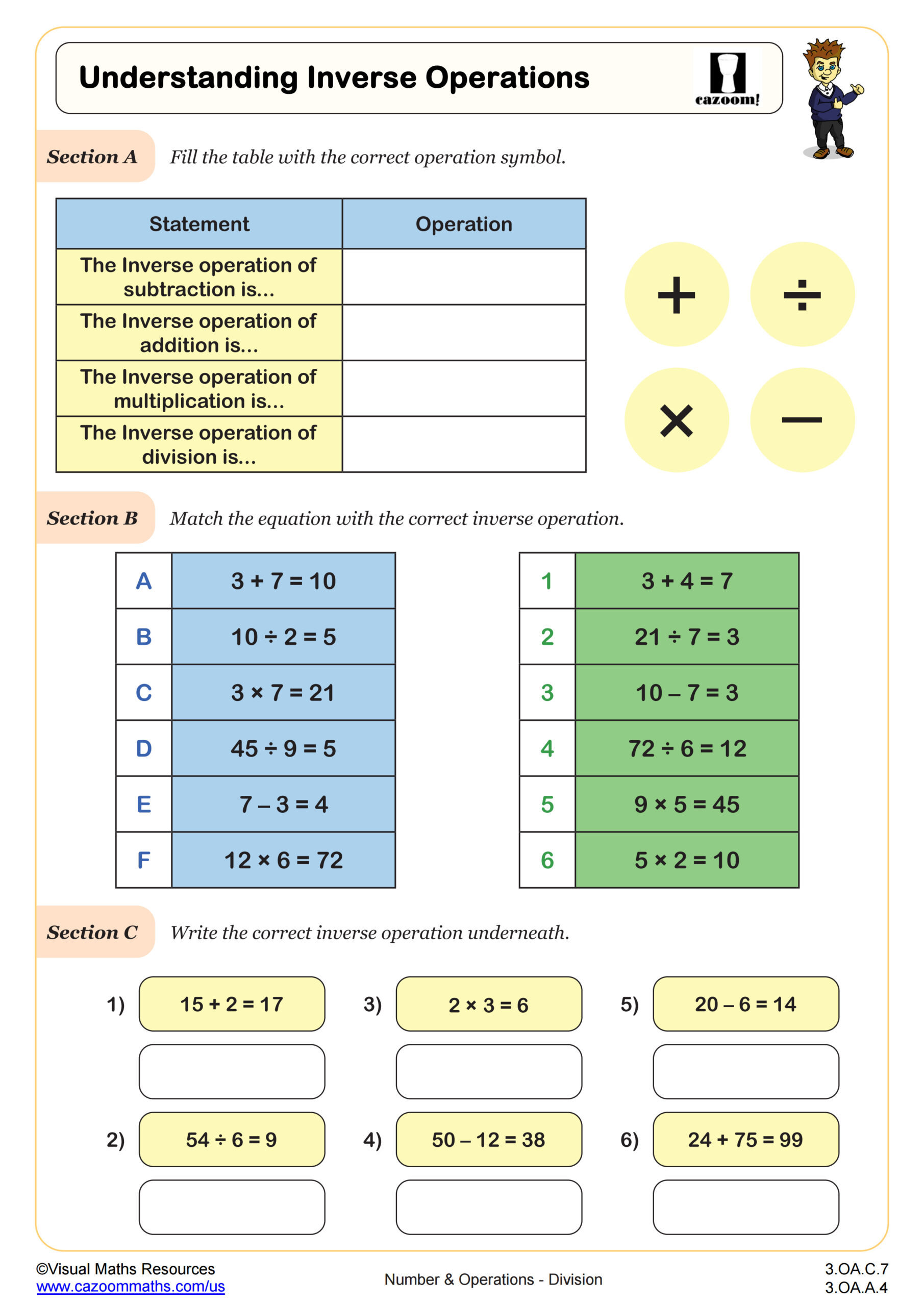
Multiplication and division are inverse operations, meaning they undo each other. When students multiply 7 × 8 = 56, they can use that same fact family to determine that 56 ÷ 8 = 7 or 56 ÷ 7 = 8. Understanding this inverse relationship helps students check their division work and build mental math strategies. Teachers consistently observe breakthroughs when students realize they can use known multiplication facts to solve unfamiliar division problems, transforming division from memorization into logical reasoning.
This concept appears throughout STEM fields, particularly in measurement and data analysis. Scientists dividing samples into equal groups, engineers calculating material distribution, and programmers splitting data sets all rely on understanding how multiplication and division relate. In everyday contexts, students encounter this relationship when sharing items equally among friends (division) and checking their work by multiplying the number of people by what each person receives (multiplication). Recognizing these inverse operations builds algebraic thinking that becomes foundational for solving equations in later grades.
How can teachers use these division worksheets effectively?
These worksheets provide structured practice that moves from visual representations to numerical fluency. The inverse operations worksheet explicitly connects multiplication and division, helping students see how fact families work together. The engaging format with visual elements maintains student interest while reinforcing computational skills. Teachers can use the answer keys to quickly identify patterns in student errors, such as consistent mistakes with specific divisors or confusion about problem structure.
Many teachers assign these worksheets during math centers for independent practice while working with small intervention groups. They're also effective as warm-up activities to activate prior knowledge before introducing new division concepts like remainders or two-step word problems. The worksheets work well for homework when families want to support math learning at home, since the answer keys allow students to self-check and learn from mistakes. Some teachers use them for paired practice, where partners solve problems independently and then compare answers, discussing any differences to deepen understanding.