3rd Grade Methods for Subtraction Worksheets
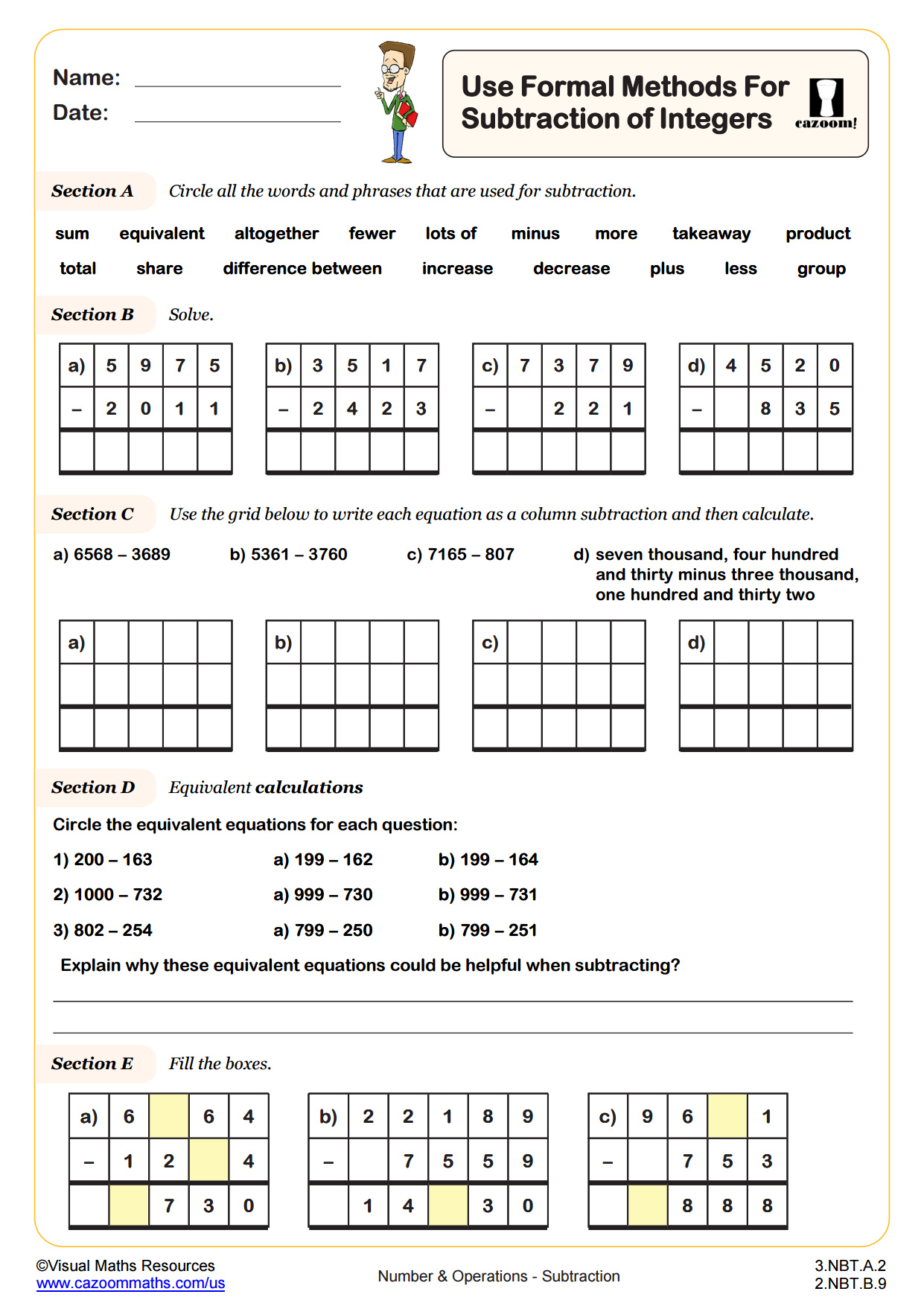
All worksheets are created by the team of experienced teachers at Cazoom Math.
What Are Formal Methods for Subtraction?
Formal methods for subtraction refer to standard algorithms that use a consistent, step-by-step procedure to solve subtraction problems. The most common formal method taught in 3rd grade is the standard algorithm with regrouping (sometimes called borrowing), where students work from right to left, regrouping from the next place value when necessary. This systematic approach provides a reliable strategy that works for any subtraction problem, regardless of the numbers involved.
Students often struggle with the conceptual understanding of regrouping, viewing it as a mechanical trick rather than an exchange of place values. Teachers notice that breakthrough moments happen when students connect regrouping to base-ten blocks or other manipulatives, realizing they're trading one ten for ten ones. A common error involves students subtracting the smaller digit from the larger digit in each column regardless of position, getting 25 instead of -25 when computing 43 - 68, which highlights why understanding the procedure's logic matters as much as memorizing the steps.
What Should 3rd Graders Know About Subtraction Methods?
By 3rd grade, students should fluently subtract within 1,000 using the standard algorithm with regrouping across multiple place values. They're expected to understand when regrouping is necessary and execute the procedure accurately without relying on concrete models for every problem. This aligns with Common Core Standard 3.NBT.A.2, which emphasizes using place value understanding and properties of operations to perform multi-digit arithmetic.
This skill builds directly on 2nd grade work with subtraction within 100 and prepares students for 4th grade multi-digit operations with larger numbers. Students who develop automaticity with the standard algorithm in 3rd grade find it easier to focus on problem-solving and reasoning in later grades rather than getting stuck on computational procedures. The formal method also provides a foundation for understanding subtraction with decimals in 5th grade, since the same place value principles apply.
How Does the Standard Algorithm With Regrouping Work?
The standard algorithm with regrouping follows a systematic process: students align numbers by place value, start with the ones column, and work left through each place value. When a digit in the minuend (top number) is smaller than the corresponding digit in the subtrahend (bottom number), students regroup by borrowing one unit from the next higher place value. This borrowed unit equals ten in the current place value, allowing subtraction to proceed.
This method has practical applications across numerous real-world contexts, from calculating change in financial transactions to determining remaining inventory in warehouse management. In STEM fields, engineers use similar algorithmic thinking when working with measurements and calculating tolerances. Students who understand the regrouping process can mentally check their work by recognizing that the difference plus the subtrahend should equal the minuend, a verification strategy that proves valuable on standardized assessments and in daily problem-solving situations.
How Can Teachers Use These Subtraction Worksheets Effectively?
These worksheets provide systematic practice with formal subtraction methods, allowing students to develop procedural fluency through repeated application. The problems are structured to reinforce the step-by-step nature of the algorithm while building confidence with increasingly complex scenarios. Answer keys enable students to self-check their work and identify specific steps where errors occur, promoting metacognition about their own problem-solving process.
Teachers find these worksheets valuable for differentiated instruction during math centers, allowing students who need additional practice to work independently while the teacher provides targeted intervention. The structured format works well as homework to reinforce classroom instruction or as warm-up activities to maintain skills already taught. Many teachers use the worksheets for paired work, where students solve problems individually then compare their regrouping steps with a partner, which helps identify misconceptions before they become ingrained habits.