3rd Grade Time Worksheets
All worksheets are created by the team of experienced teachers at Cazoom Math.
What time skills should third graders master?
Third grade students should confidently tell and write time to the nearest minute using both analog and digital clocks. They need to measure time intervals in minutes, solve word problems involving addition and subtraction of time, and understand the relationship between seconds, minutes, and hours. This aligns with Common Core Standard 3.MD.A.1, which expects students to solve problems involving measurement and estimation of time intervals.
Many students lose points on assessments when they confuse the hour and minute hands or fail to recognize that 60 minutes equals one hour when calculating elapsed time. Teachers notice that students who practice with varied clock faces, including those showing non-standard times like 7:47 or 11:08, develop stronger number sense about how time actually works throughout the day rather than just recognizing common times like 3:00 or 12:30.
How does third grade time connect to earlier learning?
By third grade, students build on the foundational clock-reading skills from first and second grade, where they learned to tell time to the nearest hour and half-hour. Now they refine this skill to read time to the nearest minute and tackle more complex problems involving elapsed time and time intervals. This progression requires stronger mental math skills and a deeper understanding of how our base-60 time system works differently from the base-10 number system they use everywhere else in math.
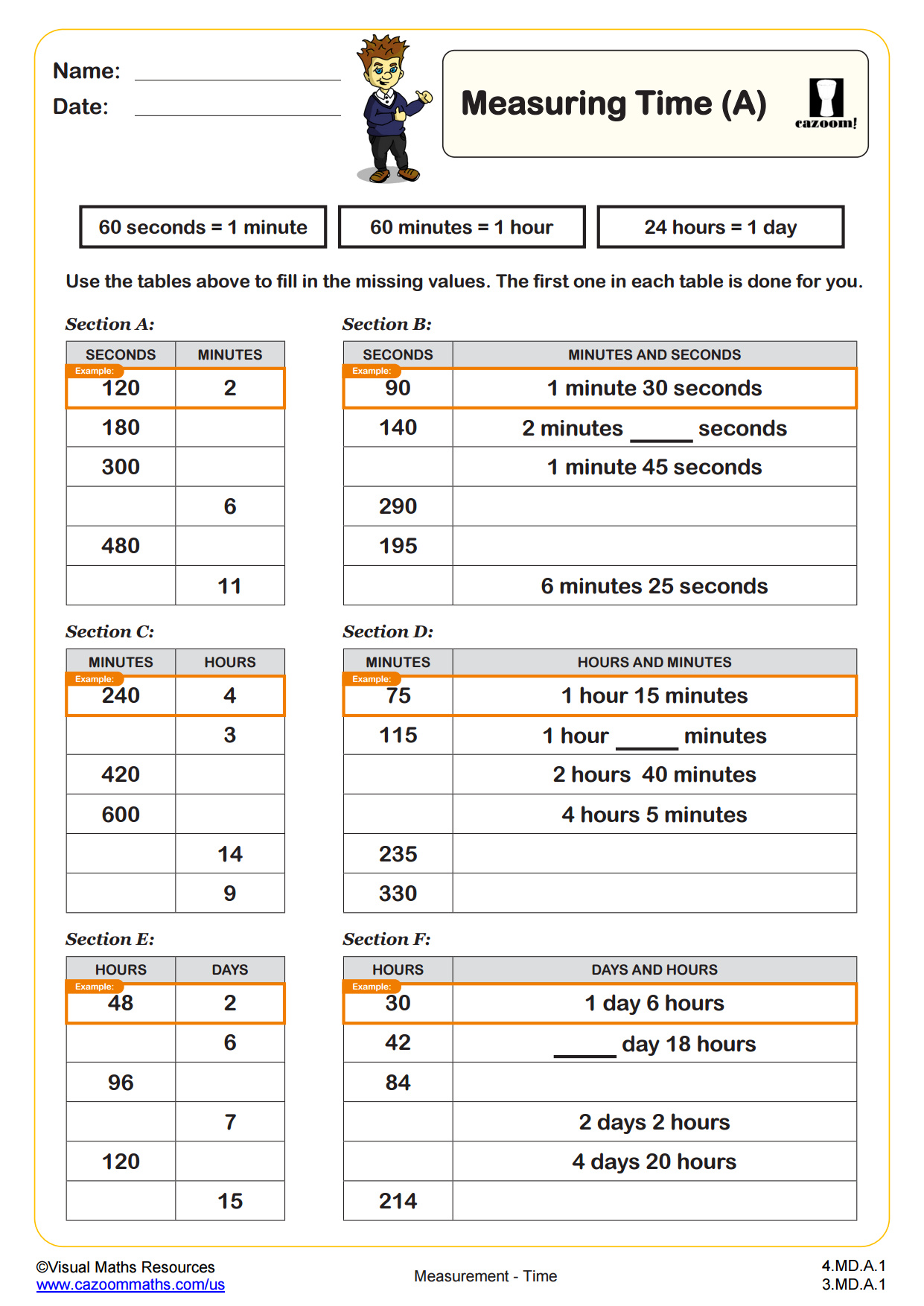
This third grade work prepares students for fourth grade standards where they'll convert between different units of time (hours to minutes, days to hours) and solve multi-step word problems involving measurement. Students who master time concepts in third grade find fraction work easier in later grades because they already understand that an hour divided into 60 parts operates on different principles than dividing a whole into tenths or hundredths.
What is elapsed time and why do students find it challenging?
Elapsed time refers to the amount of time that passes between a start time and an end time. Students must calculate how many hours and minutes have gone by, which often requires counting forward across hour boundaries or even crossing from AM to PM. The challenge lies in the base-60 system: when students add 45 minutes to 3:30, they can't simply add to get 3:75, but must regroup into the next hour to get 4:15.
This skill connects directly to real-world planning and scheduling. Students use elapsed time when figuring out how long a soccer practice lasts, calculating travel time for family trips, or determining how much time remains before bedtime. In STEM fields, elapsed time becomes critical for experiments, coding sequences, and project management. Scientists tracking chemical reactions, engineers testing materials, and programmers debugging code all rely on precise time measurement and interval calculations that begin with these third grade foundations.
How can teachers use these time worksheets effectively?
The time worksheets provide structured practice that moves students from basic clock reading to applied problem-solving. Each worksheet includes varied problem types that prevent students from simply memorizing patterns, while the complete answer keys allow teachers to quickly identify whether errors stem from misreading clocks, calculation mistakes, or conceptual misunderstandings about how time works. This diagnostic information helps teachers decide which students need reteaching versus those ready for extension activities.
These worksheets work well as independent practice after direct instruction, as warm-up activities to maintain skills throughout the year, or as homework that parents can support using the answer keys. Teachers often use them during math centers, pairing students to discuss their solution strategies and catch each other's errors before checking answers. The worksheets also serve as effective intervention tools for students who continue to struggle with time concepts, providing the repeated practice necessary for automaticity without requiring additional teacher preparation time.