4th Grade Addition Worksheets
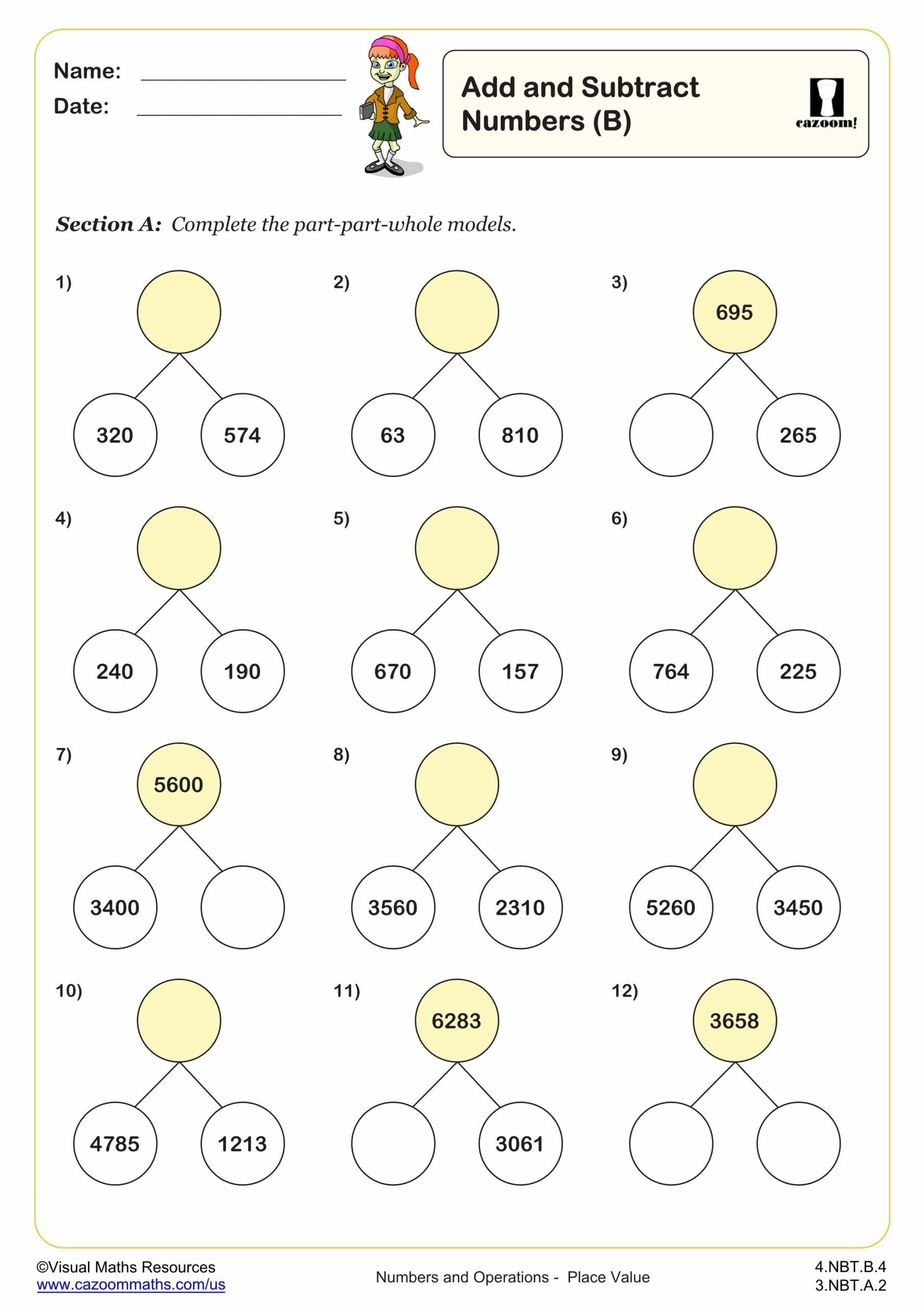
All worksheets are created by the team of experienced teachers at Cazoom Math.
What addition skills should 4th graders master?
Fourth graders should fluently add multi-digit whole numbers using the standard algorithm, understanding place value relationships up to the hundred thousands place. According to Common Core State Standards, students at this level must add numbers accurately and efficiently, explaining their reasoning when solving word problems involving addition. They begin exploring integer addition with positive and negative numbers as preparation for middle school mathematics.
Many students confidently tackle larger numbers once they recognize that the column addition process remains consistent regardless of how many digits are involved. Teachers notice that students often lose points on assessments not from conceptual misunderstanding but from misaligning digits or forgetting to carry values between place value columns. Providing graph paper or structured worksheets helps eliminate these alignment errors.
How does 4th grade addition differ from earlier grades?
Fourth grade addition builds on the single-digit and double-digit work from earlier elementary years by incorporating larger numbers and introducing formal written methods. Students who mastered basic addition facts in 2nd and 3rd grade now apply those skills to problems involving four, five, or even six-digit numbers. The focus shifts toward efficiency, accuracy, and the ability to explain mathematical reasoning rather than simply finding correct answers.
This grade level also marks the first formal introduction to integer addition for many students, laying groundwork for 6th and 7th grade work with rational numbers. Teachers find that students who struggle with 4th grade addition often have gaps in place value understanding from 3rd grade, making it worth reviewing those foundational concepts before moving to more complex problems. The addition skills developed now directly support multiplication and division algorithms taught later in the year.
What are formal methods for addition?
Formal methods for addition refer to the standard algorithm taught across US schools: the column addition method where numbers are arranged vertically by place value, added from right to left, and regrouped (carried) as needed. This systematic approach differs from mental math strategies or partial sums methods, providing a reliable procedure that works for any size numbers. Students learn to stack numbers carefully, add within each place value column, and carry digits to the next column when sums exceed nine.
This skill connects directly to real-world applications in finance, engineering, and data analysis where accuracy with large numbers matters. STEM professionals regularly use these algorithms when working with measurements, distances, or calculations that require precision. Students who master formal addition methods in 4th grade find 5th grade decimal addition much more accessible, since the process remains identical with the addition of a decimal point to align.
How can teachers use these addition worksheets effectively?
These worksheets provide structured practice with graduated difficulty levels, allowing teachers to match problems to individual student readiness. The inclusion of both whole number operations and integer work supports differentiation within the same classroom, giving advanced students exposure to new concepts while others solidify fundamentals. Complete answer keys enable students to self-check their work during independent practice, building metacognitive skills as they identify and correct their own errors.
Teachers use these materials for warm-up exercises to activate prior knowledge, as intervention resources for students who need extra practice, or as homework assignments that families can support at home. The worksheets work well for paired practice where students solve problems individually then compare answers and reasoning with a partner. Many teachers incorporate these into math centers or stations, allowing small groups to work through problems while receiving targeted instruction elsewhere in the classroom.