4th Grade Circles Worksheets
All worksheets are created by the team of experienced teachers at Cazoom Math.
What circle concepts do 4th graders need to learn?
Fourth graders focus on identifying circles as two-dimensional shapes with specific properties, understanding that all points on a circle are equidistant from the center. Students learn to recognize circles in various orientations and sizes, distinguish them from other curved shapes like ovals, and begin exploring basic circle terminology including center, radius, and diameter.
Teachers frequently observe that students grasp the concept of a circle more quickly when they physically construct circles using compasses or string tied to a center point. This hands-on experience reinforces why all points must be the same distance from the center. Students sometimes assume any round-looking shape is a circle, so activities that require precise measurement help develop their understanding of what mathematically defines a circle versus other round shapes.
How do 4th grade circle lessons fit into the geometry progression?
In 4th grade, students build on their earlier work with basic shapes from kindergarten through 3rd grade, where they learned to identify and categorize two-dimensional figures. The introduction of circle properties and vocabulary represents a bridge between simple shape recognition and the more formal geometry concepts they'll encounter in 5th grade, including calculating circumference and exploring the relationship between radius and diameter more deeply.
This progression prepares students for middle school geometry, where they'll work with circle area, arc length, and sectors. Teachers notice that students who develop a strong visual understanding of radius and diameter in 4th grade transition more smoothly to applying formulas in later grades. The foundation built at this level supports future work with coordinate geometry, where understanding distance from a center point becomes crucial for graphing circles.
How do students learn to construct circles accurately?
Constructing circles helps students move from passive recognition to active understanding of circle properties. Using tools like compasses, students learn that fixing one point (the center) and maintaining a constant distance (the radius) creates a circle. This process reinforces the mathematical definition while developing fine motor skills and precision in geometric construction, which are valuable for technical drawing and design work.
Circle construction connects directly to real-world applications in engineering, architecture, and design. Engineers use circle properties when designing wheels, gears, and rotating parts that must maintain consistent dimensions. Architects incorporate circular elements in building plans, from rounded windows to dome structures. Students who understand how circles are constructed can better appreciate why manhole covers are circular (they can't fall through the opening) or how a potter's wheel creates symmetrical vessels through rotation around a center point.
How can teachers use these circle worksheets effectively in the classroom?
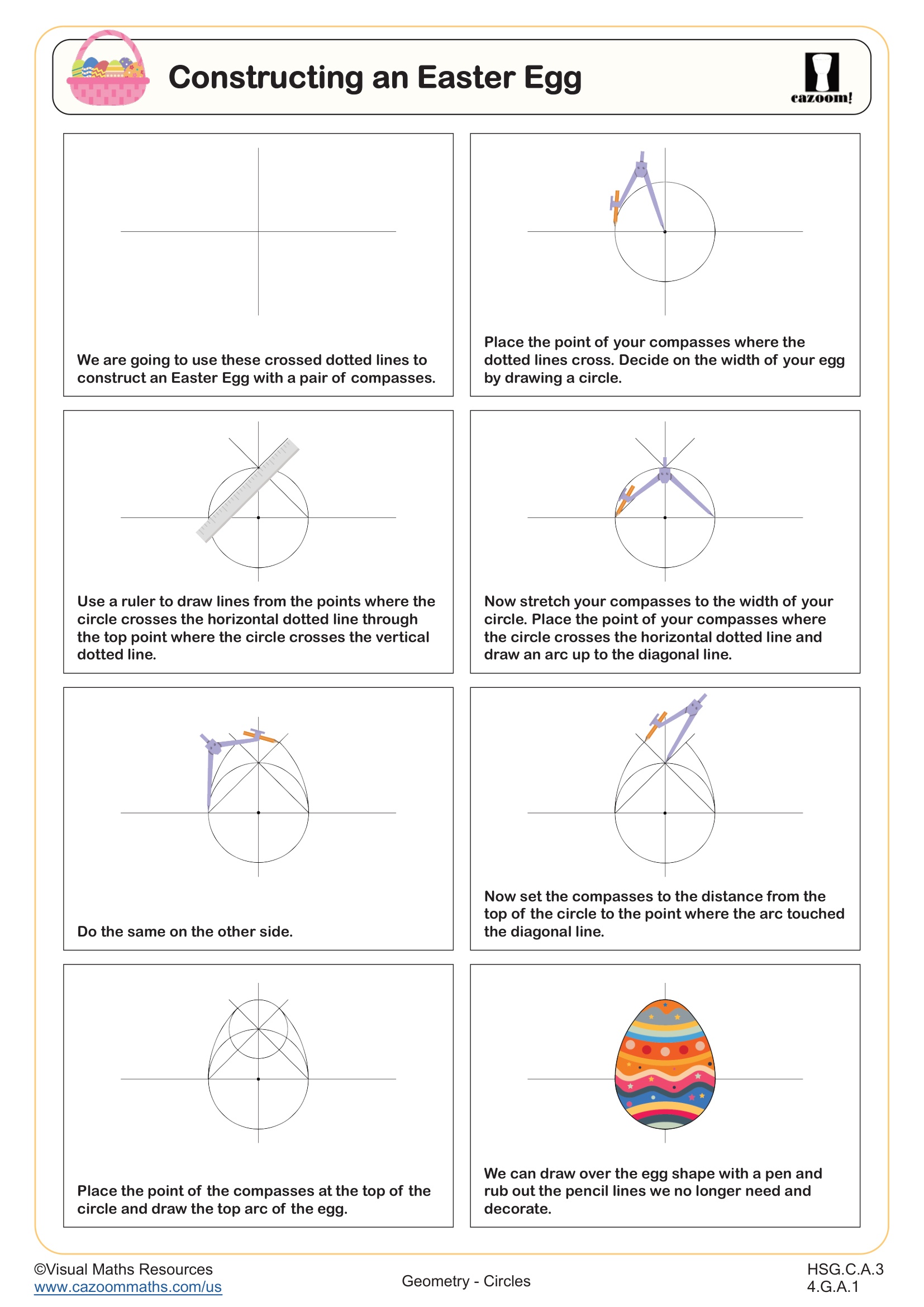
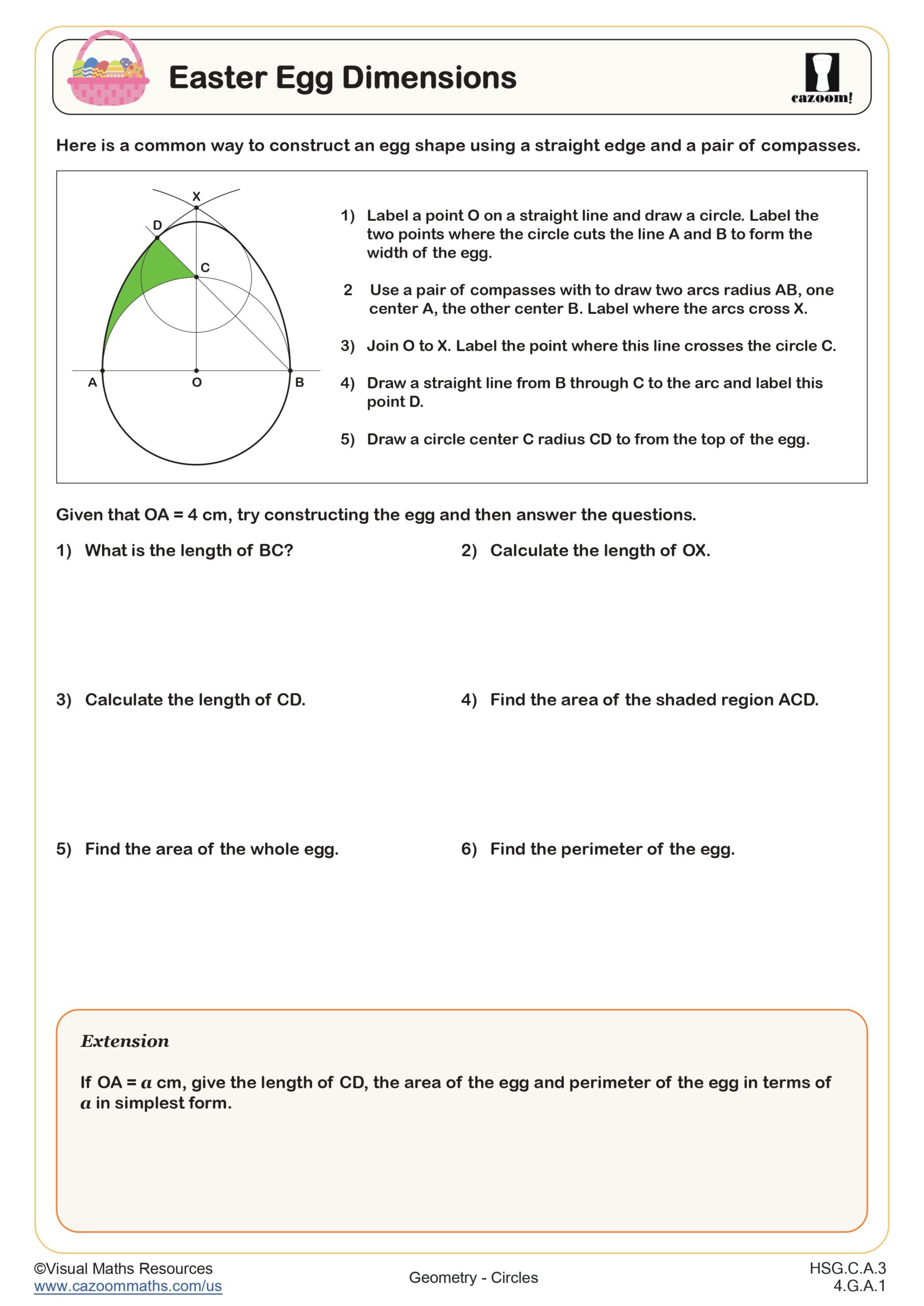
These worksheets provide structured practice with circle identification and construction, offering activities that reinforce vocabulary and visual recognition skills. The themed approach with Easter egg designs makes the geometry practice more engaging while maintaining focus on mathematical concepts. Answer keys allow teachers to quickly assess whether students accurately identify circle properties and apply measurement skills correctly.
Many teachers use these worksheets during geometry units as independent practice after introducing circle concepts with manipulatives or interactive demonstrations. They work well for math centers where students can complete them at their own pace, or as homework to reinforce classroom learning. The visual nature of circle activities makes them suitable for partner work, where students can compare their constructions and discuss why certain measurements produce specific results. Teachers also find them useful for identifying which students need additional support with using measurement tools or understanding the relationship between a circle's center and its boundary.