4th Grade Describe and Compare Shapes Worksheets
All worksheets are created by the team of experienced teachers at Cazoom Math.
What Does Describing and Comparing Shapes Mean in 4th Grade Math?
Describing and comparing shapes involves identifying and articulating the specific attributes that define geometric figures, then using those properties to determine similarities and differences between shapes. Fourth graders learn to recognize that shapes can be classified multiple ways based on properties like number of sides, angle measures, parallel sides, and symmetry.
Students often assume that visual appearance alone determines shape classification, leading to errors like calling any four-sided figure a square or confusing equilateral and isosceles triangles. Teachers notice breakthroughs when students start using a checklist approach, systematically examining each property rather than relying on how a shape "looks." This methodical thinking transfers directly to classification tasks across science and data analysis.
What Shape Skills Should 4th Graders Master?
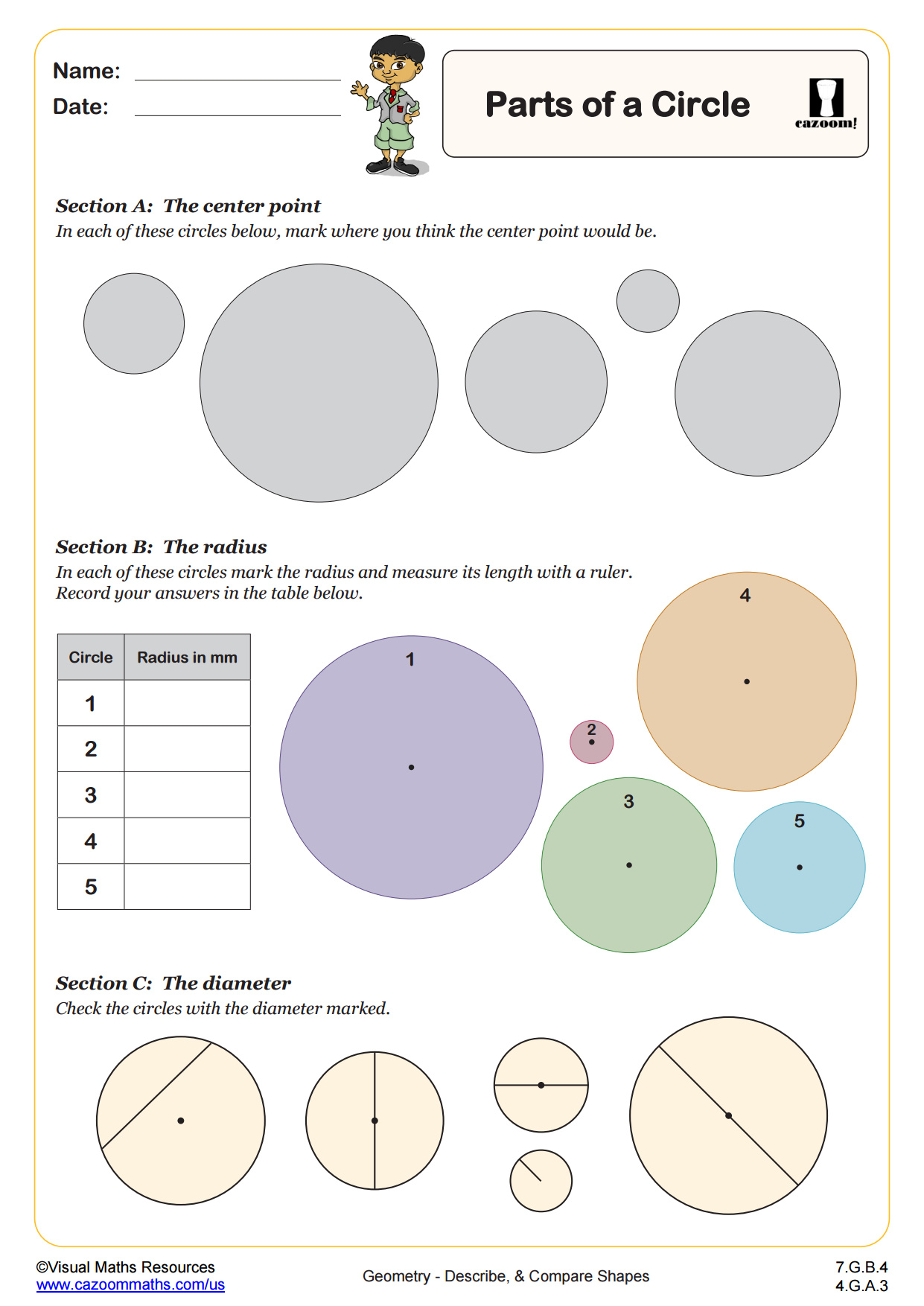
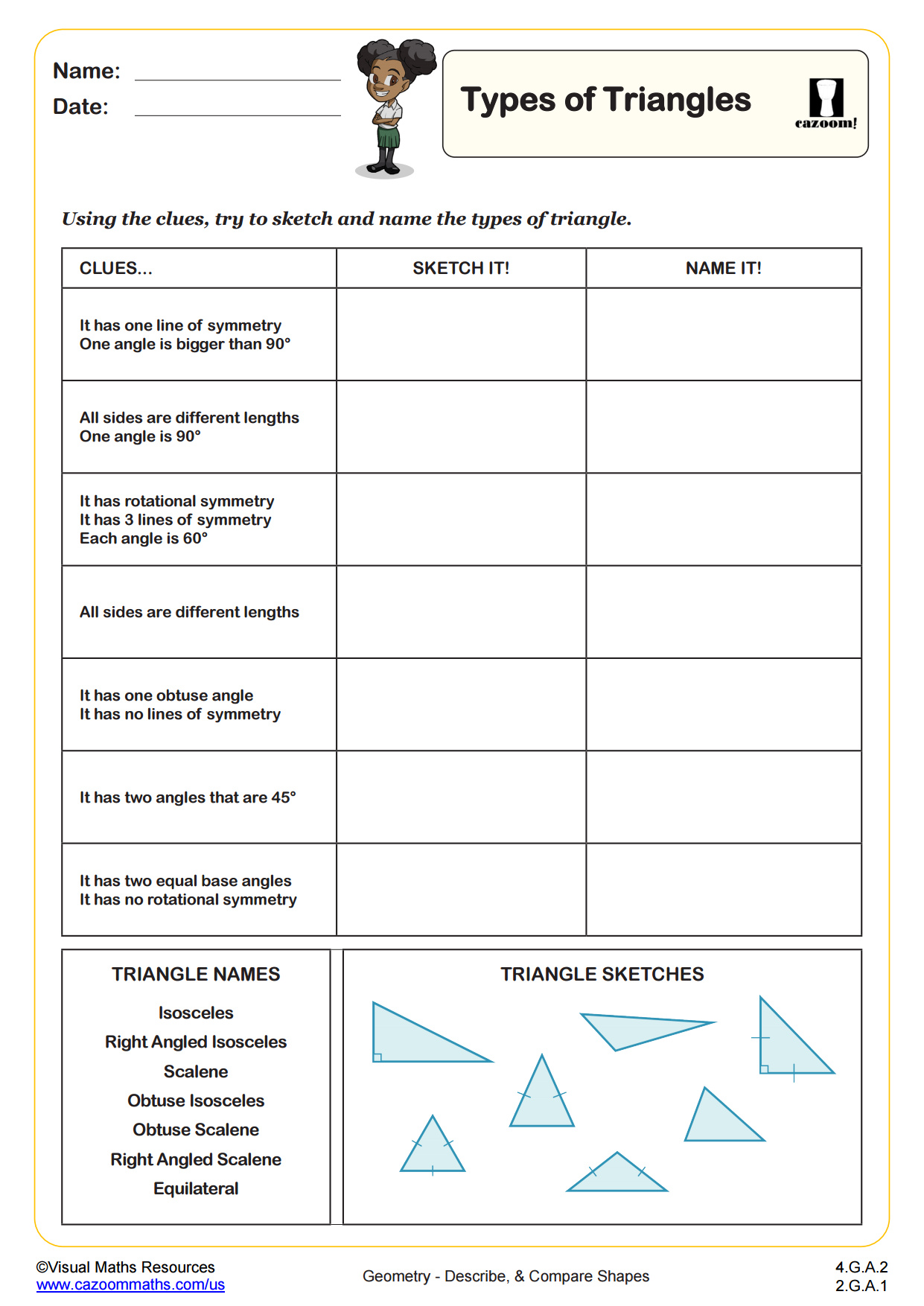
Fourth grade students should accurately identify and draw points, lines, line segments, rays, and angles while understanding how these elements combine to form two-dimensional shapes. They classify triangles as equilateral, isosceles, or scalene based on side lengths, and as acute, obtuse, or right based on angles. Students also identify and describe the parts of a circle including center, radius, diameter, and circumference.
This work builds directly on third grade shape identification and prepares students for fifth grade coordinate geometry and angle measurement. Teachers observe that students who struggle with shape comparison in fourth grade often missed foundational work with attributes in second and third grade. Conversely, students who master precise geometric vocabulary now find sixth grade area and perimeter formulas more intuitive because they understand why different shapes require different approaches.
How Do Students Learn to Classify Different Types of Triangles?
Students classify triangles using two separate systems simultaneously: by side lengths (equilateral, isosceles, scalene) and by angle measures (acute, obtuse, right). This dual classification system challenges students to examine multiple attributes at once, recognizing that a single triangle fits into both categories, like an obtuse isosceles triangle. Many students initially focus only on side lengths and overlook angle properties, or vice versa.
Architects and engineers apply triangle classification constantly when designing structures, as different triangle types provide different structural properties. Equilateral triangles distribute weight evenly, making them ideal for bridge trusses, while right triangles appear in roof construction and ramp design. Understanding these classifications helps students recognize why certain shapes appear repeatedly in buildings, towers, and frameworks throughout their communities.
How Can Teachers Use These Worksheets Most Effectively?
These worksheets present shape properties through visual examples and comparison exercises that require students to analyze rather than simply memorize definitions. The structured format helps students develop systematic observation skills, examining each attribute methodically. Answer keys allow students to self-check during independent practice or enable teachers to quickly identify patterns in student errors across the class.
Teachers find these materials work well during math centers where students practice classification independently after whole-group instruction introduces concepts. The worksheets also serve effectively as warm-up activities to activate prior knowledge before lessons on area and perimeter, or as targeted review before standardized assessments that test geometric reasoning. Some teachers assign different worksheet sections to student pairs, having them explain their classification reasoning to each other, which strengthens both mathematical vocabulary and conceptual understanding.