4th Grade Fractions Decimals Percentages Worksheets
All worksheets are created by the team of experienced teachers at Cazoom Math.
What Skills Do These Worksheets Cover?
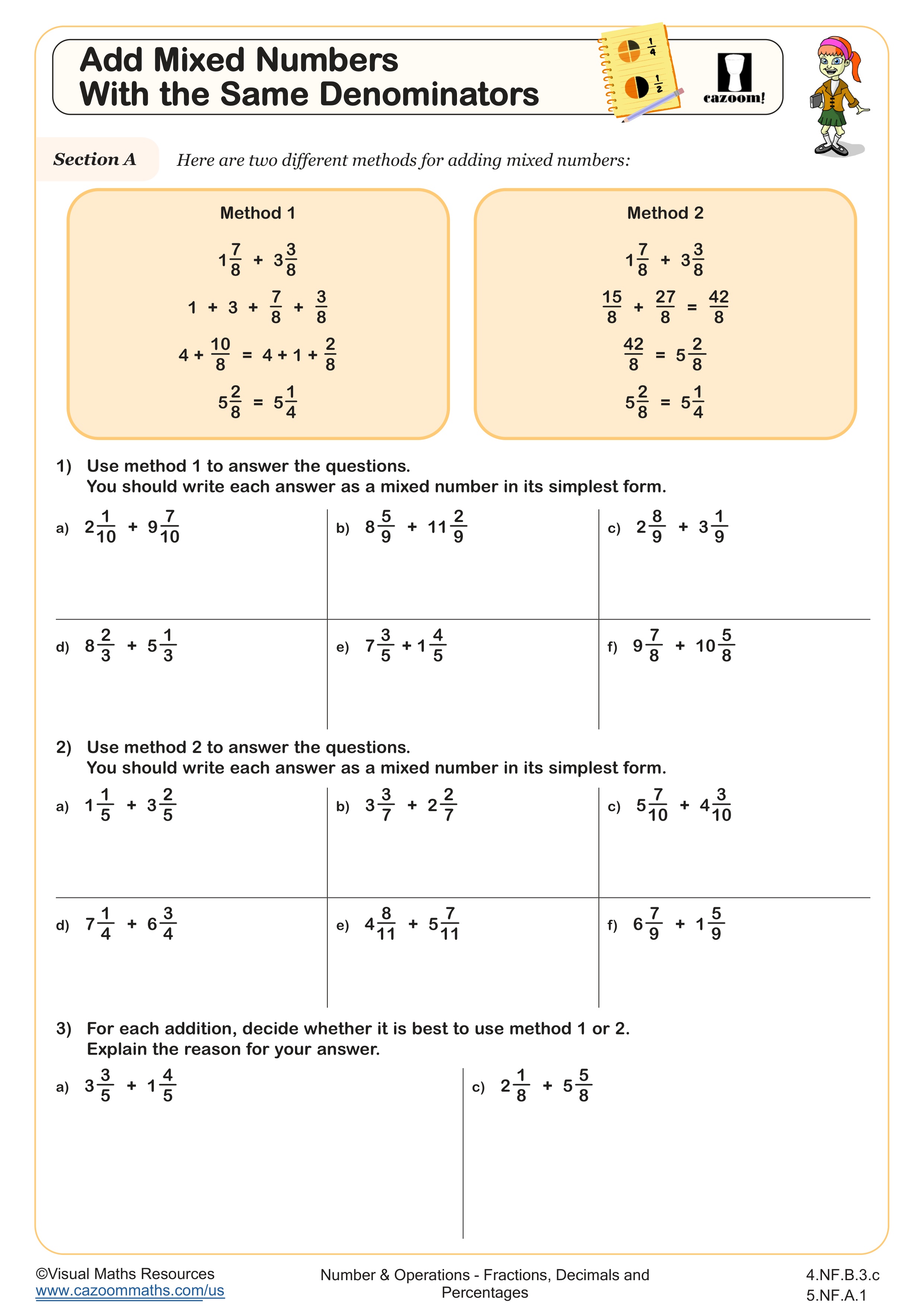
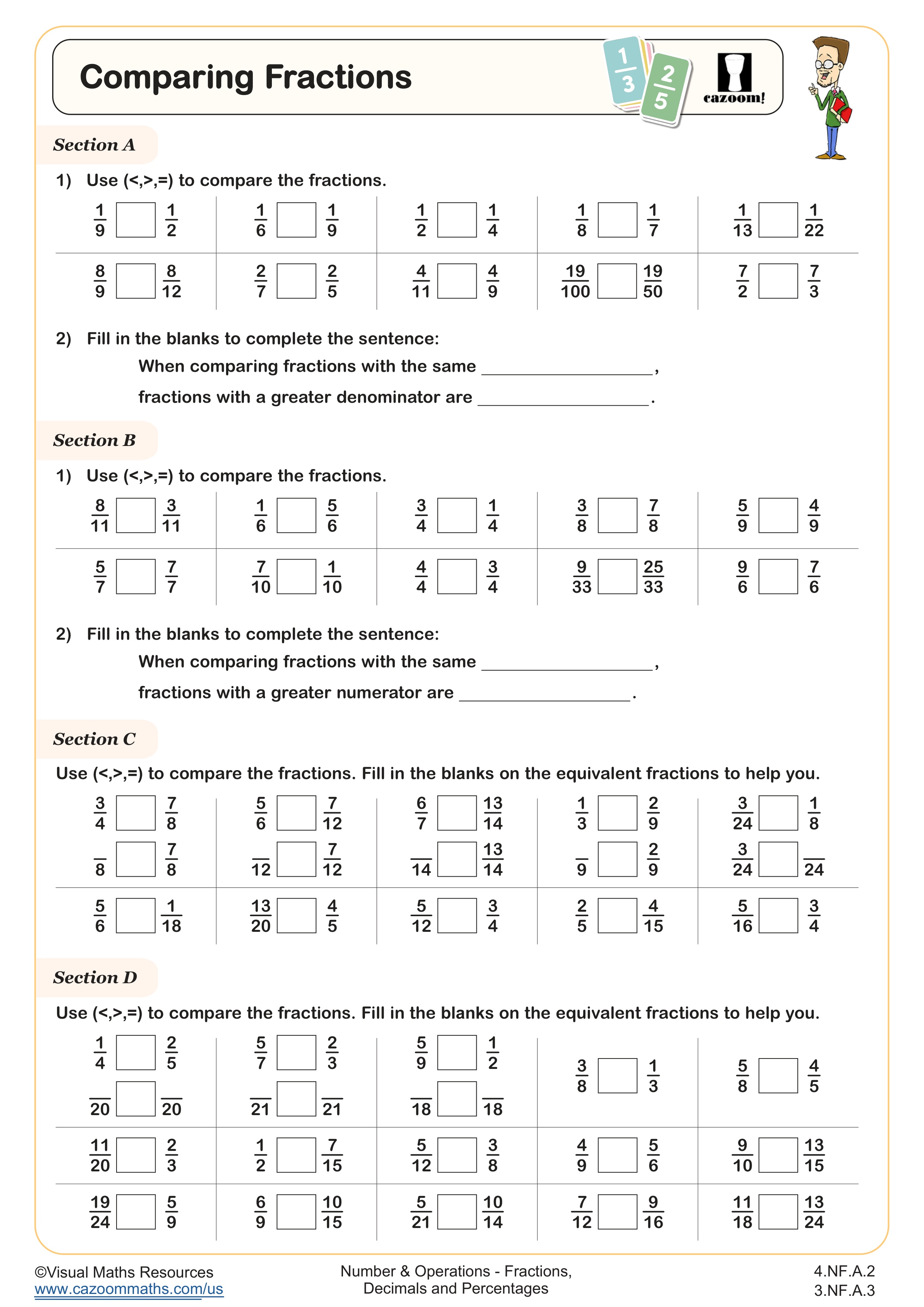
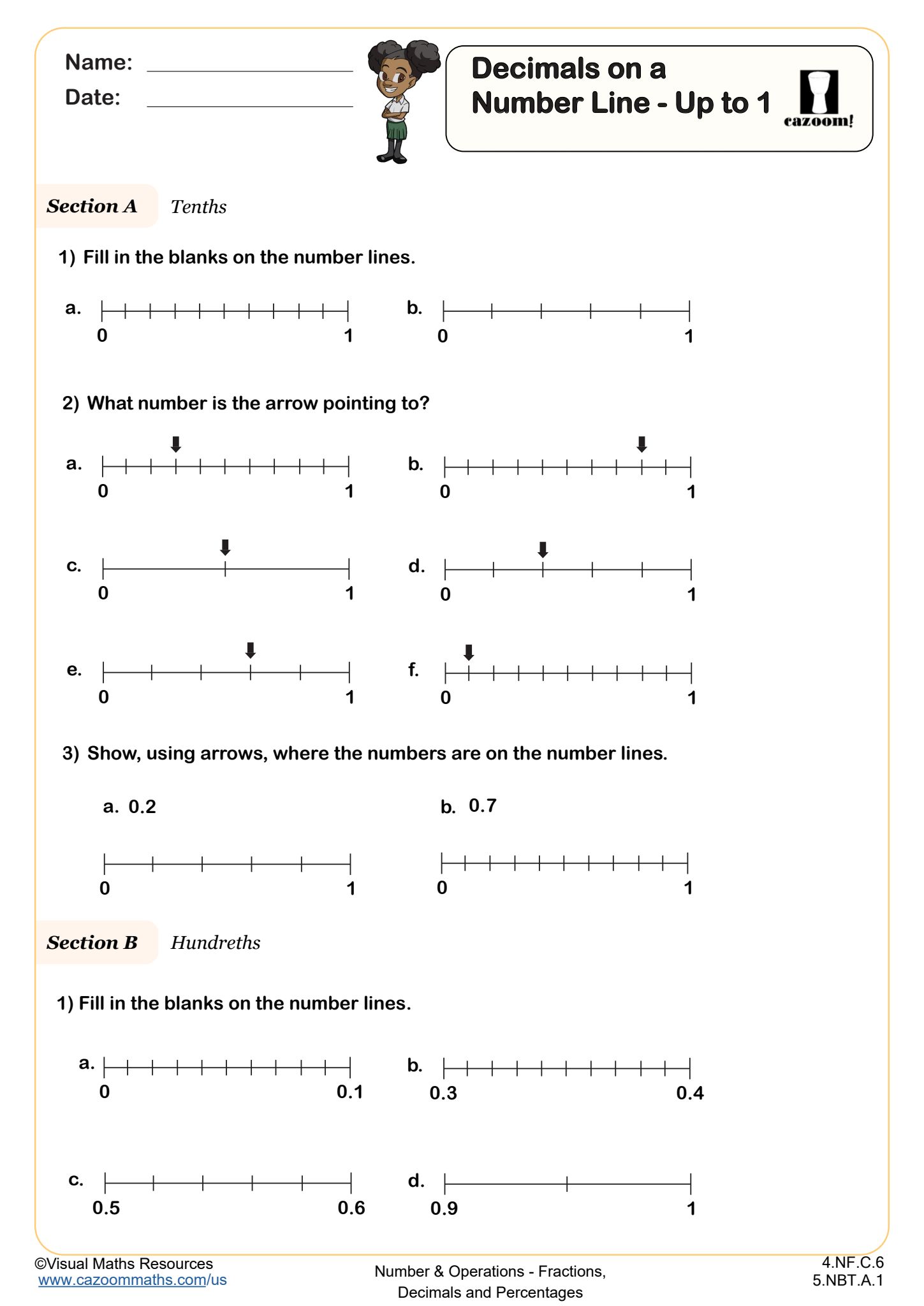
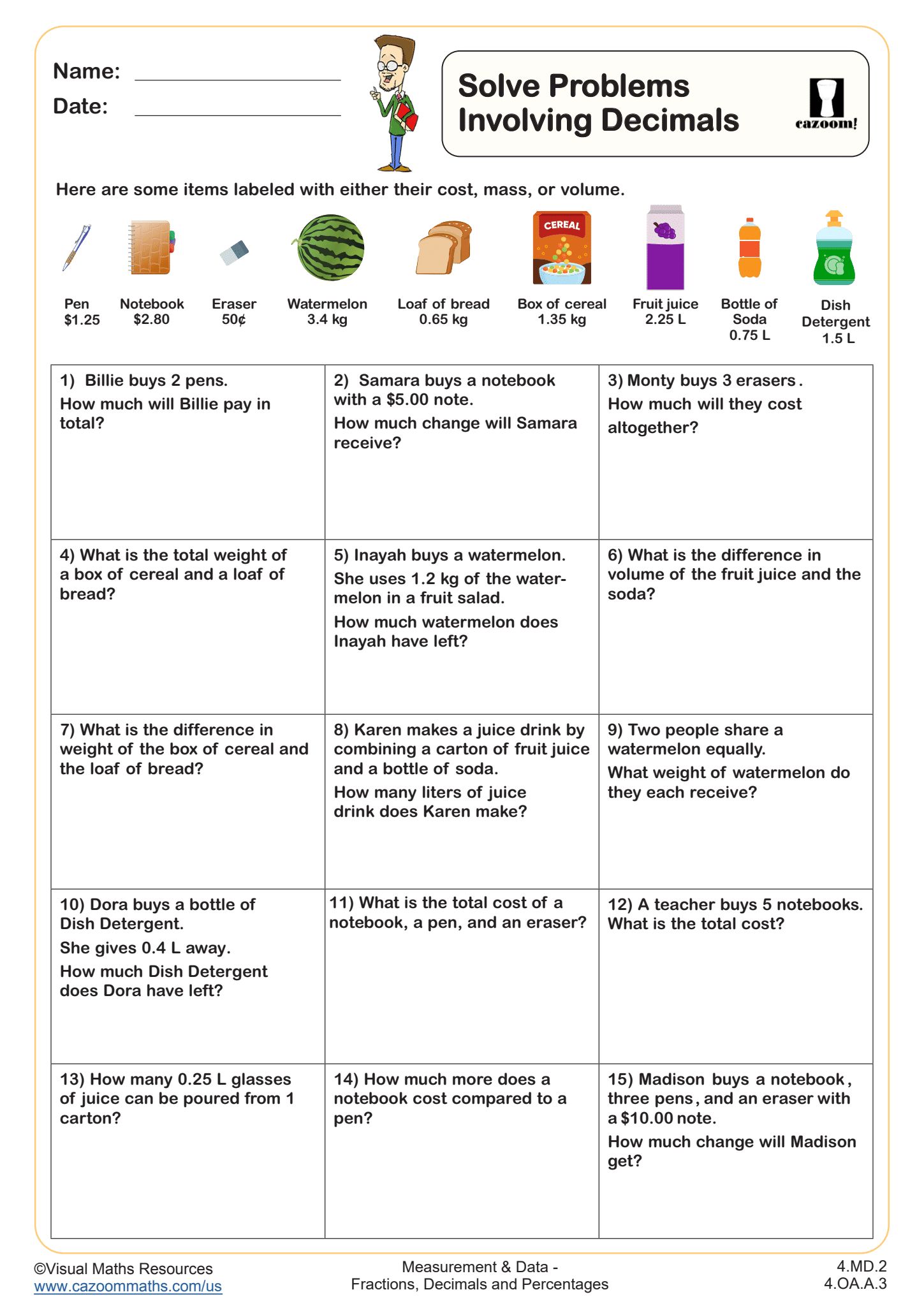
These worksheets address several Common Core State Standards for 4th grade, including comparing fractions with different numerators and denominators, adding and subtracting mixed numbers with like denominators, understanding decimal notation for fractions with denominators of 10 and 100, and using decimal notation to solve word problems involving money and measurement. The collection also includes practice with visual models like number lines to represent fractional and decimal quantities.
Students typically lose points on standardized tests when they forget to find common denominators before comparing fractions or when they misplace decimal points in word problems. The worksheets provide repeated practice with these specific trouble spots, helping students develop accuracy before encountering these concepts on state assessments.
What Should 4th Graders Know About Fractions, Decimals, and Percentages?
By the end of 4th grade, students should confidently compare fractions using benchmark fractions like 1/2, recognize and generate equivalent fractions, add and subtract fractions and mixed numbers with the same denominator, and understand decimal notation to the hundredths place. They should also solve word problems that involve decimals in the context of money, weight, and length. Percentages are typically introduced in 5th grade, though some advanced 4th graders begin exploring the concept through visual models.
This work builds directly on 3rd grade fraction concepts, where students first learned to represent fractions on number lines and understand fractions as parts of a whole. Mastery of 4th grade fraction and decimal skills prepares students for 5th grade work with fraction multiplication and division, as well as more complex decimal operations that appear throughout middle school mathematics.
How Do You Compare Fractions with Different Denominators?
Comparing fractions with unlike denominators requires students to find a common denominator or use benchmark fractions as reference points. Many 4th graders successfully compare fractions by converting both to equivalent fractions with the same denominator, then examining which numerator is larger. Another effective strategy involves comparing both fractions to 1/2: a fraction like 3/8 is less than 1/2, while 5/8 is greater than 1/2, making the comparison clear without calculation.
This skill connects directly to real-world measurement situations, particularly in cooking and construction. When a recipe calls for 2/3 cup of flour but you only have a 3/4 cup measure, students need to determine which fraction is larger to avoid adding too much. In STEM fields, engineers and scientists regularly compare fractional measurements when working with precision tools, making this elementary skill foundational for technical careers.
How Can Teachers Use These Worksheets Most Effectively?
The worksheets provide scaffolded practice that moves from visual representations to abstract problems, allowing students to build conceptual understanding before tackling purely numerical exercises. Teachers notice that starting with number line worksheets helps students visualize decimal placement, which then supports their work with decimal operations. The mixed numbers worksheet reinforces the relationship between whole numbers and fractions, a connection that strengthens overall fraction sense.
These resources work well for differentiated instruction during math centers, as intervention materials for students who need additional practice before assessments, or as homework assignments that reinforce classroom learning. The complete answer keys allow students to self-check during independent work or enable teaching assistants and parent volunteers to provide immediate feedback. Many teachers use these worksheets for quick formative assessments, assigning select problems to gauge student understanding before moving to more complex topics.