4th Grade Metric Measures Worksheets
All worksheets are created by the team of experienced teachers at Cazoom Math.
What Are Metric Measures in 4th Grade Math?
Metric measures in 4th grade introduce students to the International System of Units (SI), focusing on length (meters), mass (grams), and capacity (liters). Students learn to express measurements using decimals and perform conversions within the metric system, such as changing 2.5 meters to 250 centimeters or 1.2 liters to 1,200 milliliters. This work aligns with Common Core standard 4.MD.A.1, which requires students to know relative sizes of measurement units within one system.
Many students initially confuse which direction to move the decimal point during conversions. Teachers observe that students lose points on assessments when they multiply instead of divide (or vice versa) because they haven't internalized that converting to smaller units requires more of those units. Providing visual aids like conversion charts with the decimal point movement clearly marked helps students develop this critical skill.
What Should 4th Graders Know About Metric Measurement?
By the end of 4th grade, students should recognize that the metric system operates on powers of ten, making conversions straightforward once they understand the pattern. They should convert between millimeters, centimeters, meters, and kilometers for length; milliliters and liters for capacity; and grams and kilograms for mass. Students should also apply these conversions to solve word problems involving addition, subtraction, and multiplication of metric measurements.
This work builds directly on 3rd grade, where students first encountered measurement and data concepts with simpler whole-number relationships. The 4th grade focus on decimals within metric measures prepares students for 5th grade standards, where they'll convert measurements across different systems and work with volume calculations. Students who master metric conversions in 4th grade find fraction and decimal operations in later grades much more intuitive.
How Do Decimals Connect to Metric Conversions?
Decimals and metric measures form a natural partnership since both operate on a base-ten system. When students convert 3.4 meters to centimeters, they multiply by 100, moving the decimal point two places to the right to get 340 centimeters. This process reinforces place value understanding while building measurement fluency. Students learn that each jump between metric prefixes (kilo-, hecto-, deka-, base unit, deci-, centi-, milli-) represents a factor of ten, making mental math strategies accessible.
This connection appears throughout STEM fields where precision matters. Scientists measure chemical solutions in milliliters, engineers calculate distances in kilometers, and medical professionals dosage medications in milligrams. Students often make breakthroughs when teachers present real scenarios like mixing 1.5 liters of water with 750 milliliters of juice, requiring them to convert to the same unit before adding. These practical applications make abstract decimal operations concrete and purposeful.
How Can Teachers Use These Metric Measures Worksheets?
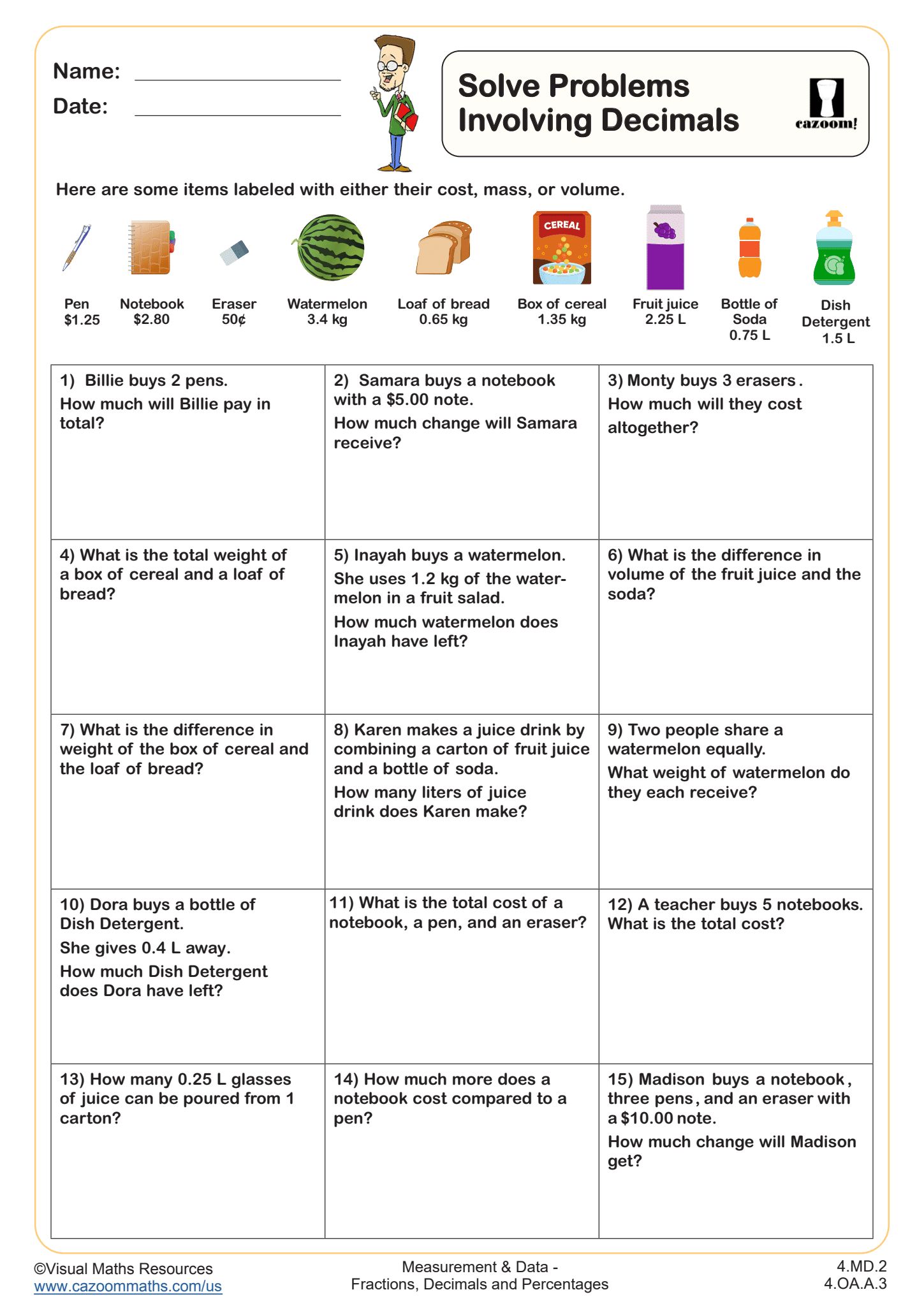
These worksheets provide structured practice with problems that progress from straightforward metric conversions to multi-step word problems involving decimals and measurements. The problems require students to identify which metric unit to use, perform conversions when necessary, and apply appropriate operations to find solutions. The included answer keys allow students to check their work independently, promoting self-assessment skills and helping teachers quickly identify which students need additional support with specific conversion types.
Teachers use these resources effectively during math centers, pairing students who can discuss their solution strategies and catch each other's conversion errors. The worksheets work well for homework after initial instruction, giving students independent practice before formative assessments. Many teachers find these materials valuable for differentiation, assigning them to students who need extra practice with decimal operations while other students work on extension activities. The real-world problem contexts keep students engaged while reinforcing computational skills.