4th Grade Number and Operations in Base Ten Worksheets
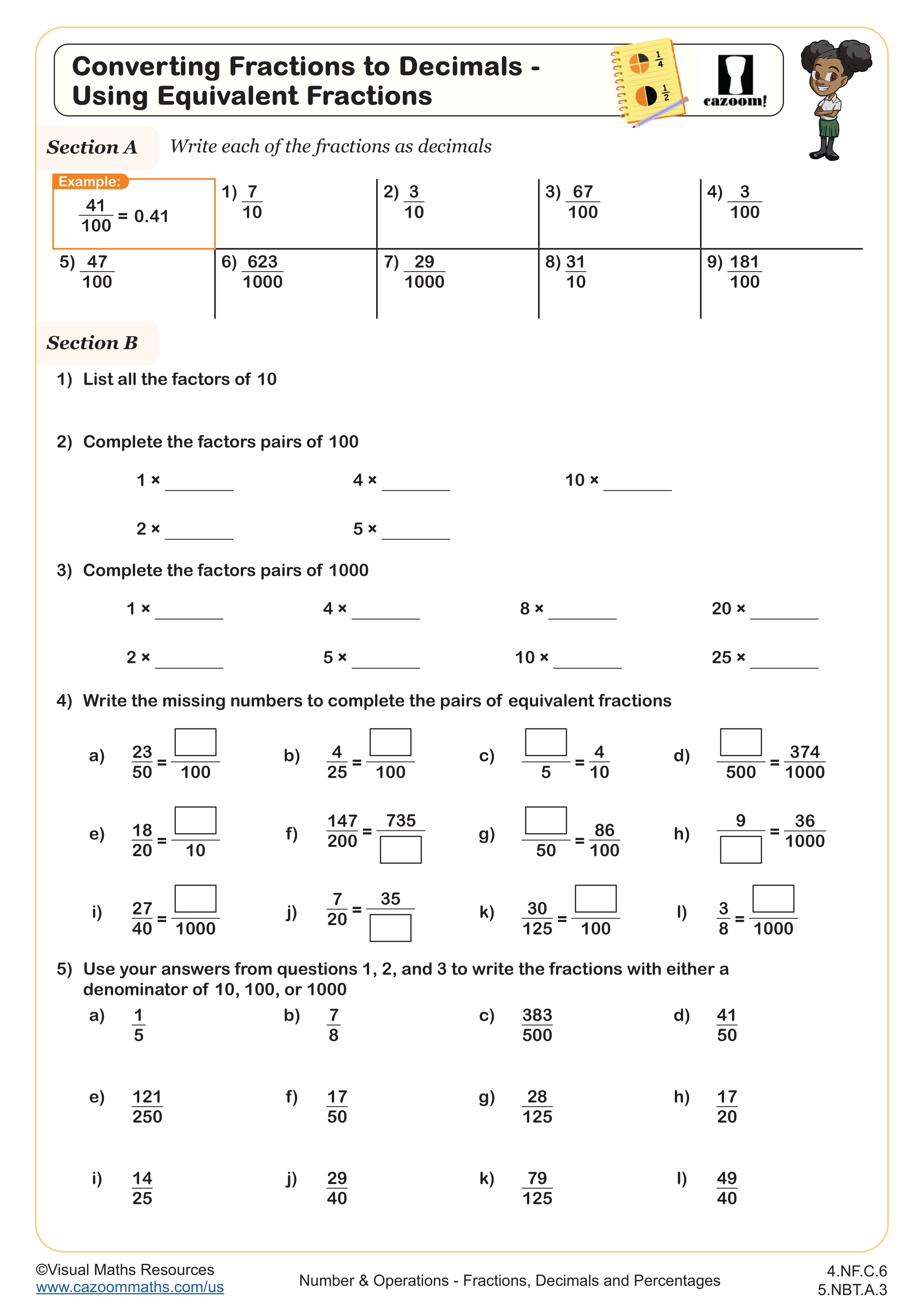
All worksheets are created by the team of experienced teachers at Cazoom Math.
What skills are covered in number and operations in base ten grade 4 worksheets?
Number and operations in base ten grade 4 worksheets align with Common Core standard 4.NBT, covering place value understanding through hundred thousands, rounding to any place value, and fluent addition and subtraction of multi-digit whole numbers. Students also practice multiplying multi-digit numbers by single digits and dividing multi-digit numbers by single-digit divisors.
Teachers frequently observe that students who master these concepts early show stronger performance in fraction operations later in the year. The most challenging area tends to be understanding that 40,000 + 3,000 + 200 + 5 represents the same quantity as 43,205, especially when numbers contain zeros in various positions.
How do these worksheets differ from number and operations in base ten grade 3 materials?
Fourth grade worksheets extend place value work to hundred thousands while third grade focuses primarily on thousands. The computational expectations also increase significantly, with fourth graders expected to multiply 4-digit by 1-digit numbers and divide 4-digit dividends by single digits with remainders.
Many teachers notice the jump from grade 3 to 4 requires more scaffolding around regrouping strategies. While third graders work with simpler algorithms, fourth graders must understand why borrowing works across multiple place values and how to interpret remainders in division contexts, particularly in word problems involving real-world scenarios.
Why do students struggle with multi-digit subtraction involving zeros?
Students often view zeros as 'nothing' rather than placeholders, making problems like 8,005 - 3,247 particularly challenging. They struggle to understand that borrowing from a zero requires looking to the next non-zero digit and adjusting multiple place values simultaneously.
Effective teachers demonstrate this concept using base-ten blocks or place value charts, showing how 8,005 becomes 7,999 + 6 when regrouping for subtraction. The worksheets provide graduated practice, starting with simpler cases like 304 - 158 before progressing to more complex multi-zero scenarios that require systematic borrowing across several places.
How can teachers use these worksheets most effectively in their classrooms?
Teachers find success using these worksheets as formative assessments to identify specific misconceptions before moving to more complex topics. The answer keys allow for quick feedback, helping teachers spot patterns in student errors and adjust instruction accordingly.
Many educators use selected problems as warm-up activities or exit tickets, focusing on one skill at a time rather than overwhelming students with mixed practice. The worksheets work well for differentiated instruction, allowing advanced students to tackle multi-step word problems while others focus on computational fluency with the basic algorithms.