4th Grade Operations and Algebraic Thinking Worksheets




All worksheets are created by the team of experienced teachers at Cazoom Math.
What topics are covered in operations and algebraic thinking grade 4 worksheets?
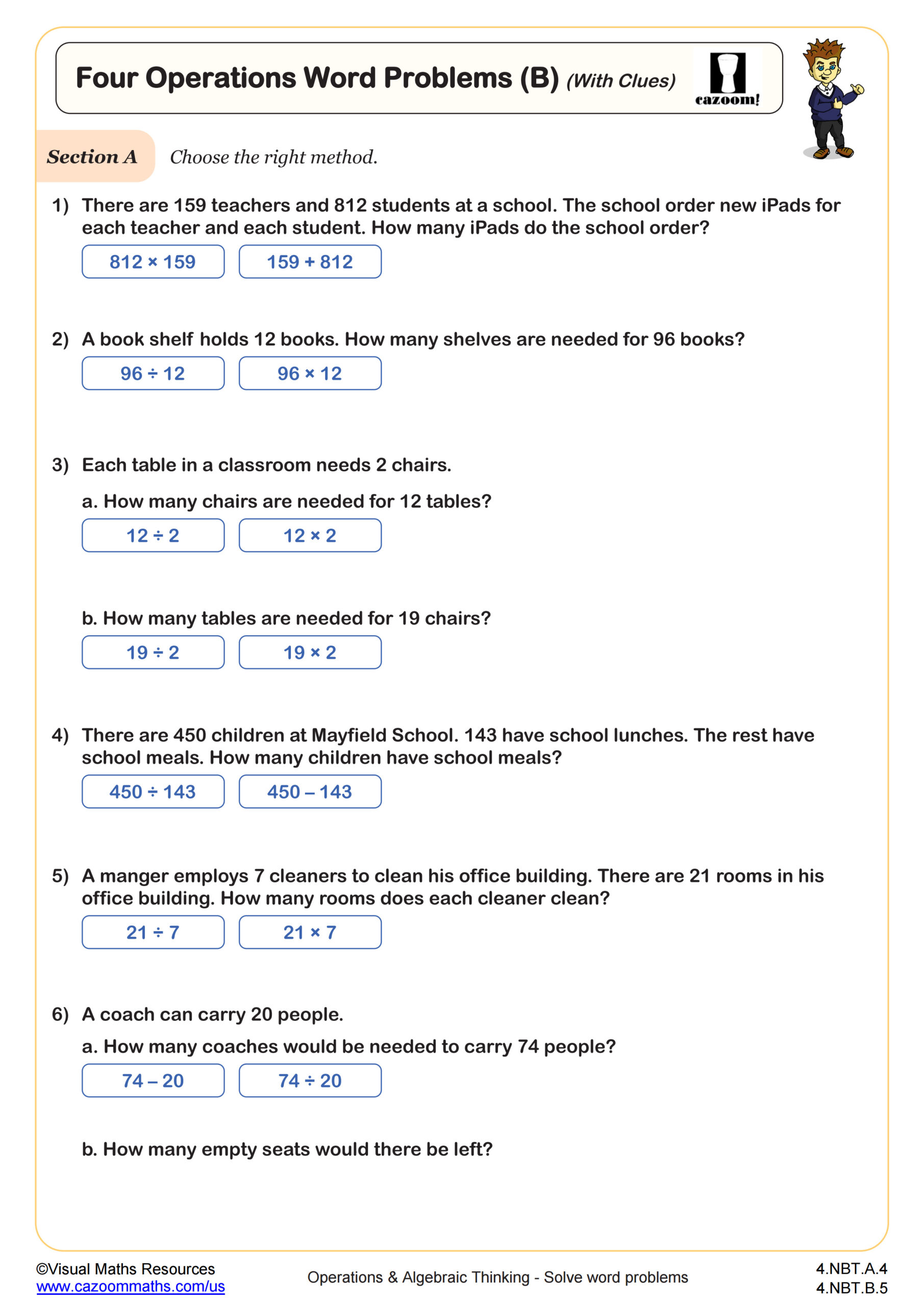
Operations and algebraic thinking grade 4 worksheets pdf resources typically cover the four main areas outlined in Common Core Standard 4.OA: using the four operations with whole numbers to solve problems, gaining familiarity with factors and multiples, generating patterns, and understanding multiplication and division relationships. Students work with multi-step word problems, interpret remainders, find factor pairs for numbers 1-100, and identify arithmetic patterns.
Teachers frequently observe that students excel at computational skills but struggle when problems require them to choose between operations or explain their reasoning. The worksheets address this by including problems where students must write equations to represent situations and justify their problem-solving strategies, building the analytical thinking skills targeted for future algebra success.
Are these worksheets appropriate for students below or above grade 4?
While designed for fourth grade, these algebraic thinking 4th grade worksheets can effectively support differentiated instruction across grade levels. Advanced third graders who have mastered basic multiplication and division facts often benefit from the pattern recognition and simple multi-step problems. Fifth graders who need reinforcement with foundational concepts can use these materials as review before tackling more complex algebraic expressions.
Teachers working with struggling learners find that starting with the simpler pattern problems builds confidence before moving to multi-step word problems. The progression from concrete number relationships to abstract thinking mirrors how students naturally develop algebraic reasoning skills, making these worksheets valuable for intervention programs and gifted education alike.
How do these worksheets help students understand factor pairs and multiples?
The factor pair activities in these four operations worksheet grade 4 collections use visual models like arrays and area models to help students see the relationship between factors and products. Students practice finding all factor pairs for numbers 1-100, recognizing prime and composite numbers, and understanding how factors relate to division. This conceptual foundation proves crucial for fraction work in fifth grade.
Many teachers notice that students memorize factor pairs without understanding the underlying relationships. The worksheets address this by including problems where students must explain why certain numbers have more factors than others and connect factor pairs to real-world contexts like arranging objects in rectangular patterns. This deeper understanding helps prevent the common misconception that larger numbers always have more factors.
What's the best way to use these worksheets for maximum learning impact?
Teachers get the best results when they use these algebra and algebraic thinking 4th grade worksheets as part of a balanced approach that includes hands-on activities, discussion, and reflection. Rather than assigning entire worksheets as homework, many teachers select 3-4 problems that target specific learning objectives and use them as warm-ups, exit tickets, or small group practice. The answer keys allow for immediate feedback during instruction.
Successful implementation often involves having students explain their thinking to partners before writing solutions. This verbal processing helps identify misconceptions early and builds the mathematical communication skills emphasized in Common Core standards. Teachers also find value in having students create their own problems similar to worksheet examples, demonstrating true understanding of algebraic thinking concepts.