4th Grade Position and Direction Worksheets
All worksheets are created by the team of experienced teachers at Cazoom Math.
What Does Position and Direction Cover in 4th Grade Math?
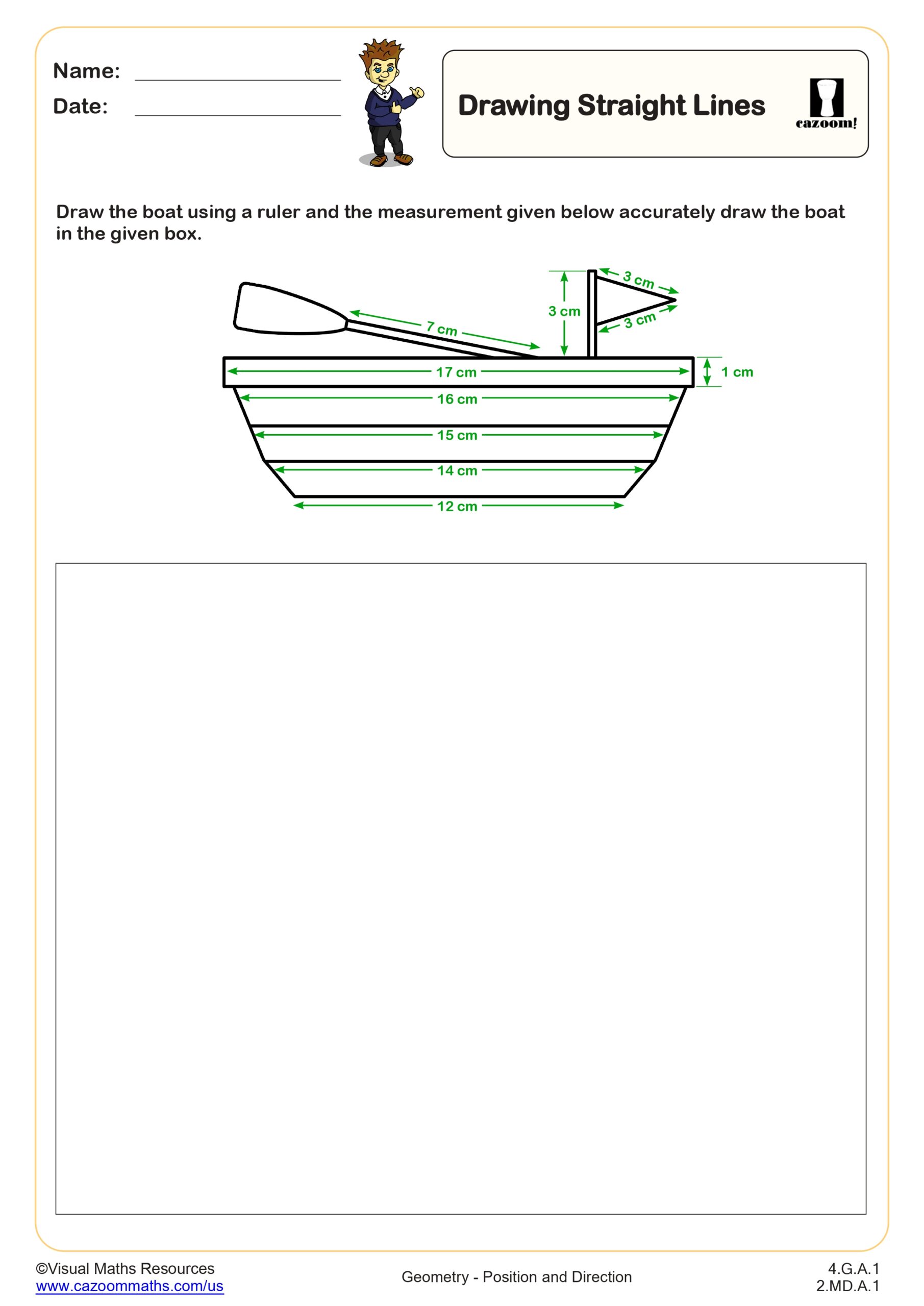
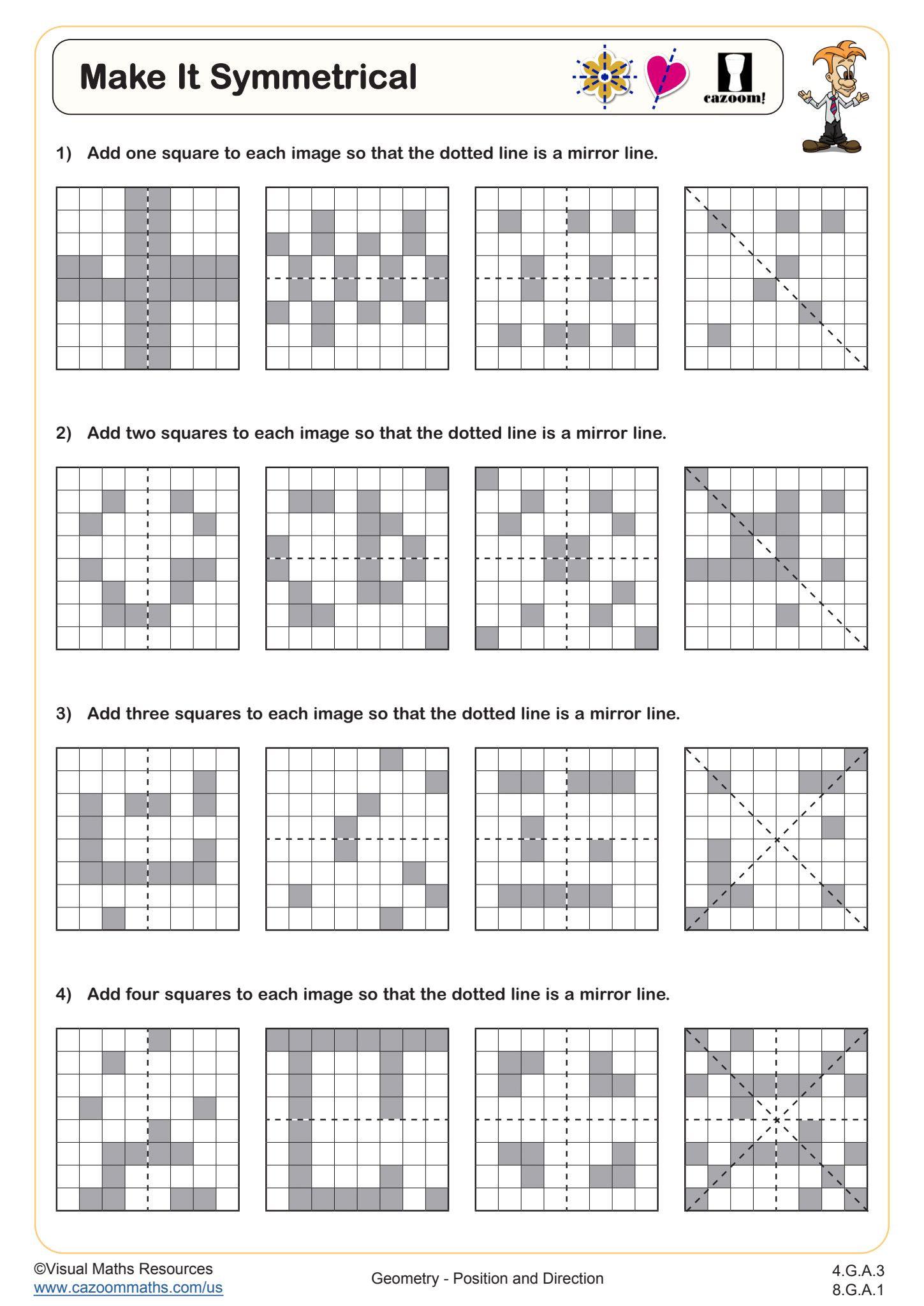
Position and direction in fourth grade focuses on coordinate systems, line drawing with rulers, and symmetry concepts that align with Common Core geometry standards. Students learn to describe locations using ordered pairs, draw lines at specific angles, and identify or create symmetrical figures on grid paper. These skills connect directly to CCSS.Math.Content.4.G.A.3, which addresses lines of symmetry.
Many teachers find that students initially confuse horizontal and vertical when drawing lines, often reversing the terms despite understanding the concept visually. This confusion diminishes when students associate "horizontal" with the horizon and practice labeling axes consistently. Grid paper provides the structure students need to draw accurately, though some learners benefit from starting with larger grids before moving to standard graph paper.
What Should 4th Graders Know About Position and Direction?
By fourth grade, students should accurately use a ruler to draw straight lines, identify and draw lines of symmetry in two-dimensional shapes, and begin describing positions using simple coordinate notation. They build on third grade work with shapes and attributes, now adding precision through measurement tools and numerical location systems. This represents a shift from purely visual geometry to quantified spatial relationships.
These skills prepare students for fifth grade coordinate plane work, where they'll plot points using ordered pairs and analyze patterns in coordinate grids. Students who master symmetry and precise line drawing in fourth grade find transformations like reflections and rotations more intuitive in middle school. The connection between drawing accurate lines and understanding angles also supports success in protractor work introduced later in elementary school.
How Do Students Learn to Identify Lines of Symmetry?
Lines of symmetry divide shapes into two identical halves that are mirror images of each other. Students learn to test for symmetry by imagining folding the shape along a potential line and checking whether both sides would match exactly. Common shapes have predictable symmetry: circles have infinite lines, squares have four, rectangles have two, and many triangles have one or none depending on their type.
Symmetry appears throughout nature and design, from butterfly wings to architectural facades, making it one of the most visually apparent math concepts in everyday life. Engineers use symmetry principles when designing everything from airplane wings to smartphone screens, ensuring balanced weight distribution and aesthetic appeal. Students often become more observant of symmetry in their environment once they learn to identify it mathematically, noticing patterns in logos, buildings, and art that they previously overlooked.
How Can Teachers Use Position and Direction Worksheets Effectively?
These worksheets provide structured practice with ruler skills and symmetry identification that many students need multiple exposures to master. The grid-based format helps students develop accuracy gradually, starting with simpler shapes before progressing to more complex figures. Answer keys allow for immediate feedback, which research shows significantly improves retention when students check their own work and correct misconceptions right away.
Teachers frequently use these worksheets during math centers or station rotations, pairing students so they can discuss their reasoning about where symmetry lines should go. They also work well as pre-assessment tools to identify which students need additional instruction with rulers or spatial reasoning before moving forward. Some teachers assign them as homework after introducing concepts in class, while others use them for morning work review or as anchor activities for early finishers who need enrichment without moving ahead in the curriculum.