4th Grade Properties of Operations Worksheets
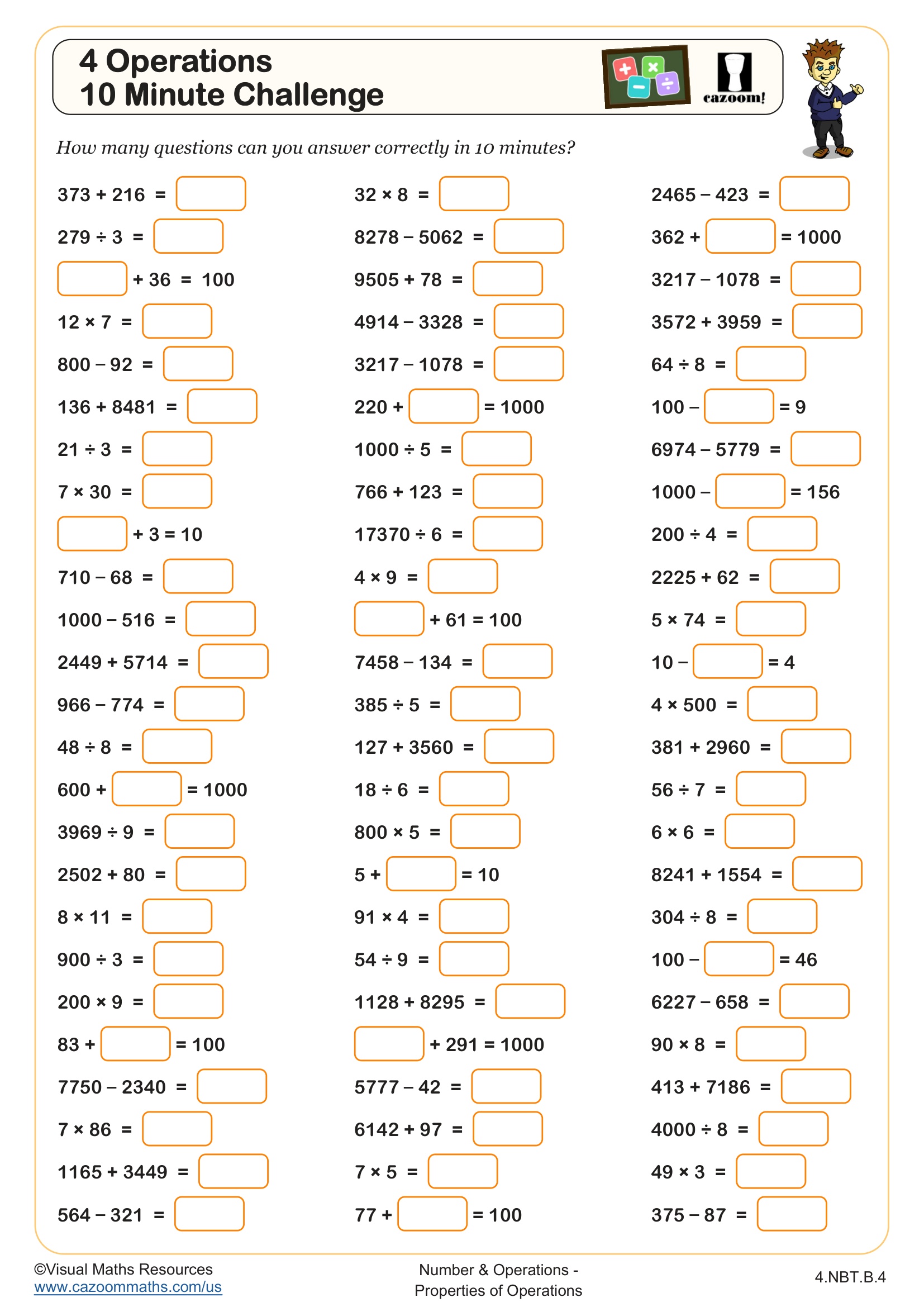
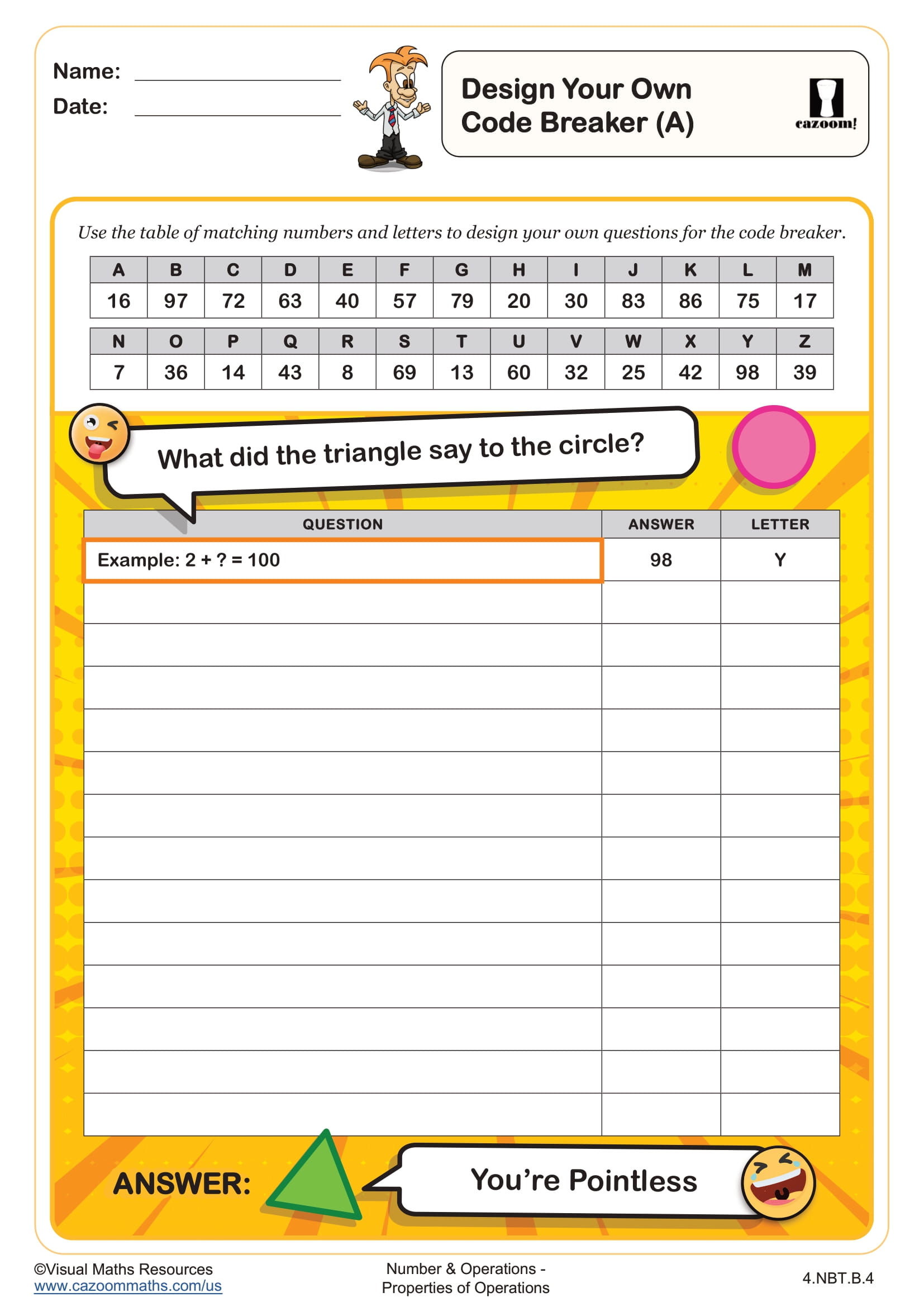
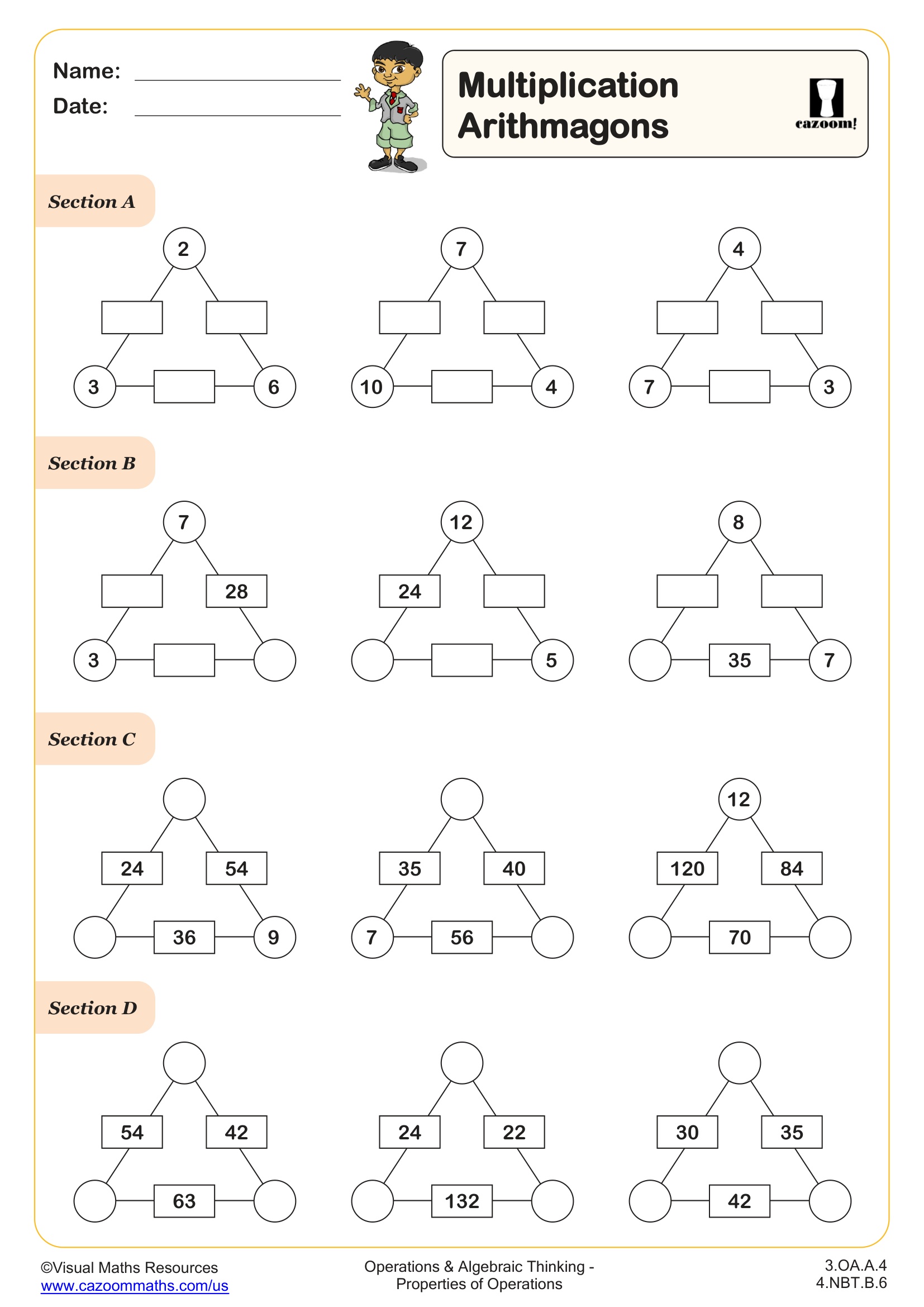
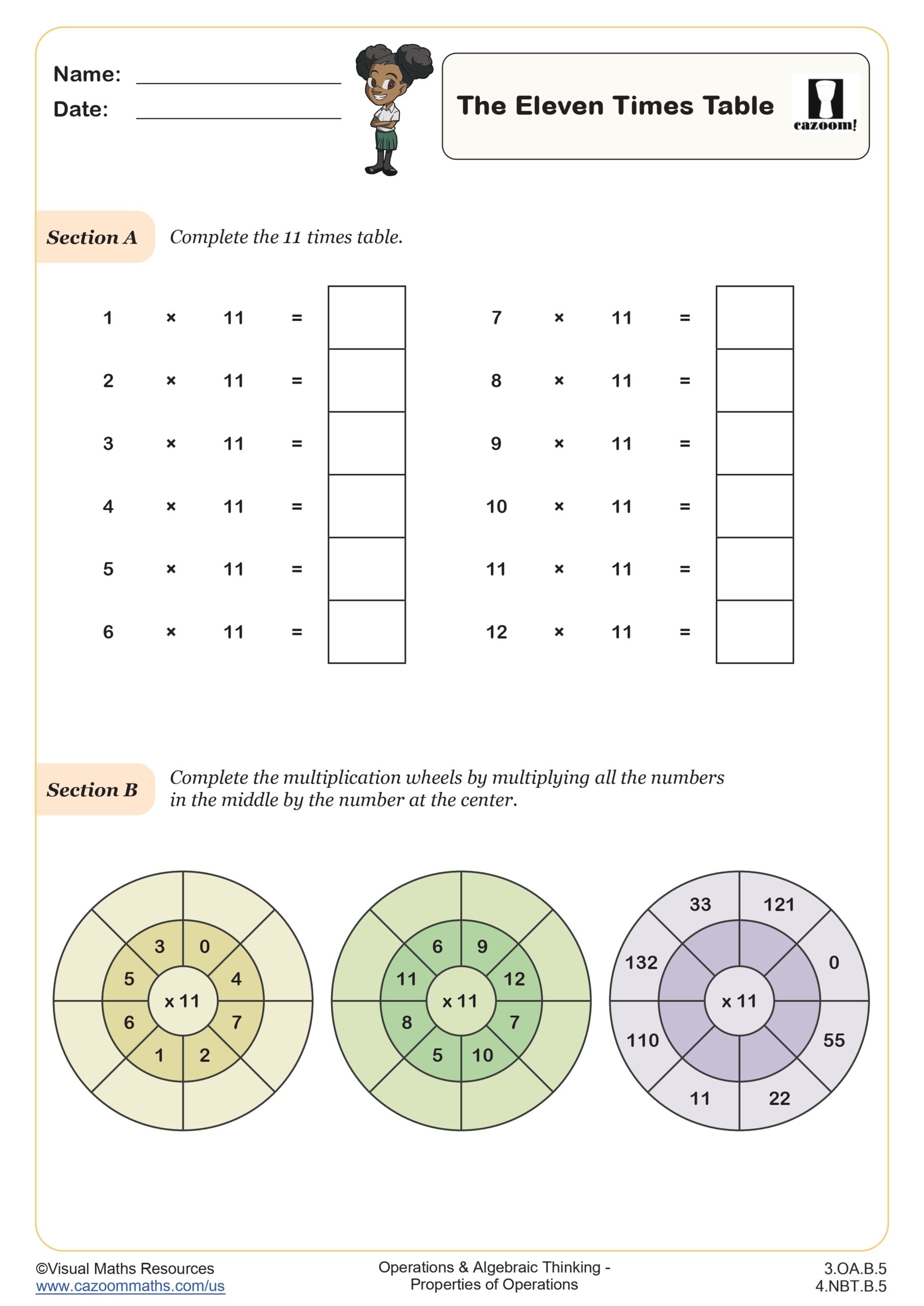
All worksheets are created by the team of experienced teachers at Cazoom Math.
What are the properties of operations in 4th grade math?
The properties of operations in 4th grade include the commutative property (changing the order doesn't change the result), associative property (changing the grouping doesn't change the result), and distributive property (multiplying a sum by breaking it into parts). Students work with these properties across addition, subtraction, multiplication, and division, though they learn that not all properties apply to all operations. For example, the commutative property works for addition and multiplication but not for subtraction or division.
A common error students make is assuming all properties work for all operations. When asked if 10 ÷ 5 equals 5 ÷ 10, many students initially say yes because they've seen the commutative property work so reliably with addition and multiplication. Teachers find that having students test properties with concrete numbers helps them understand which operations are commutative and which aren't, building deeper mathematical reasoning rather than memorized rules.
What should 4th graders know about properties of operations?
By 4th grade, students should recognize when using a property makes computation easier and apply properties flexibly to solve problems. They need to identify examples of the commutative, associative, and distributive properties and explain why certain strategies work. The Common Core State Standards expect 4th graders to use these properties as tools for mental math and to justify their reasoning when solving multi-step problems. Students should move beyond simply identifying properties to actively using them to simplify calculations.
This work builds directly on 3rd grade foundations where students first learned multiplication and division properties. Understanding these properties in 4th grade prepares students for 5th grade work with expressions and equations, where they'll use properties to generate equivalent expressions. Students who master properties of operations in elementary school show stronger algebra readiness because they understand that mathematical operations follow predictable patterns that can be manipulated strategically.
How does the distributive property work in 4th grade?
The distributive property allows students to break apart numbers to make multiplication easier. For example, 7 × 6 can be thought of as (7 × 5) + (7 × 1), or 6 × 8 can be solved as (6 × 4) + (6 × 4). Fourth graders use this property to multiply larger numbers, often breaking them into tens and ones: 6 × 23 becomes (6 × 20) + (6 × 3). This strategy helps students understand the standard multiplication algorithm and builds flexibility with number relationships.
The distributive property appears constantly in real-world contexts, particularly in calculating costs and measurements. When figuring out the cost of 6 boxes of markers at $12 each, students might naturally think "6 boxes of $10 is $60, plus 6 boxes of $2 is $12, so $72 total." Engineers and architects use the distributive property when calculating areas of complex shapes by breaking them into rectangles. Students who recognize this property in action develop stronger problem-solving skills across STEM fields.
How can teachers use properties of operations worksheets effectively?
These worksheets provide varied practice formats that keep students engaged while reinforcing property recognition and application. The code breaker activities motivate students to solve problems accurately to reveal a hidden message, while timed challenges help students build fluency with mental math strategies using properties. Arithmagons require students to think flexibly about number relationships, and times table practice helps students notice patterns that stem from these properties. The included answer keys allow students to self-check their work and identify where their reasoning went wrong.
Many teachers use these worksheets during math centers to differentiate instruction, pairing students of similar skill levels for collaborative problem-solving. The timed challenges work well as warm-ups that get students thinking about efficient strategies at the start of class. Teachers also find these useful for homework when students need additional practice beyond classroom instruction, or as review materials before state assessments that test students' ability to recognize and apply properties in multi-step problems.