4th Grade Simplification Worksheets
All worksheets are created by the team of experienced teachers at Cazoom Math.
What Does Simplification Mean in 4th Grade Math?
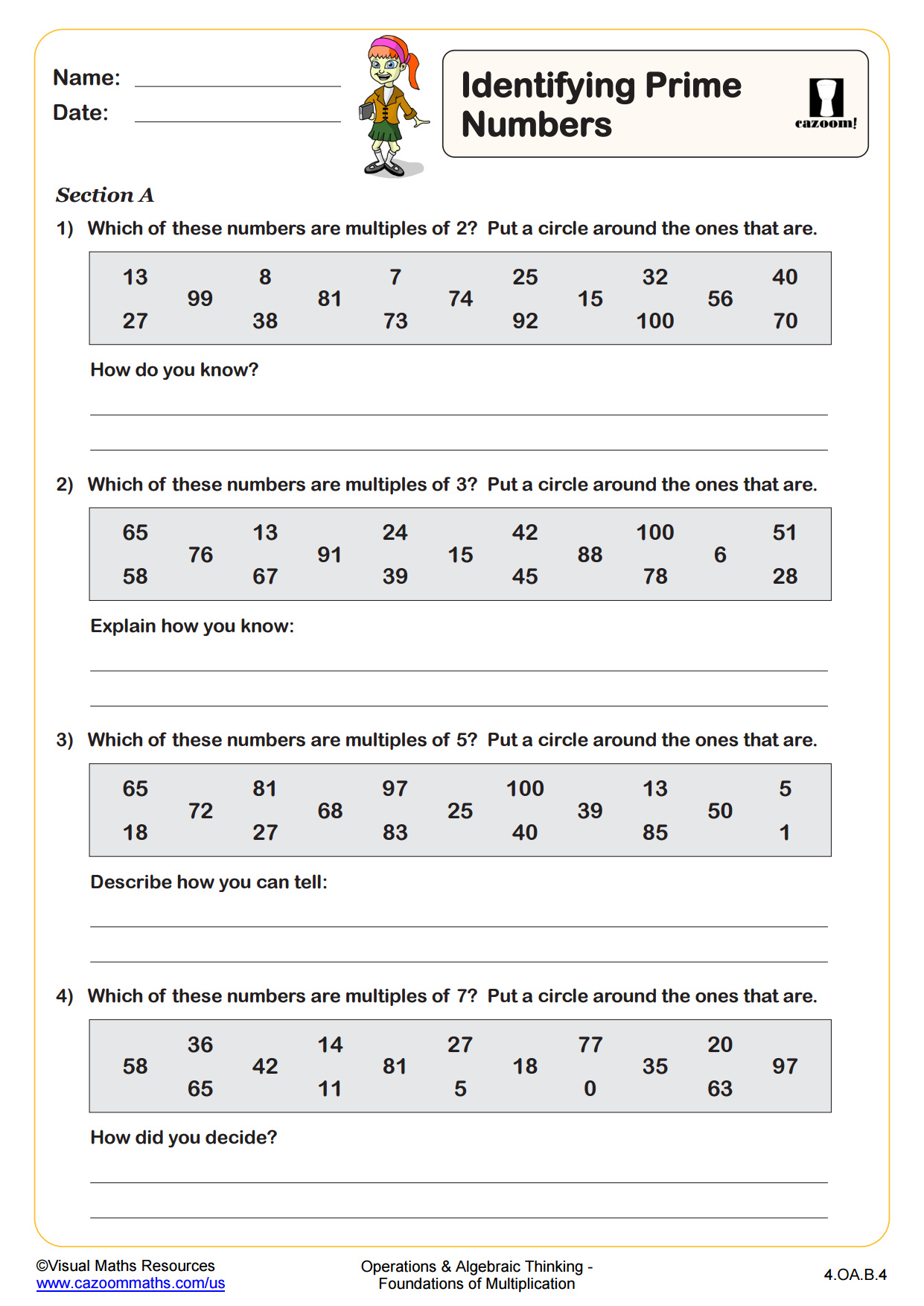
In 4th grade, simplification focuses on breaking numbers down to their simplest components and finding common relationships between them. Students work with prime numbers as the building blocks of all other numbers and learn to identify the lowest common multiple of two or more numbers. These skills prepare students for fraction operations, where finding common denominators becomes necessary.
A common misconception occurs when students confuse prime numbers with odd numbers, assuming that all odd numbers must be prime. Teachers frequently see students incorrectly classify 9, 15, or 21 as prime because they're odd. Providing systematic practice with divisibility rules helps students develop the testing strategies needed to accurately identify primes and understand why 2 is the only even prime number.
What Should 4th Graders Know About Simplification?
Fourth graders should recognize prime numbers up to 50 and understand that prime numbers have exactly two factors: 1 and themselves. They should also find the lowest common multiple of two numbers, typically working with values under 20. According to the Common Core State Standards, students at this level use factors and multiples to solve real-world problems, connecting abstract number concepts to practical applications.
This work builds directly on 3rd grade multiplication and division fluency. Students who have mastered their times tables find identifying multiples much easier, while those still developing automaticity may need additional fact practice alongside simplification worksheets. These 4th grade skills form the foundation for 5th grade fraction addition and subtraction, where finding common denominators relies entirely on LCM understanding.
How Do Students Find the Lowest Common Multiple?
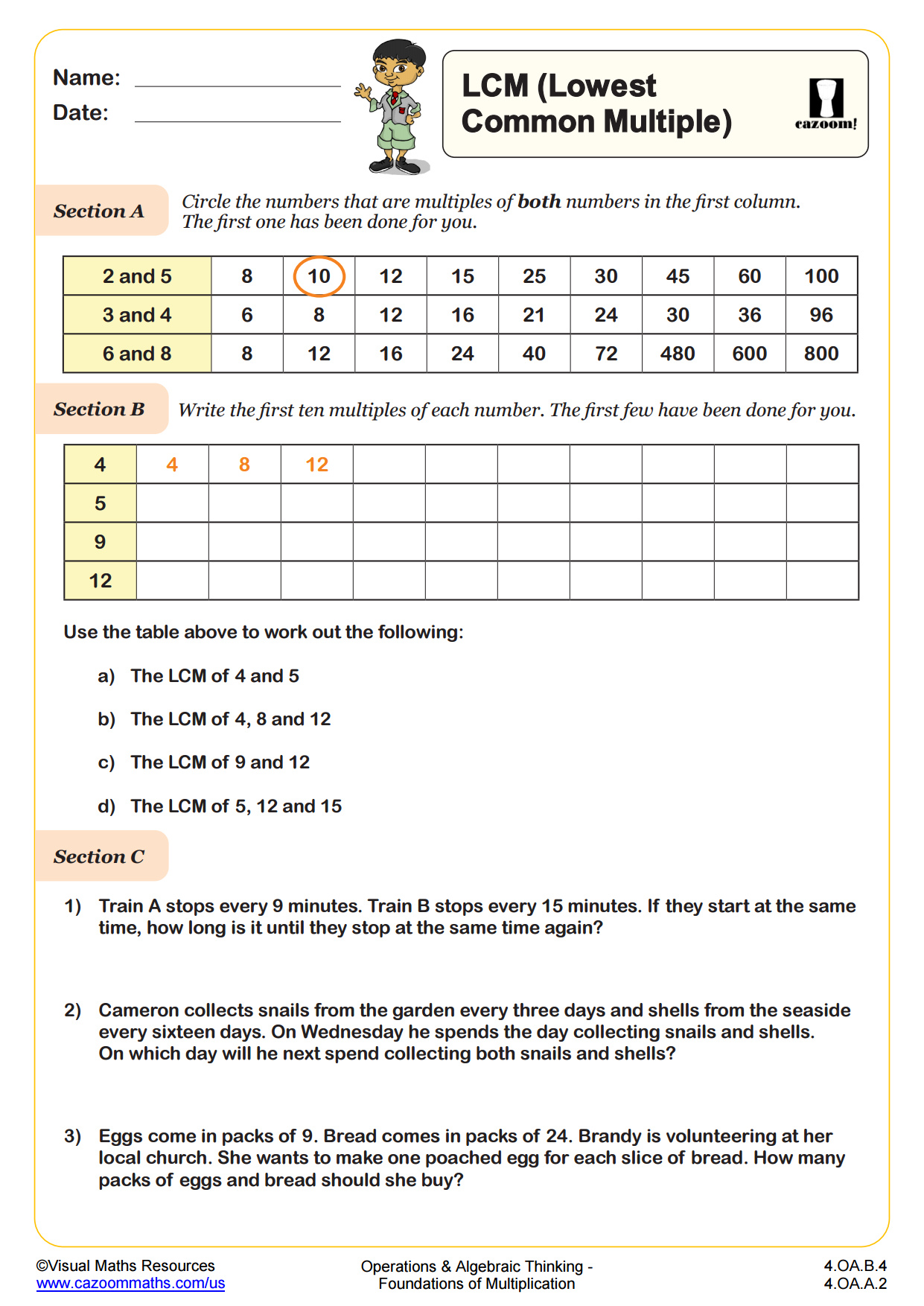
Students typically learn two methods for finding the LCM: listing multiples or using prime factorization. The listing method involves writing out multiples of each number until finding the smallest one they share (for 4 and 6: multiples of 4 are 4, 8, 12, 16; multiples of 6 are 6, 12, 18; so the LCM is 12). Prime factorization requires breaking each number into prime factors, then multiplying the highest power of each prime that appears.
Understanding LCM connects directly to scheduling problems students encounter in real life. When do two buses with different schedules arrive at the same stop together? If one bus comes every 15 minutes and another every 20 minutes, the LCM of 60 tells us they'll both arrive in an hour. Engineers use LCM when synchronizing gears, computer scientists apply it in algorithm design, and musicians rely on it to understand rhythm patterns where different note values align.
How Can Teachers Use These Simplification Worksheets?
These worksheets provide targeted practice for students developing their understanding of prime numbers and LCM. The problems progress systematically, allowing students to build confidence with straightforward examples before tackling more complex number relationships. The included answer keys let students self-check their work during independent practice, which helps them recognize patterns in their errors and adjust their approach without waiting for teacher feedback.
Many teachers use these worksheets during math centers or intervention time when small groups need focused practice on specific skills. They work well as homework assignments because the clear format helps parents understand what their child is learning. Some teachers also find them valuable for warm-up activities at the start of class or as exit tickets to quickly assess whether students have grasped the day's lesson on number relationships and simplification strategies.