4th Grade Space Worksheets
All worksheets are created by the team of experienced teachers at Cazoom Math.
What math skills do students practice with space-themed reflection worksheets?
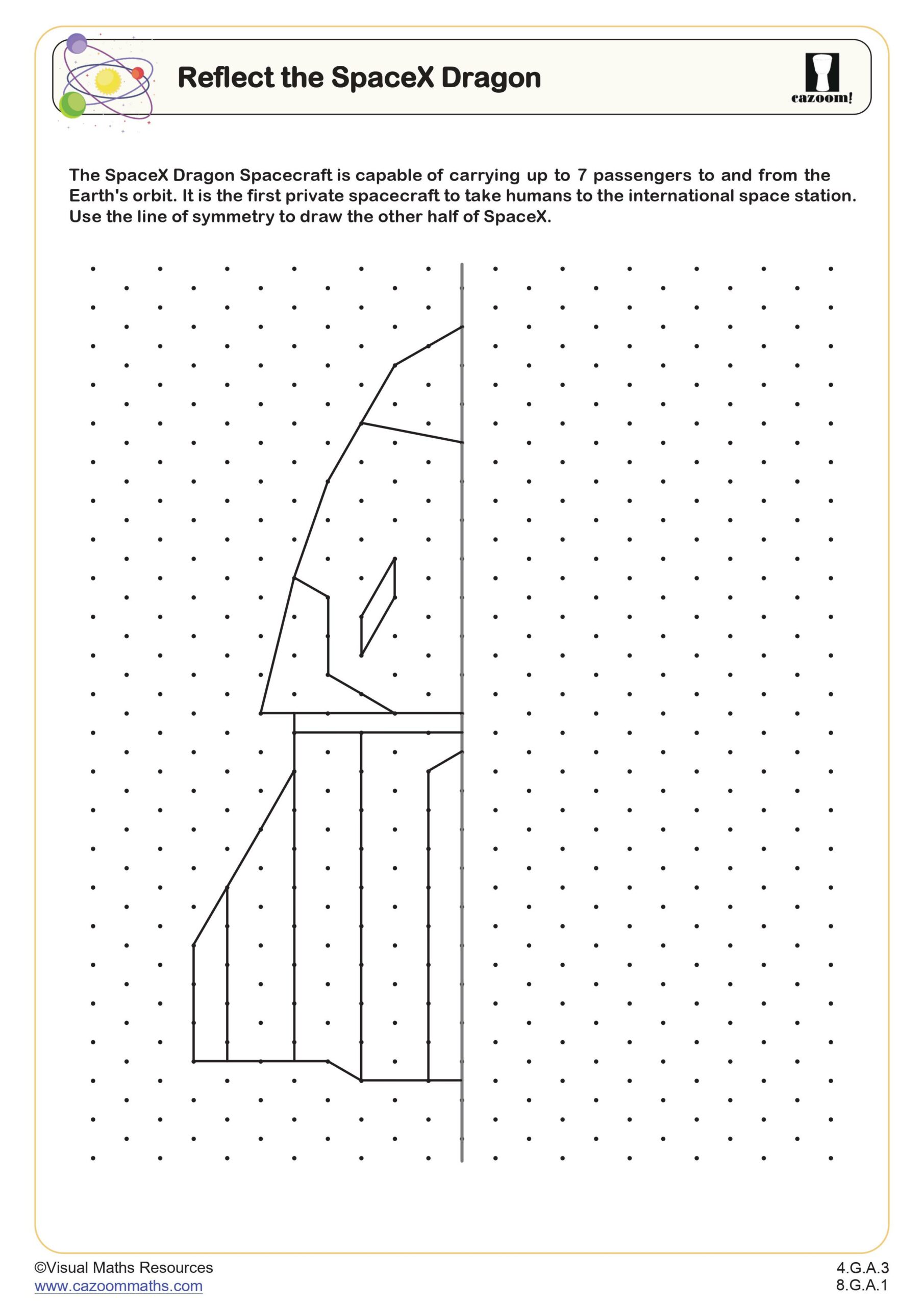
Space-themed reflection worksheets target geometric transformation skills aligned with 4th grade standards, specifically reflecting two-dimensional figures across lines of symmetry. Students identify reflection lines, determine corresponding points, and verify that reflected images maintain the same size and shape as the original figure. The space context reinforces vocabulary like horizontal axis, vertical axis, and coordinate position while making the abstract concept of transformation more concrete.
A common error occurs when students confuse reflection with rotation, particularly when working with asymmetrical shapes. Teachers notice this happens less frequently when worksheets use recognizable images like spacecraft, since students can reference the actual orientation of real objects. The SpaceX Dragon's distinctive features help students check whether their reflection makes sense, building both spatial reasoning and self-checking habits that transfer to other geometry tasks.
What should 4th grade students know about geometric transformations?
By 4th grade, students should recognize and draw lines of symmetry in two-dimensional figures and understand that reflected shapes are congruent to their originals. They identify whether figures have line symmetry and can predict where a reflected image will appear relative to the line of reflection. This builds directly on 3rd grade work with quadrilaterals and develops the foundation for understanding all rigid transformations, not just reflections.
This skill prepares students for 5th grade coordinate geometry, where they'll plot points and describe transformations using ordered pairs. The informal work with reflection in 4th grade establishes spatial reasoning that makes coordinate-based transformations more intuitive later. Students who solidly understand reflection in 4th grade transition more smoothly to working with multiple transformations and combined movements on the coordinate plane in middle school.
How does reflection symmetry apply to spacecraft design?
Reflection symmetry in spacecraft design ensures balanced weight distribution and aerodynamic stability during launch and reentry. Engineers design vehicles like the SpaceX Dragon with intentional symmetry so forces act evenly on both sides of the craft, preventing unwanted spinning or trajectory deviations. Students examining reflected spacecraft images connect mathematical symmetry to practical engineering constraints, understanding that geometry isn't just an abstract exercise but a tool professionals use to solve real problems.
This STEM connection resonates particularly well with students interested in space exploration and engineering careers. Teachers observe that students engage more deeply with reflection concepts when they understand that NASA and private space companies employ mathematicians and engineers who use these exact principles. The connection between classroom geometry and actual spacecraft makes the math feel purposeful, which often translates to increased effort and better retention of transformation concepts throughout the geometry unit.
How can teachers use space reflection worksheets in their classrooms?
These worksheets provide structured practice that moves students from identifying reflection lines to accurately drawing reflected images. The answer keys allow students to self-check their work, building independence and helping teachers quickly identify which students need additional support with transformation concepts. The visual nature of the tasks makes them accessible entry points for students who struggle with purely numerical math while still reinforcing the precise thinking geometry requires.
Many teachers use these worksheets during small group instruction to target students who need extra practice with spatial reasoning, while others assign them as extension activities for students who finish core geometry lessons early. The space theme works well for paired activities where students compare their reflected drawings and discuss any differences, building mathematical communication skills. Some teachers incorporate these worksheets into cross-curricular units on space exploration, reinforcing both science content and mathematical thinking simultaneously.