4th Grade Subtraction Worksheets
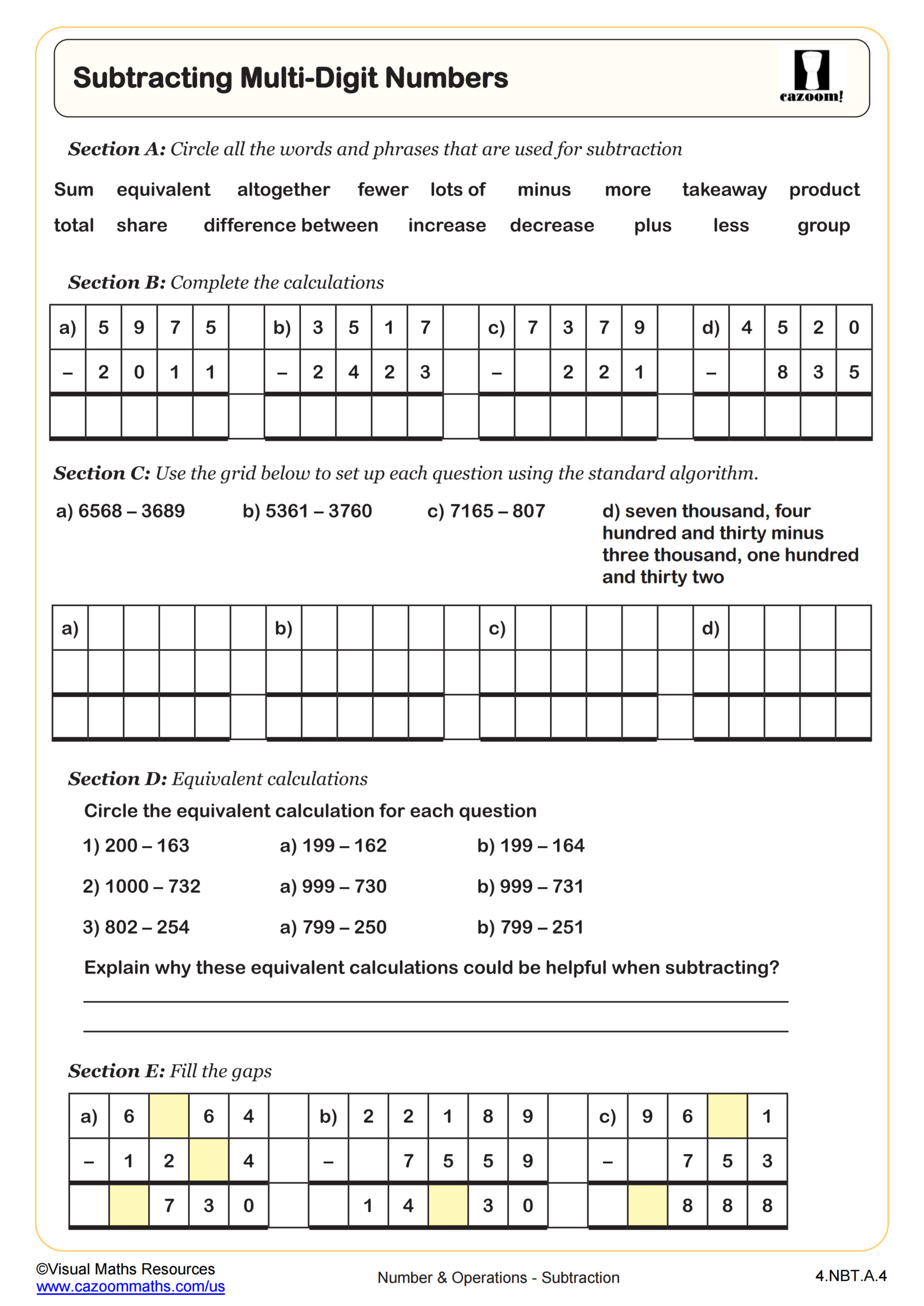
All worksheets are created by the team of experienced teachers at Cazoom Math.
What Are Common Subtraction Mistakes in 4th Grade?
Fourth graders commonly make errors when regrouping across zeros, such as in problems like 5,003 - 2,847. Students often subtract the smaller digit from the larger digit regardless of position, writing 3 - 7 as 4 instead of recognizing the need to regroup. Another frequent mistake involves incomplete regrouping, where students regroup from one place value but forget to reduce that place value by one, leading to incorrect answers that seem plausible at first glance.
Teachers also notice students losing points when they misalign place values, particularly when the subtrahend has fewer digits than the minuend. A student might incorrectly align 8,456 - 327 by placing the 3 under the 4 instead of under the 2. Encouraging students to write numbers in columns with clear place value labels and to circle zeros before starting helps reduce these systematic errors significantly.
What Should 4th Graders Know About Subtraction?
By fourth grade, students should fluently subtract multi-digit whole numbers using the standard algorithm, typically working with numbers up to the ten-thousands place. According to Common Core State Standards (4.NBT.B.4), fourth graders must subtract numbers with regrouping across multiple place values and explain their reasoning using place value understanding. Students at this level should recognize when regrouping is necessary and execute it accurately without relying on manipulatives for every problem.
This skill builds directly on third grade work with three-digit subtraction and prepares students for fifth grade decimal subtraction and fraction operations. Students who master multi-digit subtraction in fourth grade develop the number sense needed for estimating differences, checking reasonableness of answers, and solving multi-step word problems. The procedural fluency gained here also supports algebraic thinking as students begin verifying solutions and working backward from totals in later grades.
How Does the Standard Subtraction Algorithm Work?
The standard algorithm for subtraction works from right to left, starting with the ones place and moving through each place value systematically. When the digit in the minuend is smaller than the corresponding digit in the subtrahend, students regroup by borrowing one unit from the next higher place value, which becomes ten units in the current place. For example, in 4,215 - 1,748, students regroup from the tens place to subtract 8 from 5, turning the 1 ten into 10 ones and reducing the tens place accordingly.
This algorithm appears constantly in real-world contexts, from calculating change in financial transactions to determining distances in navigation systems. Engineers use subtraction algorithms when calculating tolerances in manufacturing, where parts must fit within specific measurements. Budget analysts subtract expenditures from allocations to track remaining funds, and scientists subtract baseline measurements from current readings to determine changes in experiments. Understanding this efficient method prepares students for these practical applications throughout their education and careers.
How Can Teachers Use These Subtraction Worksheets Effectively?
The subtraction worksheets provide structured practice with multi-digit problems that gradually increase in complexity, allowing students to build confidence before tackling more challenging regrouping scenarios. The included answer keys enable students to self-check their work during independent practice, helping them identify error patterns before those misconceptions become ingrained. Teachers can use the answer keys to quickly review student work and pinpoint which place values or regrouping steps need additional instruction.
These materials work well for differentiated instruction, supporting students who need extra practice to achieve grade-level fluency. Many teachers assign worksheets as warm-up activities to maintain skills throughout the year, while others use them during intervention blocks for students who scored below proficient on benchmark assessments. The worksheets also function effectively as homework assignments that parents can support using the answer keys, or as partner activities where students solve problems independently then compare their solution strategies with a classmate.