4th Grade Time Worksheets
All worksheets are created by the team of experienced teachers at Cazoom Math.
Why Do Students Need Practice with Measuring Time?
Time measurement forms a critical bridge between abstract mathematical concepts and practical daily routines. Students apply these skills constantly when reading schedules, planning activities, and understanding duration in contexts from cooking to travel. The Common Core State Standards for 4th grade expect students to solve word problems involving addition and subtraction of time intervals in minutes, moving beyond the simpler clock-reading skills from earlier grades.
Many students lose points on assessments because they forget that time doesn't follow base-ten patterns. When calculating elapsed time from 10:45 to 11:15, students often subtract 45 from 15 and become confused by the negative result, rather than recognizing they need to regroup 60 minutes. Regular practice with varied problem types helps students internalize these unique properties of time measurement and develop reliable strategies for different scenarios.
What Should 4th Graders Know About Time?
By 4th grade, students should confidently read analog and digital clocks, understand the relationships between seconds, minutes, and hours, and calculate elapsed time within and across hours. They're expected to solve multi-step word problems that require determining start times, end times, or duration when given two of these three variables. Students at this level also work with time in mixed units, such as expressing 90 minutes as 1 hour 30 minutes.
This work builds directly on 3rd grade skills where students learned to tell time to the nearest minute and solve simpler one-step problems involving time intervals. The 4th grade focus on measurement conversions and multi-step reasoning prepares students for 5th grade work with decimal operations and more complex unit conversions. Teachers often see significant growth when students connect their understanding of place value and regrouping from whole number operations to the base-60 structure of time.
How Do Students Calculate Elapsed Time Across Hours?
Calculating elapsed time becomes more complex when intervals cross hour boundaries, requiring students to think strategically about breaking problems into manageable parts. The most reliable approach involves splitting the calculation: first finding how many minutes remain until the next hour, then adding any complete hours, and finally adding remaining minutes. For example, finding elapsed time from 2:45 PM to 5:20 PM means calculating 15 minutes to reach 3:00, then 2 full hours to 5:00, then 20 more minutes.
This skill connects directly to real-world scheduling and time management, from calculating flight durations across time zones to determining cooking times for recipes with multiple stages. In STEM fields, precise time measurement matters for experiments, data collection intervals, and understanding rates of change. Students who master elapsed time calculations develop stronger number sense around non-decimal systems, a foundation they'll use later with angles measured in degrees and minutes.
How Can Teachers Use These Time Worksheets Effectively?
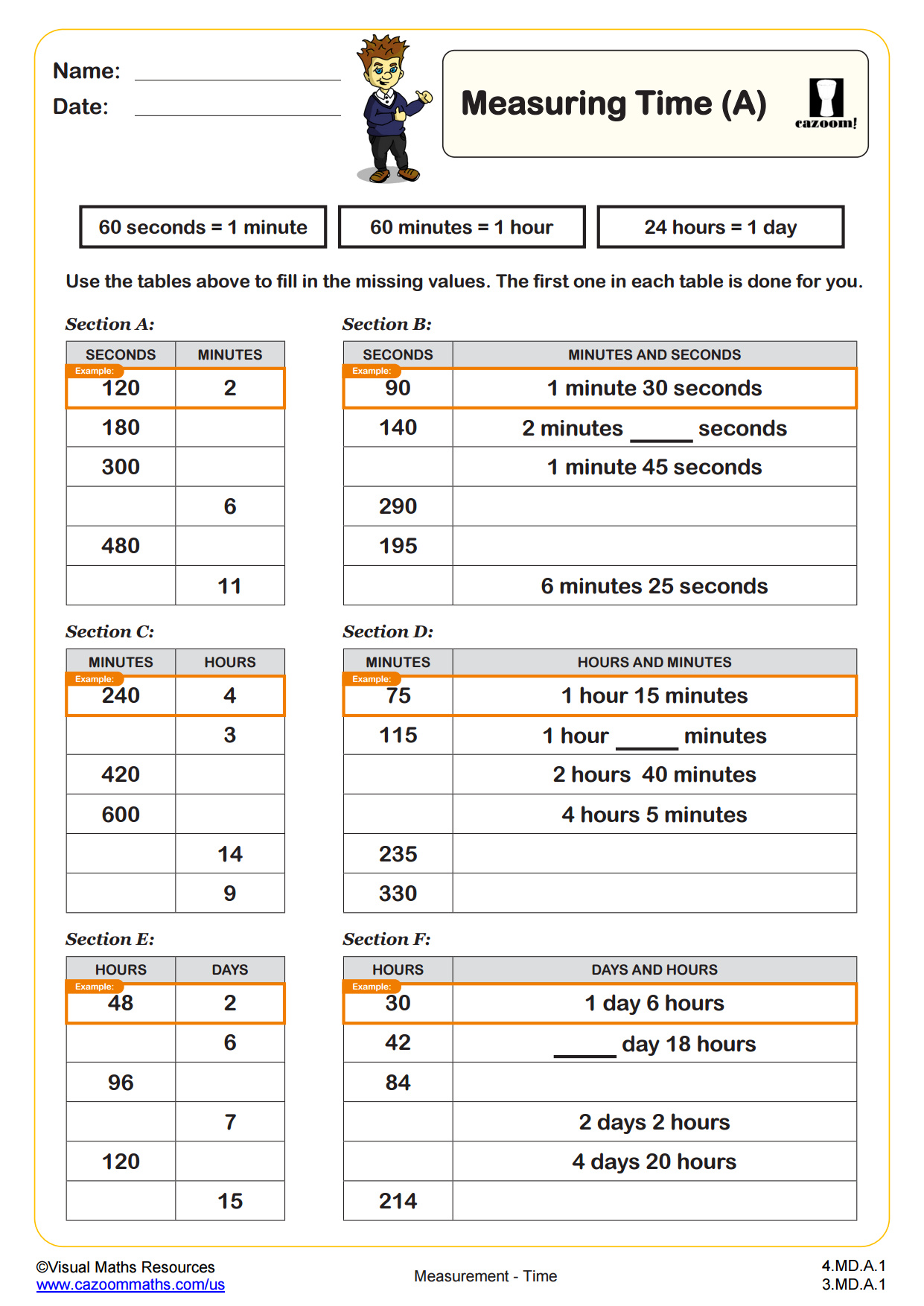
The time worksheet provides structured practice with measuring time intervals and converting between time units, allowing students to develop procedural fluency alongside conceptual understanding. Problems typically progress from straightforward calculations within a single hour to more challenging scenarios that require regrouping and strategic thinking. The included answer key allows teachers to quickly identify whether errors stem from calculation mistakes, conceptual misunderstandings about time structure, or difficulty translating word problems into mathematical operations.
These worksheets work well as targeted intervention for students who struggle with time concepts during broader measurement units, as independent practice after direct instruction, or as homework that reinforces classroom learning. Teachers often use them in paired activities where students solve problems individually then compare their solution strategies, revealing that there are multiple valid approaches to elapsed time problems. The immediate feedback from answer keys helps students self-correct and recognize patterns in their errors, particularly the common mistake of treating time like base-ten numbers.