5th Grade Operations and Algebraic Thinking Worksheets
All worksheets are created by the team of experienced teachers at Cazoom Math.
What concepts are covered in operations and algebraic thinking grade 5 worksheets?
Operations and algebraic thinking grade 5 worksheets focus on three main Common Core domains: writing and interpreting numerical expressions, analyzing patterns and relationships, and applying order of operations. Students work with expressions that include parentheses, brackets, and braces while learning to translate verbal phrases into mathematical symbols.
Teachers frequently observe that students confuse the phrases "sum of" and "product of" when writing expressions, often defaulting to addition regardless of the context. These worksheets provide systematic practice with various expression types, helping students recognize key vocabulary that signals specific operations and building their confidence with algebraic thinking skills needed for middle school mathematics.
How do 5th grade algebraic thinking skills prepare students for middle school math?
Fifth grade algebraic thinking creates the foundation for formal algebra by introducing students to variables, expressions, and pattern recognition in age-appropriate contexts. Students learn to see relationships between numbers and operations, which directly supports their understanding of equations and inequalities in grades 6-8.
Many teachers notice that students who master these algebraic reasoning concepts in elementary school demonstrate greater confidence when tackling linear equations and functions later. The transition becomes smoother because they already understand how to manipulate expressions and recognize mathematical relationships, rather than viewing algebra as an entirely new subject when they reach middle school.
Why do students struggle with order of operations in algebraic expressions?
Students often struggle with order of operations because they apply a left-to-right reading approach to mathematical expressions, ignoring the hierarchical rules that govern calculation sequences. Many fifth graders initially solve expressions like 3 + 4 × 2 as 14 instead of 11, treating the expression as a simple left-to-right calculation.
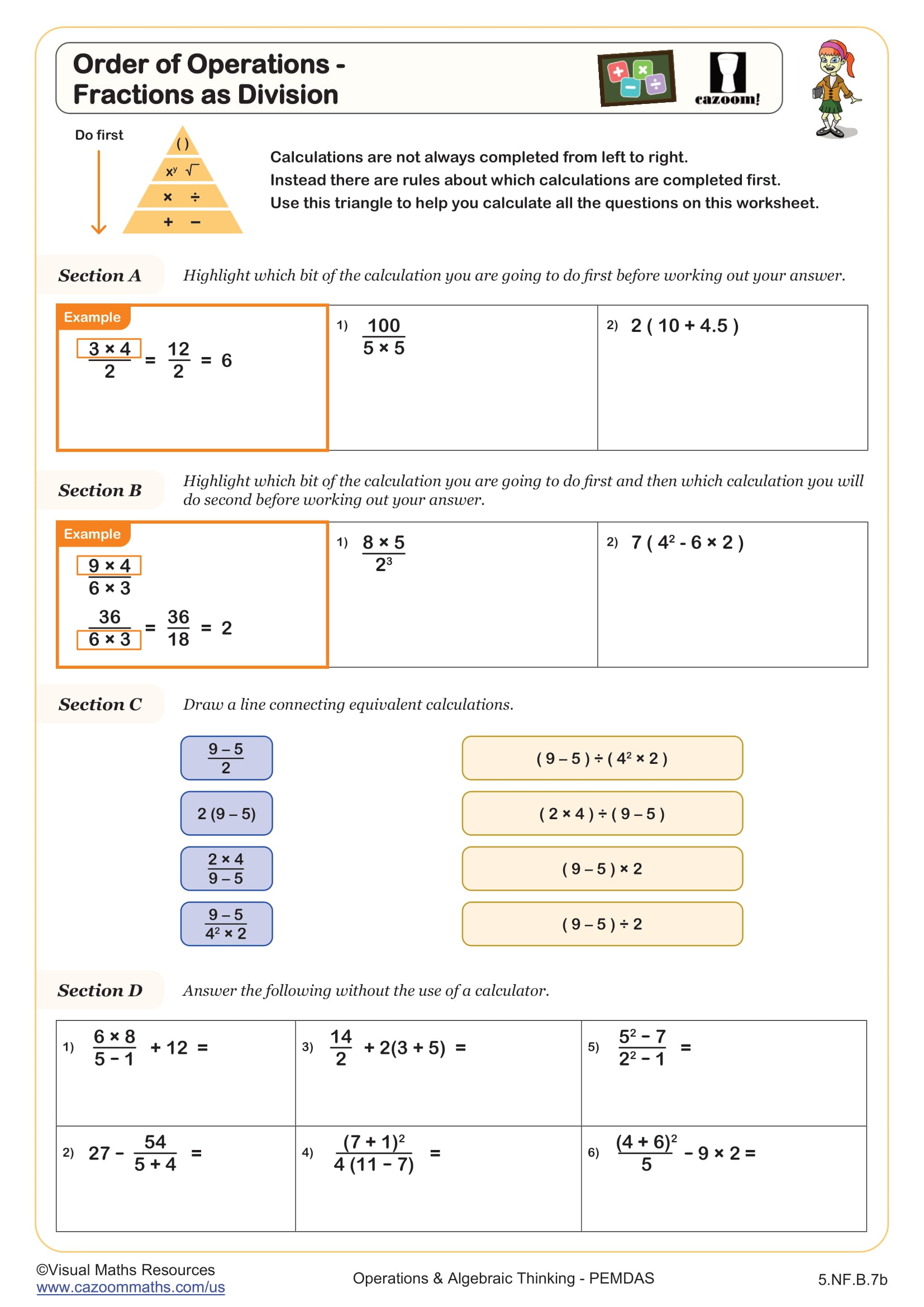
Classroom observations reveal that students benefit from consistent use of memory devices and visual strategies like underlining or color-coding different operation levels. These algebra and algebraic thinking 5th grade worksheets provide scaffolded practice that helps students internalize PEMDAS through repeated exposure to increasingly complex expressions, building both accuracy and automaticity with this critical skill.
How can teachers use these algebraic thinking worksheets most effectively?
Teachers find the most success when they introduce these worksheets gradually, starting with simpler expressions and building complexity over time. The included answer keys allow for immediate feedback during guided practice sessions, helping teachers identify and address misconceptions before they become ingrained habits.
Effective implementation often involves pairing worksheet practice with hands-on activities like using algebra tiles or real-world problems from engineering and computer programming contexts. Teachers report that students retain algebraic thinking concepts better when they can connect abstract expressions to concrete situations, making the transition from arithmetic to algebraic reasoning feel more natural and purposeful.