5th Grade Position and Direction Worksheets
All worksheets are created by the team of experienced teachers at Cazoom Math.
What Are Position and Direction Skills in 5th Grade Math?
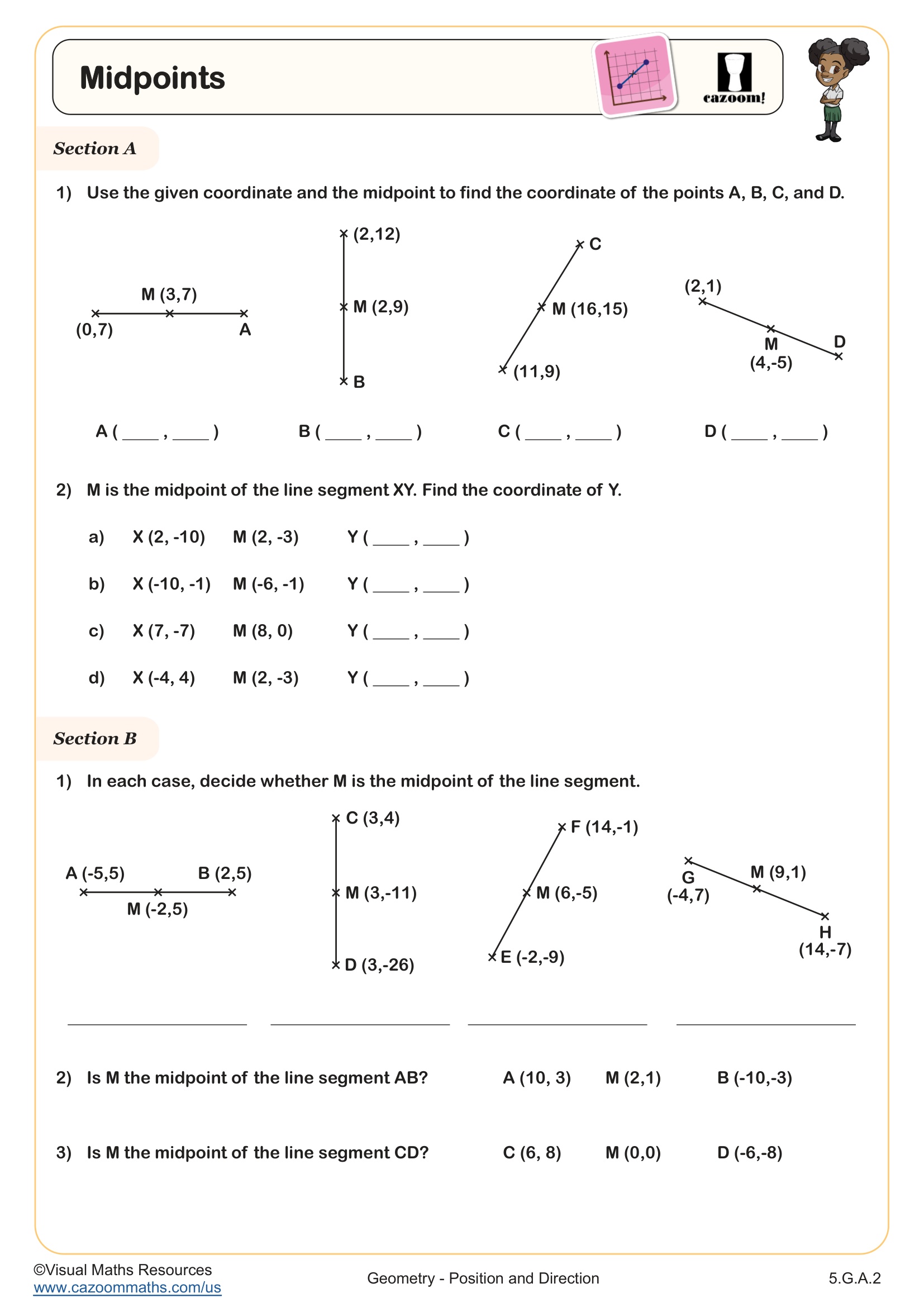
Position and direction skills in 5th grade focus on understanding numerical relationships on a number line and preparing students for work with coordinate planes in later grades. Students learn to identify positions between two points, calculate distances, and determine midpoints, which reinforces their understanding of fractions, decimals, and whole numbers in spatial contexts.
The midpoint concept specifically addresses Common Core standard 5.G.A.1 as students develop fluency with the coordinate system. Many students lose points on assessments when they confuse finding the midpoint with finding the distance between two numbers. Teachers can address this by having students visualize the number line and asking, "What number is exactly halfway between these two values?" rather than immediately applying a formula.
What Should 5th Graders Know About Finding Midpoints?
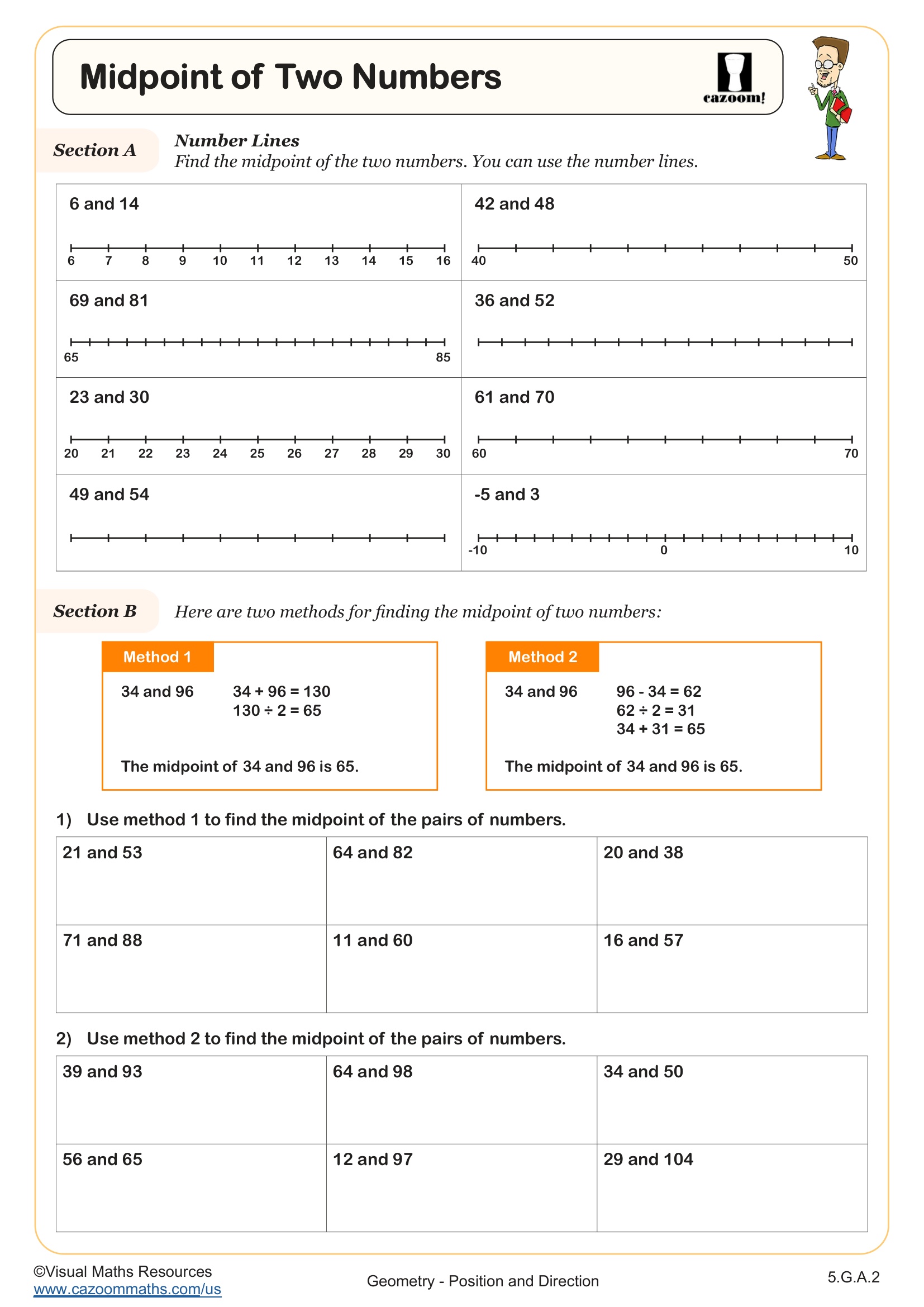
By 5th grade, students should understand that a midpoint divides a segment into two equal parts and represents the average of two numbers. They should be able to find midpoints with whole numbers confidently and begin working with decimals and simple fractions. This skill requires solid addition and division skills, as students must add two numbers and divide by two to find the midpoint.
This concept builds directly on 4th grade work with factors, multiples, and number patterns while preparing students for 6th grade coordinate plane work. Students who master midpoints on a number line transition more smoothly to finding midpoints between coordinate pairs. Teachers notice that students who struggle often need to revisit division by two and understanding of averages before the midpoint concept clicks.
How Do Students Calculate Midpoints Between Two Numbers?
To find the midpoint between two numbers, students add the two values together and divide the sum by two. For example, the midpoint between 8 and 14 is (8 + 14) ÷ 2 = 11. Students should verify their answer by checking that the distance from each original number to the midpoint is equal. A breakthrough typically happens when students recognize this as finding the average, connecting it to their work with mean in data analysis.
This skill appears frequently in real-world applications, particularly in measurement and design contexts. Engineers use midpoints when finding center points for construction projects, and computer programmers use midpoint calculations in graphics and game design. GPS systems calculate midpoints to find meeting locations equidistant between two addresses, making this mathematical concept directly relevant to everyday technology students use.
How Can Teachers Use These Position and Direction Worksheets?
These worksheets provide structured practice with midpoint problems that gradually increase in complexity, allowing students to build confidence with whole numbers before moving to more challenging decimal values. The answer keys let teachers quickly identify whether errors stem from calculation mistakes or conceptual misunderstandings about what a midpoint represents, enabling more targeted intervention.
Many teachers use these worksheets during math centers or for differentiated small group instruction, pairing students who grasp the concept quickly with those who need additional support. The worksheets work well as warm-up activities before coordinate plane lessons or as review before state assessments that test spatial reasoning. Teachers also assign these for homework when students demonstrate readiness for independent practice, as the answer keys help families support learning at home.