5th Grade Statistics Worksheets
All worksheets are created by the team of experienced teachers at Cazoom Math.
What skills do 5th grade data analysis worksheets target?
These worksheets focus on the complete data analysis process outlined in Common Core standard 5.MD.2, including collecting data through surveys and observations, organizing information in tables and charts, and creating appropriate graphical displays. Students practice interpreting data worksheet grade 5 concepts by analyzing patterns, trends, and making predictions based on their findings.
Teachers notice that students often rush through the interpretation phase without carefully examining their graphs for meaningful insights. The worksheets emphasize asking questions like "What does this data tell us?" and "What patterns do we notice?" to develop deeper analytical thinking skills that extend beyond simply plotting points.
How do these worksheets prepare students for middle school mathematics?
Grade 5 statistics worksheets establish the foundation for more complex statistical concepts students encounter in sixth and seventh grade, particularly measures of center and variability. The data organization and graphing skills practiced here directly support future work with histograms, box plots, and statistical analysis.
Many teachers find that students who master data interpretation in fifth grade show greater confidence when tackling probability concepts and more sophisticated statistical reasoning in middle school. The emphasis on asking analytical questions about data sets prepares students for the critical thinking required in advanced mathematics courses.
What types of graphs do fifth graders learn to create and interpret?
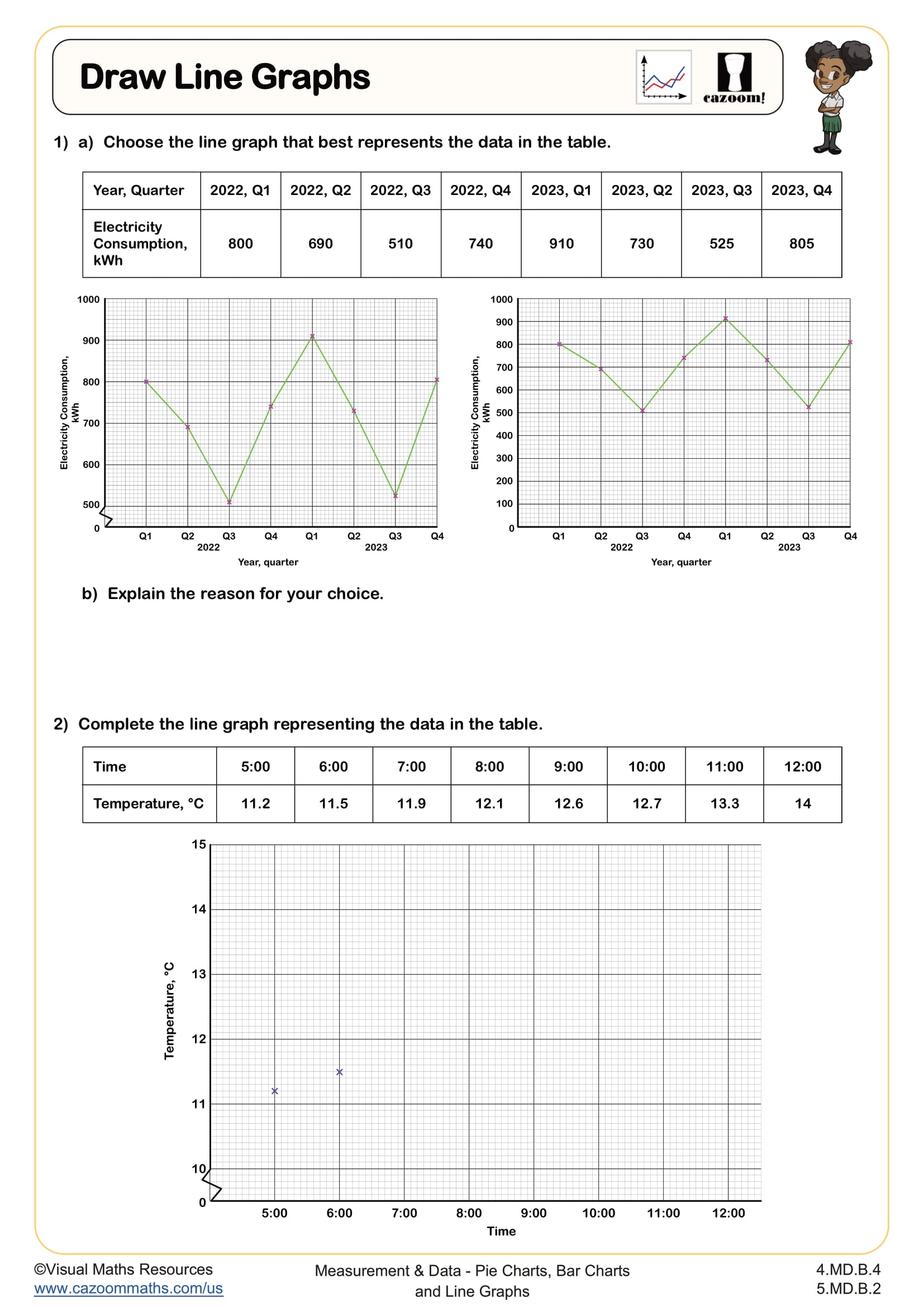
Students work with line graphs to show change over time, bar graphs for comparing categories, and stem-and-leaf plots for organizing numerical data. The worksheets also introduce coordinate graphing concepts that bridge into algebraic thinking, helping students plot points and understand relationships between variables.
Teachers frequently observe that students confuse when to use different graph types, often defaulting to bar graphs for all situations. The worksheets provide clear decision-making frameworks, helping students understand that line graphs work best for continuous data over time while bar graphs excel at comparing distinct categories or groups.
How can teachers use these worksheets most effectively in their classrooms?
These worksheets work well as both individual practice and collaborative activities where students can compare their data interpretations and discuss different perspectives on the same data set. Teachers often use them as formative assessments to identify students who need additional support with scale selection or graph interpretation.
Many educators find success pairing these worksheets with real classroom data collection projects, such as tracking daily temperatures or surveying classmates about preferences. This connection between worksheet practice and authentic data experiences helps students see the practical applications of statistics grade 5 concepts in science experiments and social studies research.