5th Grade Time Worksheets
All worksheets are created by the team of experienced teachers at Cazoom Math.
Why Do Students Need to Practice Time Conversions in 5th Grade?
Time conversions form a bridge between basic time-telling skills from earlier grades and the more complex measurement work students encounter in middle school. By 5th grade, students should move beyond reading analog clocks to understanding relationships between different time units. This skill aligns with Common Core Standard 5.MD.A.1, which requires students to convert among different-sized measurement units within a given measurement system.
Students often lose points on assessments when they multiply instead of divide, particularly when converting from smaller units (minutes) to larger units (hours). The key teaching moment happens when students recognize the pattern: converting to a smaller unit means more of them, so multiply; converting to a larger unit means fewer of them, so divide. This conceptual understanding prevents the common error of choosing the wrong operation based solely on whether the numbers should get bigger or smaller.
What Should 5th Graders Know About Time Measurement?
Fifth graders should fluently convert between minutes and hours, understanding that 60 minutes equals one hour and applying multiplication or division to make these conversions accurately. Students at this level work with whole numbers and begin encountering problems that require expressing answers in mixed units, such as 90 minutes equals 1 hour and 30 minutes. They should also solve word problems involving elapsed time and time conversions without relying on counting strategies from earlier grades.
This work builds directly on 4th grade understanding of relative sizes of measurement units and prepares students for 6th grade ratio and proportion work. Many teachers notice that students who master time conversions in 5th grade find it easier to tackle conversions between seconds, minutes, and hours in middle school science classes, where precise time measurements become necessary for calculating rates, speeds, and experimental durations.
How Do Students Convert Minutes to Hours?
Converting minutes to hours requires dividing by 60 since there are 60 minutes in one hour. For example, 180 minutes ÷ 60 = 3 hours. When the division doesn't result in a whole number, students express the answer as a mixed measurement: 150 minutes becomes 2 hours and 30 minutes (150 ÷ 60 = 2 remainder 30). The remainder represents the leftover minutes that don't make a complete hour.
This skill connects directly to scheduling and time management in STEM fields and everyday contexts. Scientists converting experiment durations, engineers calculating project timelines, and nurses administering medication on specific time intervals all rely on accurate time conversions. Students grasp the practical importance when teachers present scenarios like calculating how many hours of video game time they've earned after accumulating 240 minutes, or determining arrival times for trips when given travel duration in minutes rather than hours.
How Can Teachers Use These Time Conversion Worksheets?
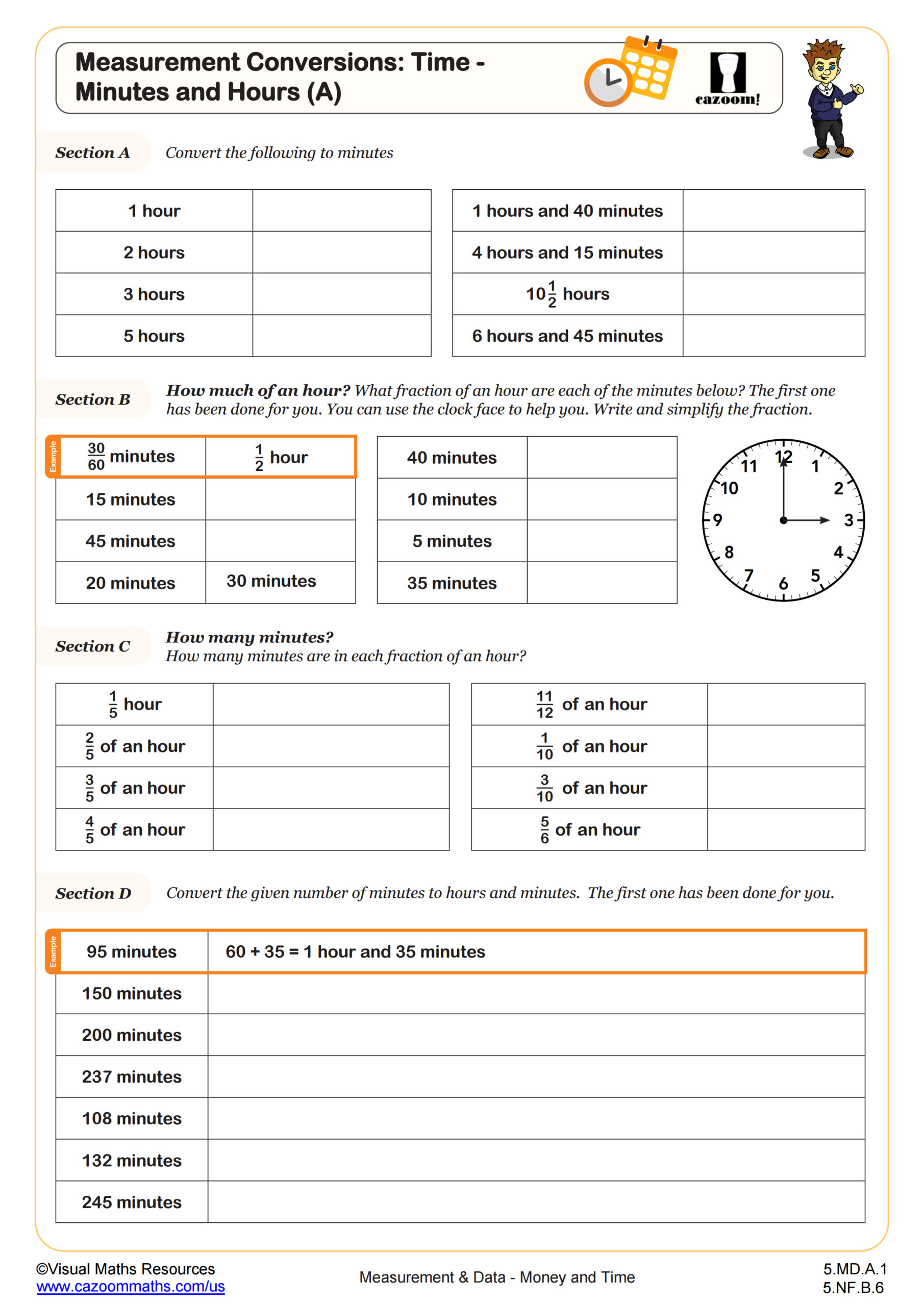
The worksheets provide structured practice with converting between minutes and hours, featuring problems that gradually build from straightforward conversions to those requiring more reasoning. The included answer keys allow teachers to quickly check student work and identify specific error patterns, such as consistently multiplying when they should divide or incorrectly handling remainders when minutes don't convert evenly into whole hours.
Many teachers use these worksheets during small group instruction to address specific conversion difficulties, or as independent practice after introducing the concept through hands-on activities with analog clocks. The format works well for homework assignments since parents can reference the answer key to support their child's learning. Teachers also find these useful as quick formative assessments before unit tests, or as targeted intervention for students who performed poorly on measurement conversion questions during benchmark assessments.