6th Grade Describe and Compare Shapes Worksheets
All worksheets are created by the team of experienced teachers at Cazoom Math.
What Are Nets and Why Do 6th Graders Study Them?
Nets are two-dimensional patterns that fold into three-dimensional shapes, showing all faces of a solid laid flat in connected arrangement. In 6th grade, students work with nets as part of Common Core Standard 6.G.A.4, which requires them to represent three-dimensional figures using nets and use those representations to find surface area. This skill develops the spatial reasoning necessary for higher-level geometry and real-world applications in design and engineering.
Students often make the mistake of assuming any arrangement of connected faces will form a valid net, but specific edge connections determine whether a pattern actually folds correctly. Teachers notice that hands-on activities like physically cutting and folding paper nets dramatically improve student understanding, especially for those who struggle with purely visual tasks. State assessments regularly include problems requiring students to identify which net corresponds to a given prism or pyramid, making this a tested skill worth mastering.
What Should 6th Grade Students Know About Describing and Comparing Shapes?
By 6th grade, students should fluently identify and classify three-dimensional figures including prisms, pyramids, cylinders, cones, and spheres based on their properties. They need to recognize how many faces, edges, and vertices each shape has, distinguish between lateral faces and bases, and understand the relationship between a solid's net and its surface area. This knowledge extends beyond simple identification to analytical comparison of shape characteristics.
This work builds directly on 5th grade standards where students classified two-dimensional figures in hierarchies and represents the foundation for 7th and 8th grade geometry involving surface area, volume, and cross-sections. Students who master nets in 6th grade find surface area calculations significantly easier because they can visualize all faces simultaneously. Many teachers find that students make the strongest progress when they connect net patterns to familiar objects like cereal boxes and gift wrap, creating tangible references for abstract geometric concepts.
How Do Students Identify Whether a Net Will Form a Specific Shape?
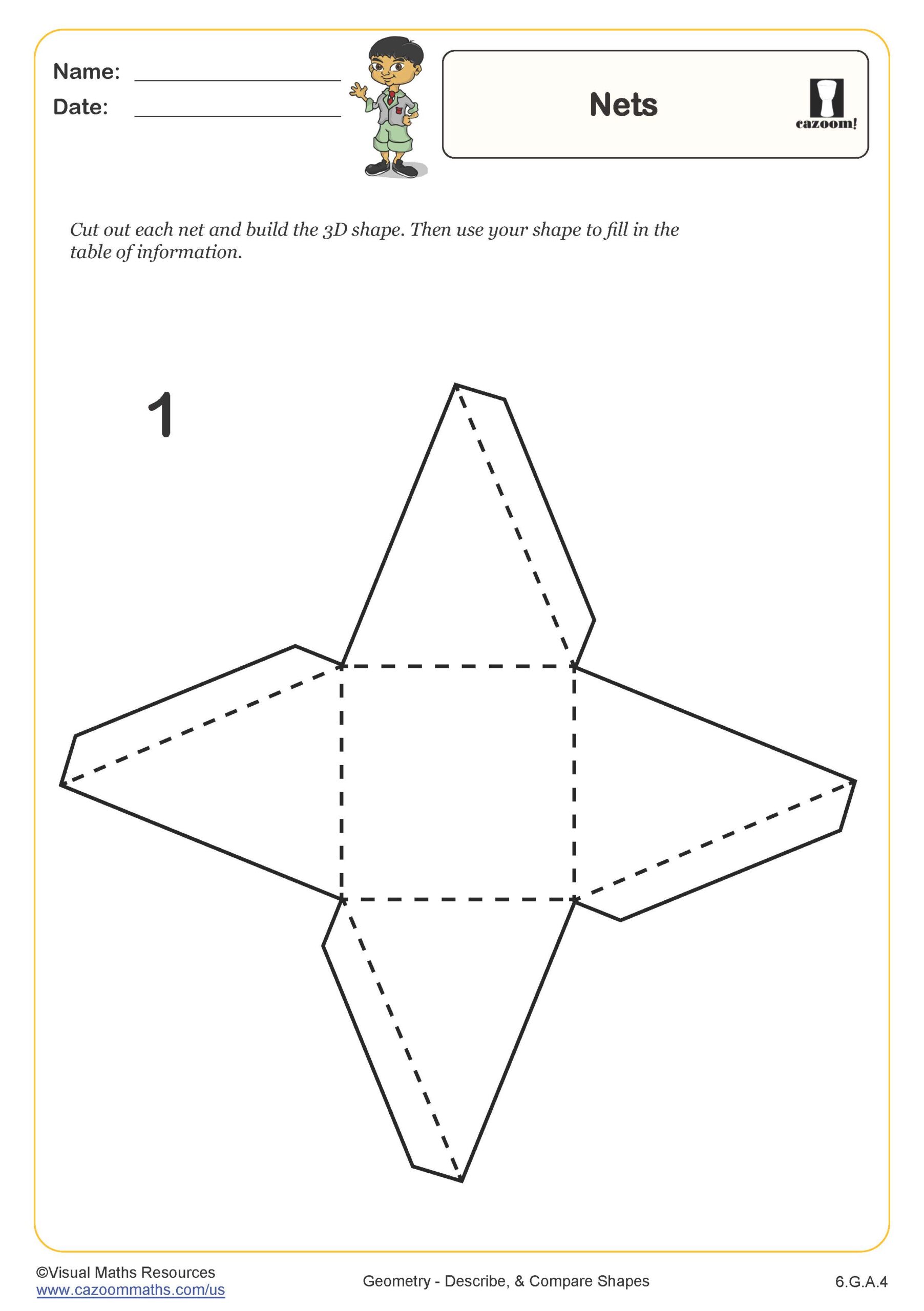
To determine if a net correctly forms a particular three-dimensional shape, students must count faces and analyze their arrangement, ensuring the pattern includes the right number of polygons in the proper configuration. For a rectangular prism, the net needs six rectangles arranged so opposite faces are congruent; for a square pyramid, one square base with four congruent triangular faces connected to its edges. Students learn to mentally fold the net, tracking which edges will join together and whether the resulting solid matches the target shape.
This skill connects directly to package design, a billion-dollar industry where engineers create efficient nets that minimize material waste while ensuring structural integrity. Architecture and manufacturing rely on net analysis when fabricating sheet metal components, designing pop-up structures, or creating flat-pack furniture. Students who understand nets develop stronger problem-solving abilities in STEM fields, as they can visualize how flat materials transform into functional three-dimensional objects, a skill used in everything from aerospace engineering to medical device design.
How Can Teachers Use These Worksheets Most Effectively?
The worksheets provide focused practice in visualizing and analyzing nets, with problems that progress from straightforward identification to more complex comparison tasks. Complete answer keys allow teachers to quickly check student work and identify common errors, particularly the tendency to approve invalid nets that appear correct but won't actually fold properly. The structured format helps students develop systematic approaches to analyzing whether faces are positioned correctly for folding.
Many teachers use these worksheets during intervention periods for students who need additional practice before surface area units, as net fluency prevents confusion later. They work well as warm-up activities to maintain spatial reasoning skills throughout the year, not just during geometry units. Pairing students for worksheet completion encourages mathematical discussion as partners explain their reasoning about why specific nets will or won't work. Teachers also assign these as homework to reinforce classroom lessons with hands-on cutting and folding activities, bridging abstract visualization with physical manipulation.