6th Grade Inequalities Worksheets
All worksheets are created by the team of experienced teachers at Cazoom Math.
What Are Inequalities and Why Do Students Learn Them in 6th Grade?
Inequalities are mathematical statements that compare two expressions using symbols like < (less than), > (greater than), ≤ (less than or equal to), and ≥ (greater than or equal to). In 6th grade, students transition from working exclusively with equations that have single solutions to understanding that inequalities represent ranges of values. This aligns with Common Core Standard 6.EE.B.8, which expects students to write, read, and graph inequalities in real-world contexts.
Many teachers observe that students initially treat inequality symbols like equal signs, trying to find one specific answer rather than recognizing the infinite solutions that satisfy the statement. The breakthrough typically happens when students connect inequality notation to number line representations, where they can visually see that shading extends in one direction to capture all possible solutions. Students lose points on assessments when they use closed circles for strict inequalities or shade in the wrong direction.
What Should 6th Grade Students Know About Inequalities?
At the 6th grade level, students should understand how to read inequality statements, determine whether specific values make an inequality true, and represent solutions on a number line using appropriate notation. They should recognize that x > 3 means "all numbers greater than 3" and know when to use open circles (for > and <) versus closed circles (for ≥ and ≤). Students should also translate real-world situations into inequality statements, such as "you must be at least 48 inches tall to ride" becoming h ≥ 48.
This work builds directly on 5th grade understanding of the number line and coordinate systems, while preparing students for 7th grade when they'll solve inequalities algebraically and graph them on coordinate planes. Students who master inequality representation in 6th grade find it significantly easier to handle compound inequalities and systems of inequalities in algebra courses. The visual foundation established through number line work becomes the mental framework for more abstract algebraic manipulation.
How Do Students Graph Inequalities on a Number Line?
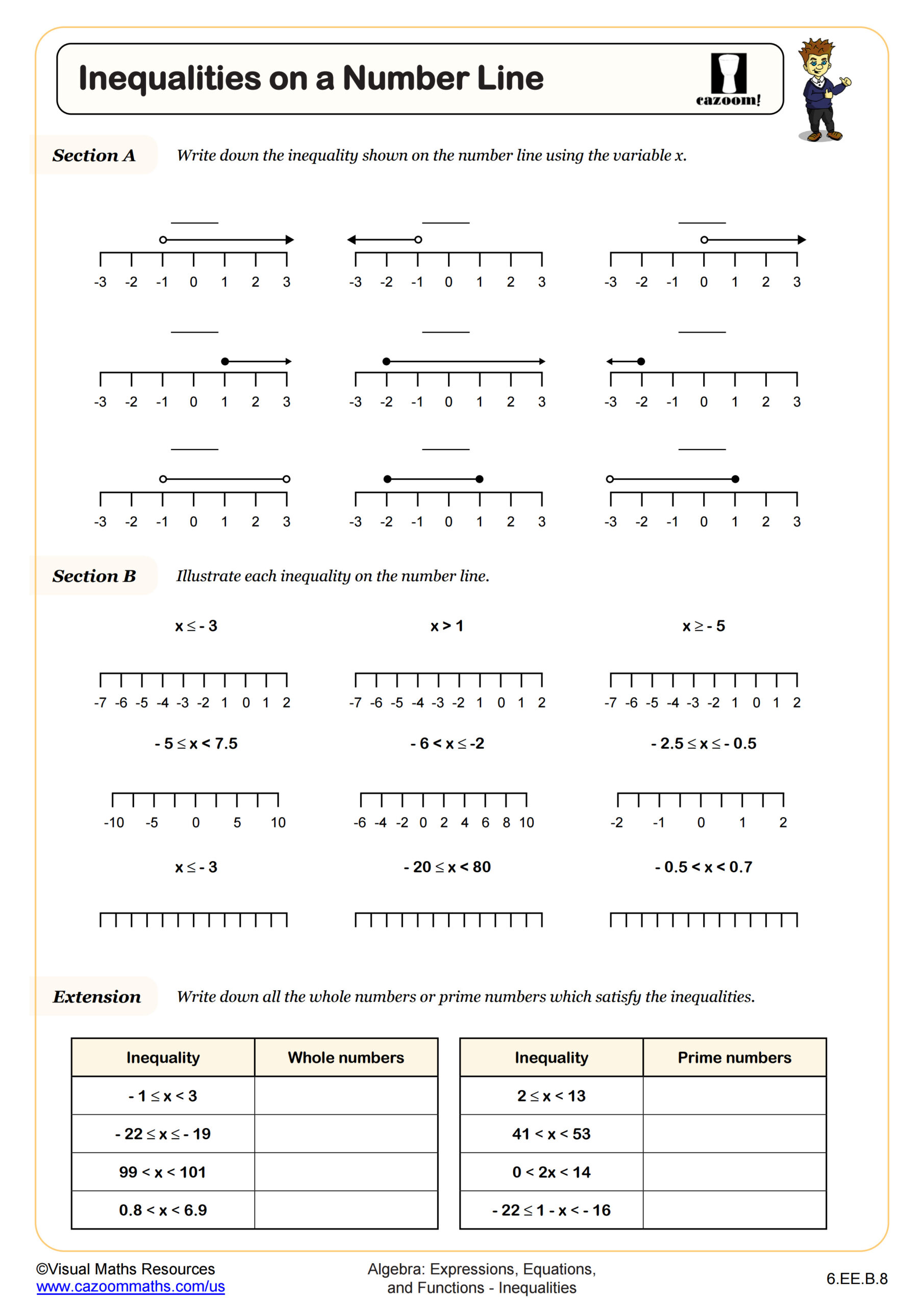
Graphing inequalities on a number line requires students to identify the boundary value, determine whether that value is included in the solution set, and shade the appropriate direction. For x ≤ 5, students place a closed (filled) circle at 5 because 5 is part of the solution, then shade left to show all numbers less than 5 also work. For x > -2, they use an open (unfilled) circle at -2 and shade right. Teachers notice that students confidently tackle graphing once they recognize the mnemonic that "equal" in the symbol (≤ or ≥) means a "filled-in" circle.
This skill connects to real-world constraints students encounter daily. Speed limits represent inequalities (drive less than or equal to 55 mph), as do age restrictions, weight capacities, and budget constraints. In STEM fields, engineers use inequalities to define acceptable ranges for measurements, tolerances, and safety margins. Understanding that real-world situations rarely have exact single answers prepares students for scientific thinking where conditions must fall within specific parameters.
How Can Teachers Use These Inequality Worksheets in the Classroom?
These worksheets provide structured practice with number line representations, allowing students to develop accuracy with inequality notation before moving to more abstract algebraic solving. The problems progress from identifying whether given values satisfy an inequality to graphing solutions independently, giving students multiple entry points regardless of their comfort level. Having answer keys available lets teachers quickly identify which students confuse symbol direction or circle notation, enabling targeted intervention before summative assessments.
Many teachers use these worksheets during small group instruction to address specific misconceptions revealed during whole-class lessons. They work well as warm-up activities to maintain skills throughout the unit or as homework assignments that parents can support using the answer keys. Some teachers find success assigning worksheets for paired work, where students must justify their graphing decisions to a partner, forcing them to articulate why they chose open versus closed circles and which direction to shade. This verbalization often solidifies understanding more effectively than independent silent practice.