6th Grade Rearranging Equations Worksheets
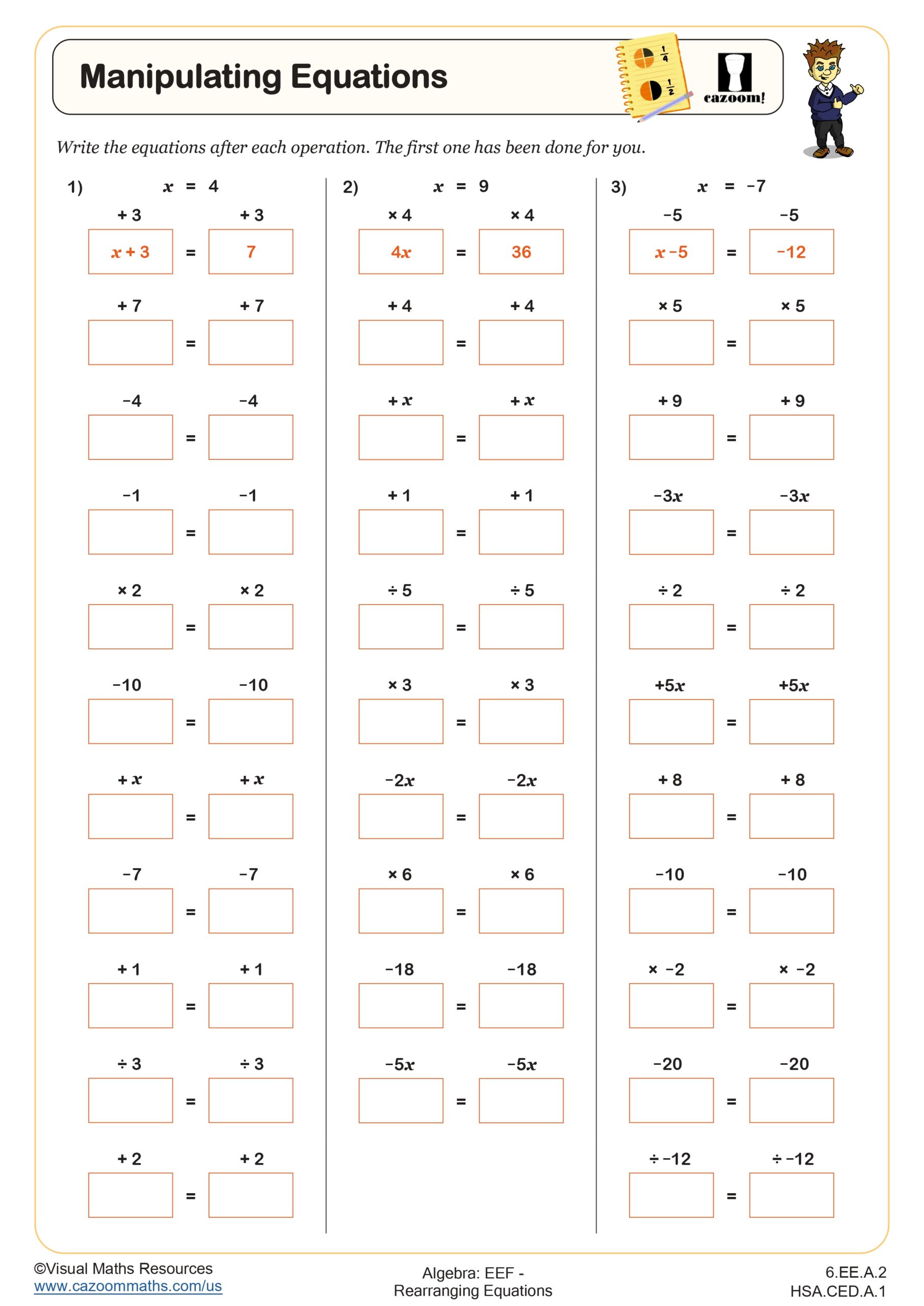
All worksheets are created by the team of experienced teachers at Cazoom Math.
What Does Rearranging Equations Mean in 6th Grade Math?
Rearranging equations means changing the form of an equation to isolate a specific variable or term without altering the equation's truth. In 6th grade, this typically involves using inverse operations to move numbers or variables from one side of the equals sign to the other while keeping both sides balanced. Students learn that whatever operation they perform on one side must also be performed on the other side to maintain equality.
A common error students make is treating the equals sign as a "do something" symbol rather than a statement of balance. Many students initially want to subtract only from the left side when isolating a variable, forgetting that the equation represents an equal relationship. Teachers frequently find success by using balance scale visuals or physically modeling with manipulatives to reinforce that both sides must change identically to preserve the equation's meaning.
What Should 6th Graders Know About Rearranging Equations?
By 6th grade, students should understand how to rearrange simple equations involving one or two steps, primarily focusing on addition, subtraction, multiplication, and division. According to Common Core standards (6.EE.B.7), students should be able to write and solve equations in the form x + p = q and px = q for cases where p, q, and x are all non-negative rational numbers. This includes recognizing that solving an equation is really a process of strategic rearrangement to get the variable alone.
This work builds directly on 5th grade arithmetic with whole numbers and fractions, where students developed fluency with inverse operations. The equation rearrangement skills practiced in 6th grade lay critical groundwork for 7th and 8th grade algebra, where students will tackle more complex equations involving negative numbers, distribution, and combining like terms. Students who struggle with basic rearrangement in 6th grade often face significant challenges when multi-step equations appear in later grades.
How Do Inverse Operations Help in Rearranging Equations?
Inverse operations are mathematical operations that undo each other, such as addition and subtraction or multiplication and division. When rearranging equations, students use inverse operations to systematically move terms from one side of the equation to the other. For example, if an equation shows x + 7 = 15, students subtract 7 from both sides because subtraction is the inverse of addition, leaving x isolated on one side.
This concept connects directly to real-world problem-solving in fields like engineering and computer science, where professionals routinely rearrange formulas to solve for unknown quantities. A civil engineer might need to rearrange the formula for calculating load distribution to determine the required beam thickness, or a software developer might rearrange equations to optimize code performance. Understanding that formulas are flexible tools that can be manipulated to highlight different variables prepares students for STEM careers where formula manipulation is a daily task.
How Can Teachers Use These Rearranging Equations Worksheets Effectively?
The worksheets provide structured practice with equation manipulation, allowing students to develop procedural fluency alongside conceptual understanding. Each problem guides students through the logical steps of identifying which operations to undo and in what order, helping them build a mental framework for approaching unfamiliar equations. The answer keys enable students to check their work independently, promoting self-assessment skills that are valuable for building mathematical confidence.
Many teachers use these worksheets during guided practice sessions where students work in pairs to discuss their reasoning before writing solutions. The worksheets also work well for differentiated instruction, as struggling students can receive targeted support on foundational rearrangement skills while advanced students explore more complex variations. Some teachers assign portions as homework to reinforce classroom instruction, while others incorporate them into math centers or use them as quick formative assessments to identify which students need additional intervention before moving to multi-step equations.