6th Grade Reason with Shapes Worksheets
All worksheets are created by the team of experienced teachers at Cazoom Math.
What Does Reasoning with Shapes Mean in 6th Grade Math?
Reasoning with shapes in 6th grade focuses on analyzing properties of two-dimensional and three-dimensional figures, understanding their relationships, and applying geometric concepts to solve problems. This includes working with nets (unfolded representations of 3D shapes), calculating surface area, identifying cross-sections, and understanding how shapes relate to real-world objects. The Common Core State Standards emphasize visualization and geometric reasoning as foundational skills for middle school geometry.
A common misconception emerges when students assume every net can fold into a cube simply because it has six squares. Teachers frequently see students count squares without considering whether the arrangement allows proper folding. Students lose points on assessments when they don't verify that opposite faces align correctly or when they miss duplicate nets that are rotations of each other.
What Should 6th Graders Know About Geometric Reasoning?
By 6th grade, students should confidently identify and classify two-dimensional shapes based on their properties, understand basic angle relationships, and begin connecting flat representations to three-dimensional objects. They're expected to visualize how a net folds into a solid figure, determine which nets work for specific shapes, and use this understanding to calculate surface area. This marks a shift from simply naming shapes to analyzing their structure and relationships.
This work builds directly on 5th grade experience with coordinate planes and volume, while preparing students for 7th and 8th grade geometry involving scale drawings, cross-sections, and the Pythagorean theorem. Students who struggle with spatial reasoning often lack sufficient practice rotating shapes mentally or manipulating physical models. The progression from concrete paper folding to abstract visualization happens gradually and requires repeated exposure to varied problems.
How Do Students Work with Nets of Three-Dimensional Shapes?
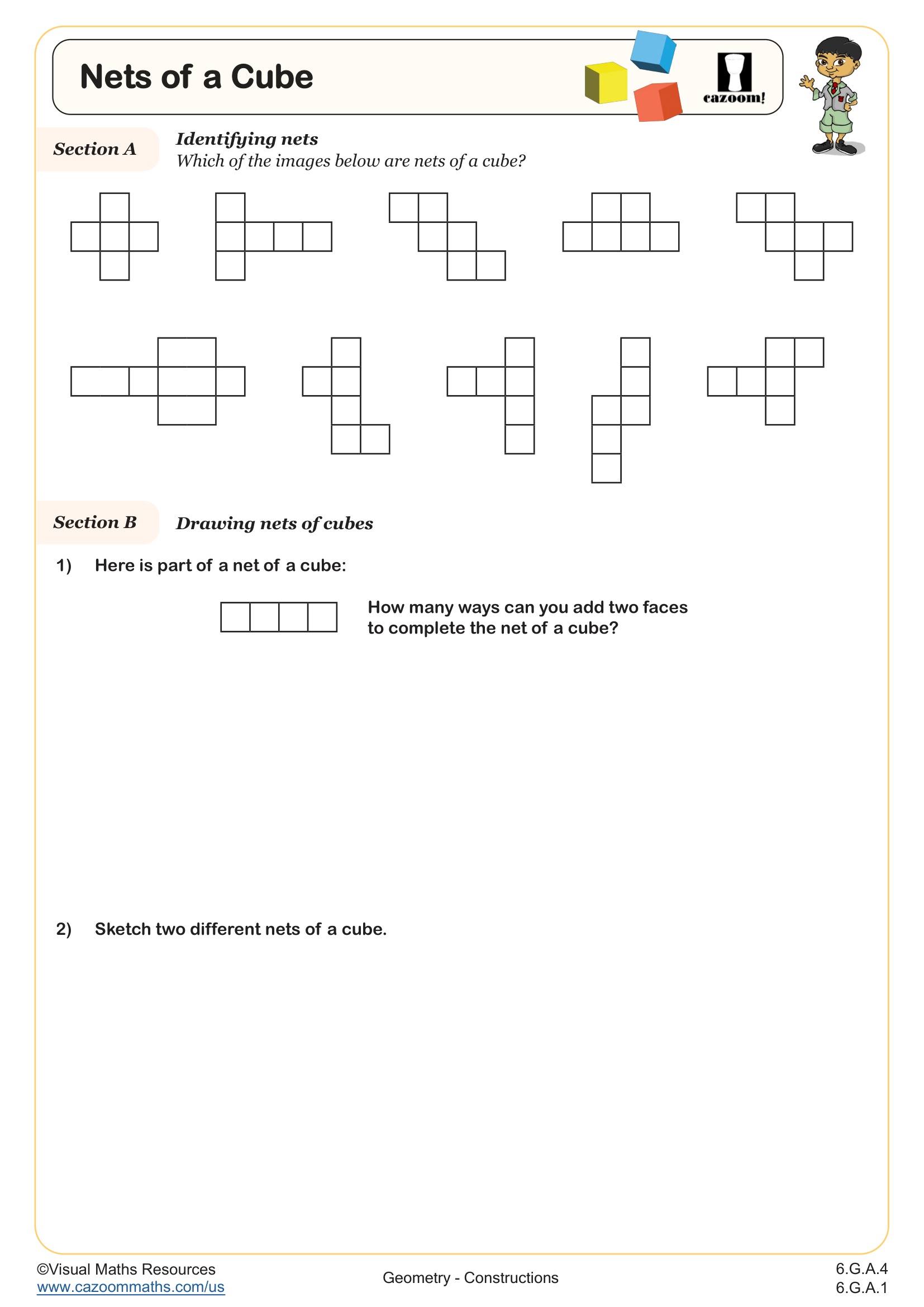
A net is a two-dimensional pattern that folds into a three-dimensional shape without overlapping. For cubes, students analyze arrangements of six squares to determine which configurations work—there are exactly eleven distinct nets of a cube, though students often initially believe there are far fewer or countless possibilities. The key skill involves visualizing the folding process and identifying which edges connect when the shape forms. Students must recognize that certain square positions make folding impossible or create overlaps.
This concept connects directly to packaging design, manufacturing, and engineering. Product designers use nets to create efficient box templates that minimize material waste, while architects use similar thinking when planning building components. In STEM fields, understanding how flat materials transform into structures appears in everything from sheet metal fabrication to origami-inspired solar panel arrays used in space exploration. Students make real progress when they see nets as practical tools rather than abstract puzzles.
How Can Teachers Use These Worksheets Effectively?
These worksheets provide structured practice in identifying valid nets, visualizing three-dimensional shapes, and developing spatial reasoning skills. The problems guide students through systematic analysis, helping them develop criteria for evaluating whether a net will fold correctly. With answer keys included, teachers can quickly assess whether students grasp the core concept or need additional support with physical models before attempting more abstract problems.
Many teachers use these worksheets during small group instruction while other students work on related surface area calculations, creating a natural differentiation opportunity. They work well as homework assignments after hands-on lessons with paper nets, or as warm-up activities to activate spatial thinking before geometry lessons. Some teachers pair students to discuss their reasoning for each net, which surfaces misconceptions and strengthens mathematical communication skills. The worksheets also serve as effective review before standardized assessments that include spatial reasoning questions.