6th Grade Simplification Worksheets
All worksheets are created by the team of experienced teachers at Cazoom Math.
What Does Simplification Mean in 6th Grade Math?
In 6th grade mathematics, simplification involves rewriting algebraic expressions in their most compact form by combining like terms and factoring out common factors. This process requires students to recognize that terms with identical variable parts can be added or subtracted, while terms with different variables or exponents must remain separate. The concept bridges arithmetic fluency with algebraic reasoning, preparing students for equation solving in later grades.
A common misconception occurs when students try to combine unlike terms, such as adding 3x and 5y to get 8xy. Teachers observe that students lose points on state assessments when they incorrectly apply the commutative property across different variables. Emphasizing that only terms with matching variable parts can combine helps students avoid this error and builds the foundation for polynomial operations in high school algebra.
What Should 6th Graders Know About Simplifying Expressions?
By 6th grade, students should understand how to identify coefficients and variables within expressions, combine like terms accurately, and use the distributive property to expand or factor simple expressions. According to Common Core State Standards (6.EE.A.3 and 6.EE.A.4), sixth graders apply properties of operations to generate equivalent expressions and identify when expressions are equivalent. This work extends their understanding from numerical operations to algebraic thinking.
This topic builds directly on 5th grade work with numerical expressions and order of operations while preparing students for 7th grade equation solving. Students who struggle with combining like terms in 6th grade often face difficulties when solving multi-step equations the following year, since they cannot efficiently consolidate variable terms on one side of an equation. Mastering simplification now creates smoother pathways through middle school algebra and beyond.
How Do Algebra Tiles Help With Combining Like Terms?
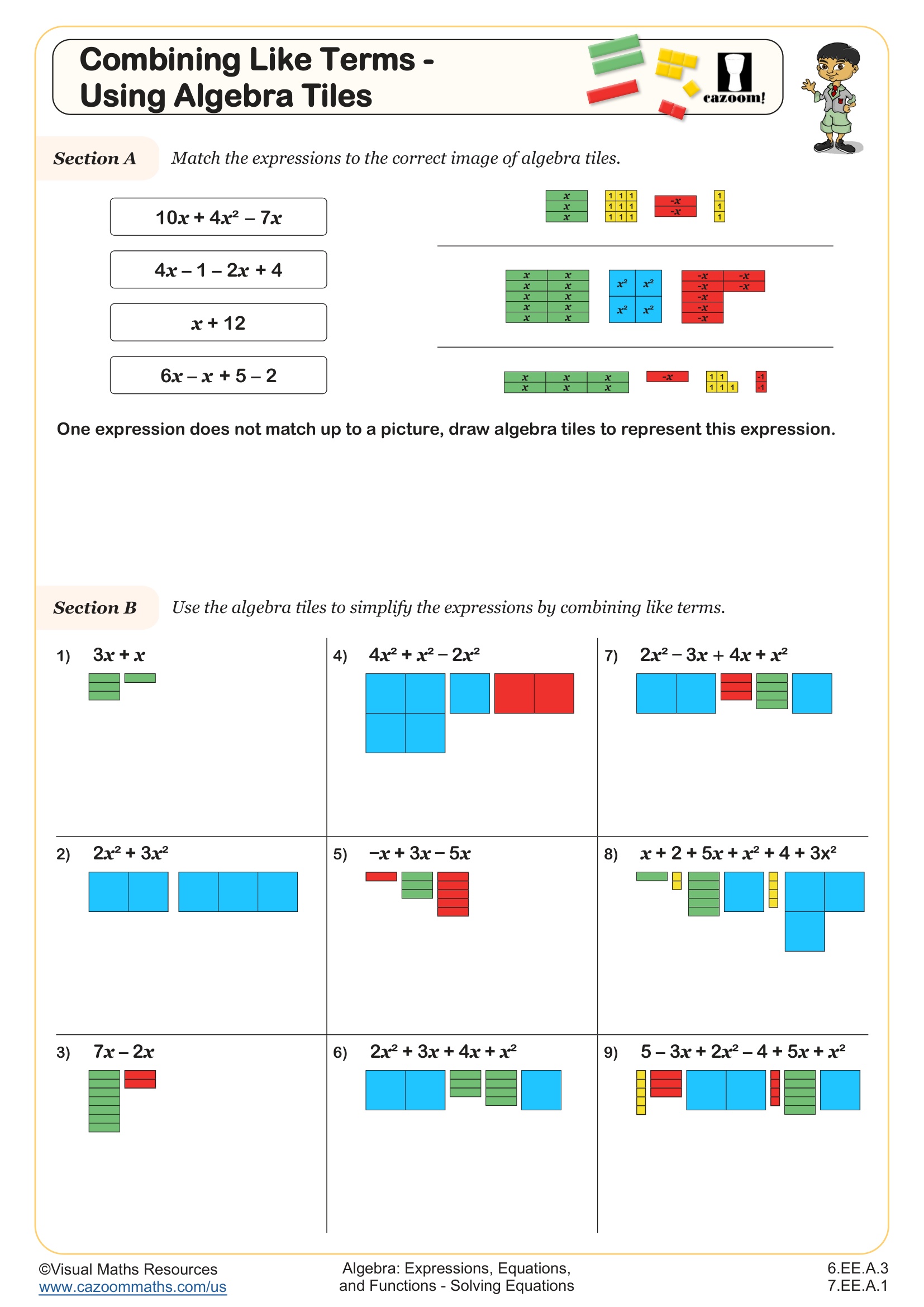
Algebra tiles provide a concrete, visual representation of abstract algebraic expressions by assigning specific shapes to constants, variables, and squared terms. Students physically group identical tiles together, making the concept of combining like terms tangible rather than purely symbolic. This manipulative approach helps students see that 2x + 3x becomes 5x because they're literally combining five identical x-tiles, not because they memorized a rule.
This visual reasoning connects to engineering and architecture, where professionals simplify complex measurements and material calculations. When calculating total lumber needed for a construction project, builders combine like measurements (all 2x4 pieces together, all 2x6 pieces separately) just as students combine like terms. Recognizing this pattern early helps students understand that algebra isn't arbitrary symbol manipulation but a practical tool for organizing and simplifying real quantities in STEM fields.
How Can Teachers Use These Simplification Worksheets Effectively?
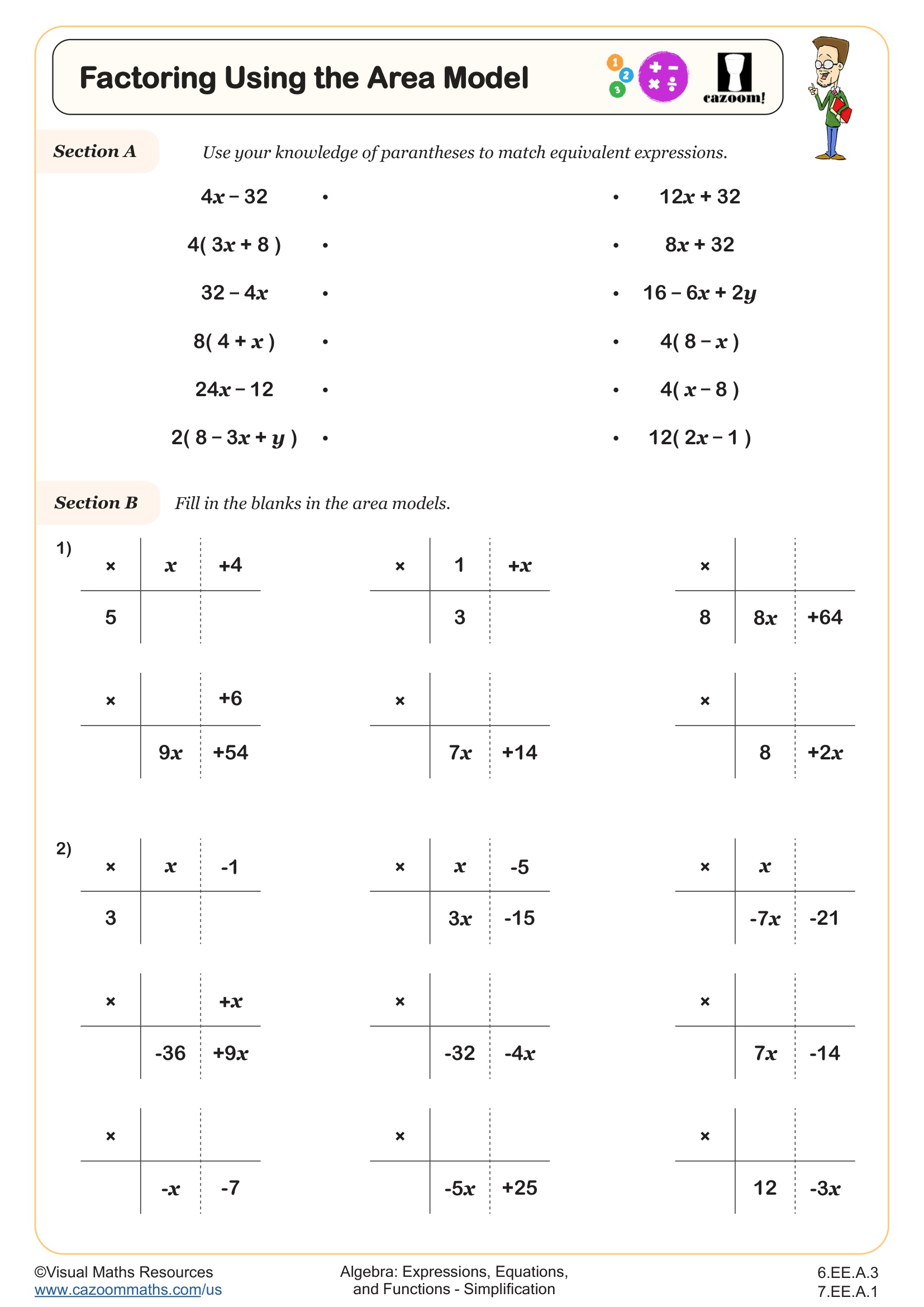
These worksheets incorporate visual models and structured practice that moves students from concrete representations to abstract symbolic manipulation. The area model worksheet helps students understand factoring as the reverse of distribution, while the algebra tiles worksheet provides tactile reinforcement of combining like terms. Teachers find that starting with visual approaches before moving to purely symbolic problems reduces frustration and builds conceptual understanding alongside procedural skill.
Many teachers use these worksheets during small group instruction to address specific misconceptions identified during whole-class lessons. They work well as intervention materials for students who struggle with abstract algebraic notation, as homework to reinforce classroom learning, or as partner activities where students explain their reasoning to each other. The included answer keys allow students to self-check during independent practice or enable quick assessment during formative checks throughout a unit.