7th Grade Angles Worksheets
All worksheets are created by the team of experienced teachers at Cazoom Math.
What Angle Relationships Do 7th Graders Need to Master?
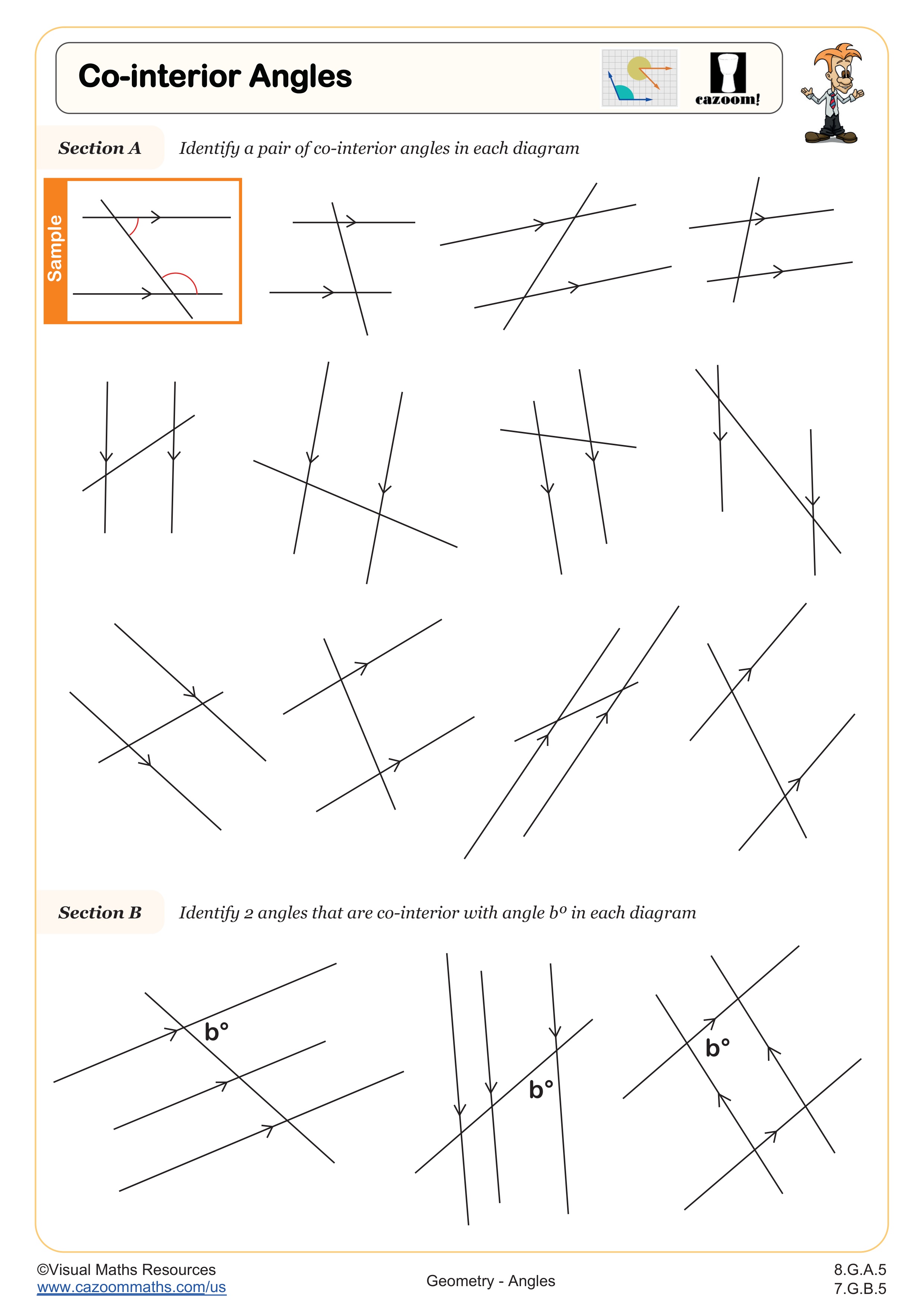
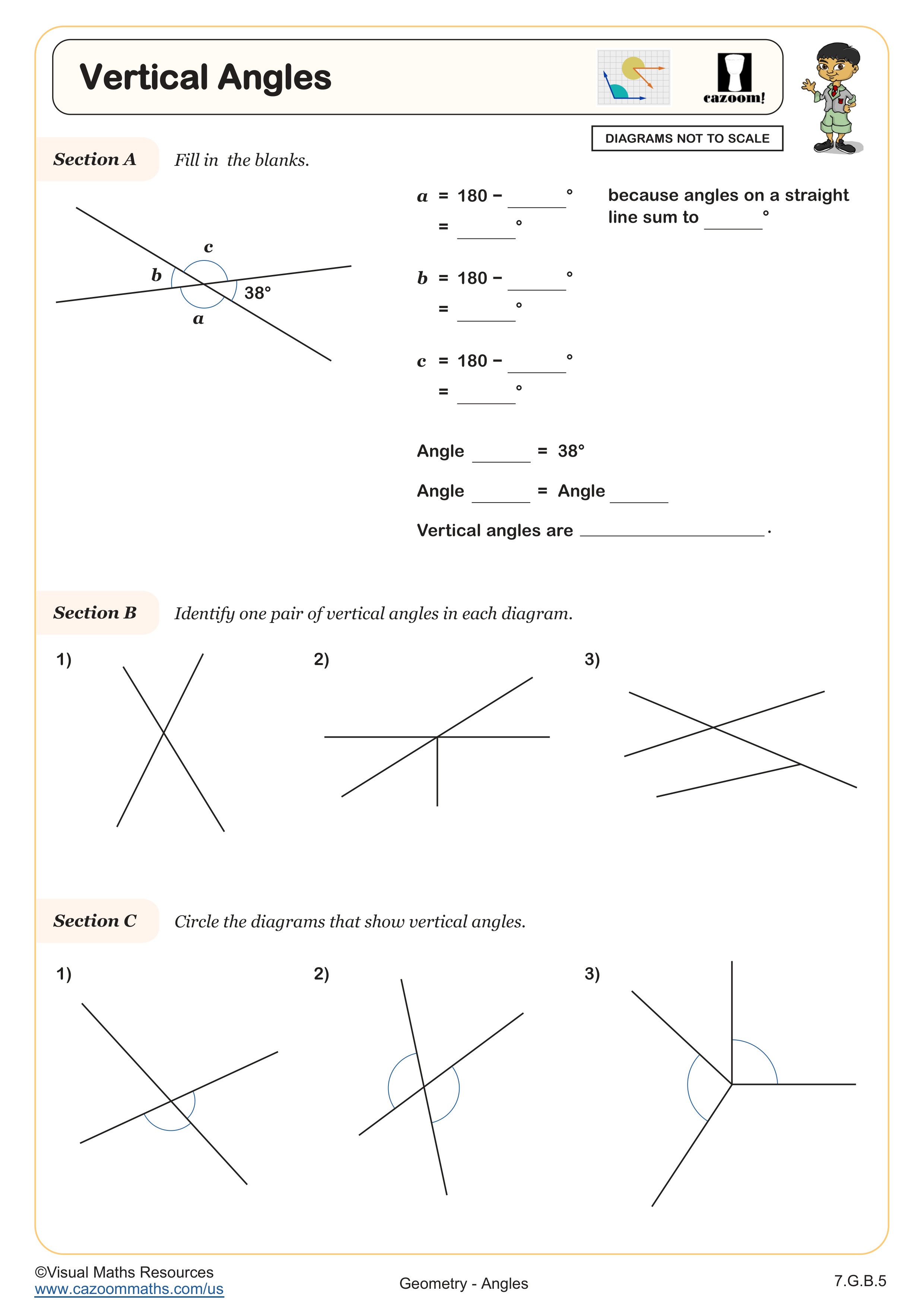
Seventh grade students work with several critical angle relationships that form the foundation for formal geometry proofs. The curriculum emphasizes vertical angles (which are always congruent), identifying parallel and perpendicular lines through angle patterns, co-interior angles (also called same-side interior angles, which are supplementary when lines are parallel), and calculating exterior angles in polygons using the relationship that an exterior angle equals the sum of its two remote interior angles.
Teachers frequently notice that students confuse co-interior angles with alternate interior angles, particularly when working with parallel lines cut by a transversal. A helpful strategy involves having students mark angles with different symbols to visualize which pairs should be supplementary versus congruent. Students lose points on state assessments when they apply the wrong angle relationship, so consistent practice identifying which rule applies to each situation builds both accuracy and confidence.
Are These Worksheets Appropriate for Middle School Students?
These worksheets align with 7th grade Common Core State Standards for geometry, specifically standard 7.G.B.5, which addresses angle relationships and geometric constructions. Middle school is when students transition from informal angle measurement in elementary grades to formal geometric reasoning that prepares them for high school proof-based courses.
In 6th grade, students work primarily with measuring and classifying individual angles and basic shapes. Seventh grade builds on this foundation by introducing relationships between multiple angles and the properties of parallel lines. By 8th grade, students apply these angle relationships when working with transformations, congruence, and similarity—making mastery of these concepts now critical for continued success. Students who confidently identify angle relationships in 7th grade tackle triangle congruence proofs and more complex geometric reasoning with significantly less frustration later.
How Do Exterior Angles in Polygons Work?
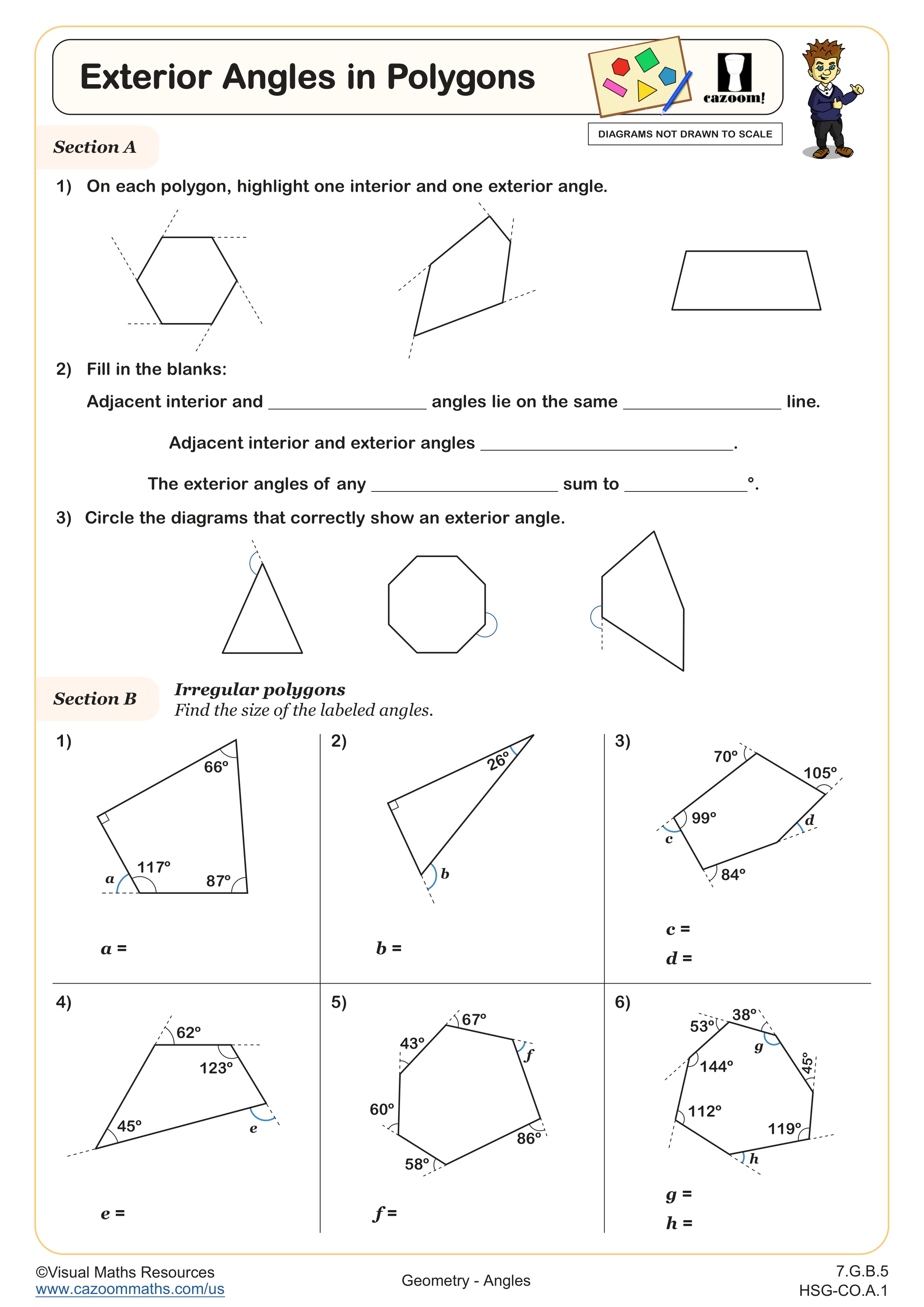
The exterior angle of a polygon is formed when one side is extended beyond a vertex. A fundamental theorem states that each exterior angle equals the sum of the two non-adjacent interior angles (the remote interior angles). This relationship holds true for all polygons and provides a powerful problem-solving tool when one or more angle measures are unknown.
This concept connects directly to real-world applications in architecture and engineering. Architects use exterior angle relationships when designing roof trusses and support structures, where understanding how angles interact determines structural stability. Video game designers and animators rely on polygon exterior angles when creating 3D models and calculating how light reflects off surfaces. Many students make the connection between this mathematical principle and the structural elements they observe in buildings, bridges, and even furniture design, which helps the abstract concept feel more tangible and relevant.
How Can Teachers Use These Angle Worksheets in Class?
The worksheets provide scaffolded practice that moves from identifying angle relationships to calculating unknown measures using those relationships. This progression allows students to build conceptual understanding before applying procedural skills. The variety of subtopics—from vertical angles to polygon exterior angles—means teachers can assign specific worksheets that target the exact concept their class is studying or where individual students need additional support.
These resources work effectively for differentiated instruction, serving as intervention materials for students who need extra practice or as independent work for students who grasp concepts quickly. Many teachers use them for homework assignments because the answer keys allow students to self-check and identify errors before the next class. The worksheets also function well as warm-up activities to review previous lessons or as assessment preparation when state testing approaches. Paired work often helps struggling students, as explaining angle relationships to a partner reinforces understanding for both learners.