7th Grade Coordinates Worksheets
All worksheets are created by the team of experienced teachers at Cazoom Math.
What Skills Do Students Practice with Coordinate Plane Worksheets?
Coordinate plane worksheets for 7th grade develop several interconnected skills aligned with middle school math standards. Students practice plotting ordered pairs accurately across all four quadrants, identifying coordinates of existing points, calculating horizontal and vertical distances, and using coordinates to solve contextual problems. The worksheets also address interpreting line graphs, understanding bearings in coordinate contexts, and applying the coordinate system to real-world scenarios.
A common error appears when students calculate distance on a coordinate grid. Many forget that distance is always positive and attempt to subtract coordinates without considering absolute value. Teachers see this particularly when points span different quadrants, where students might report a distance of -8 units instead of 8 units. Worksheets that explicitly practice distance calculations help students recognize that they're measuring length, not direction.
What Grade Level Are These Coordinate Worksheets For?
These coordinate worksheets target 7th grade students in middle school, aligning with Common Core standards 7.G.A.1 and 7.RP.A.2. At this level, students transition from working primarily with positive coordinates to confidently navigating all four quadrants and solving more complex spatial problems. The content bridges foundational graphing skills and prepares students for algebraic applications in 8th grade.
By 7th grade, students build on 6th grade experiences with first-quadrant graphing and coordinate relationships. The work prepares them for 8th grade topics including slope, linear equations, and transformations on the coordinate plane. Students who struggle with signed number operations often find coordinate plane work challenging, since plotting points requires fluency with both positive and negative integers and understanding their positions relative to the origin.
How Do Students Calculate Distance on a Coordinate Grid?
Calculating distance on a coordinate grid requires students to find the absolute difference between corresponding coordinates. For horizontal distances, students subtract the x-coordinates and take the absolute value. For vertical distances, they subtract the y-coordinates and take the absolute value. This method works because the points create right angles with the axes. Students confidently tackle distance problems once they recognize that distance questions always involve points sharing either the same x-coordinate or the same y-coordinate.
This skill connects directly to urban planning and navigation systems. City planners use coordinate systems to measure distances between locations when designing transportation routes. GPS technology calculates distances using coordinate mathematics to determine the shortest path between two points. Students often make meaningful connections between coordinate distance and reading maps, understanding that Manhattan distance (moving only horizontally and vertically) differs from straight-line distance in real applications like delivery route optimization.
How Can Teachers Use These Coordinate Plane Worksheets Effectively?
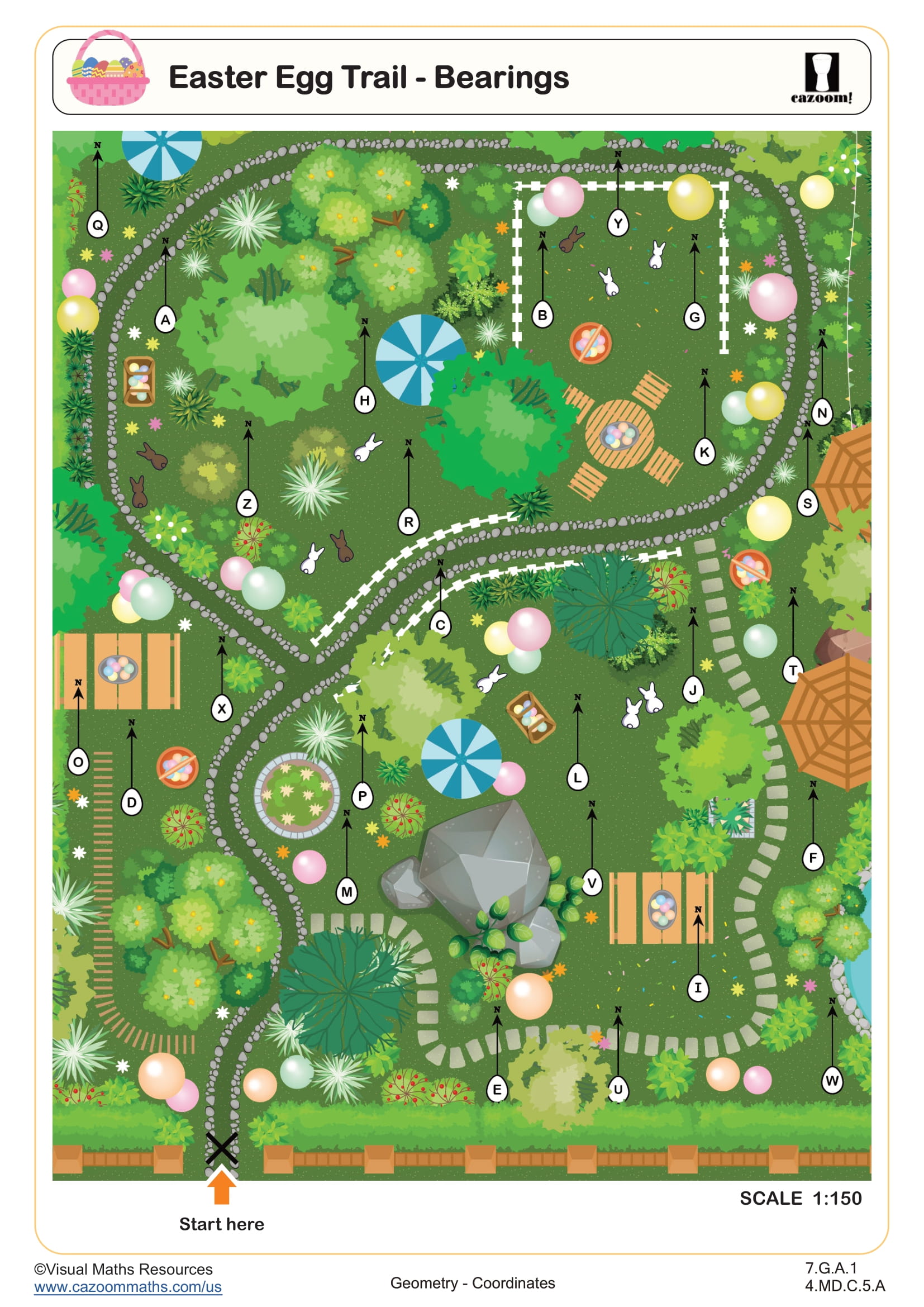
These worksheets provide scaffolded practice that moves from basic coordinate identification to more complex applications like word problems and distance calculations. The variety of formats, including engaging activities like coordinate emoji puzzles and themed trails, maintains student interest while reinforcing essential skills. Complete answer keys allow students to check their work independently or enable quick grading, making these resources suitable for both guided instruction and self-paced learning.
Many teachers use coordinate worksheets during math centers or stations, pairing visual learners with kinesthetic activities that involve physically plotting points on large grid paper before transferring to worksheets. The word problems work well for small-group instruction where students can discuss solution strategies. Teachers also assign these as homework following direct instruction, or use them as warm-up activities to maintain coordinate fluency throughout the year, particularly before standardized assessments that test graphing skills across multiple question formats.