7th Grade Decimals Worksheets
All worksheets are created by the team of experienced teachers at Cazoom Math.
What decimal skills do 7th graders need to master?
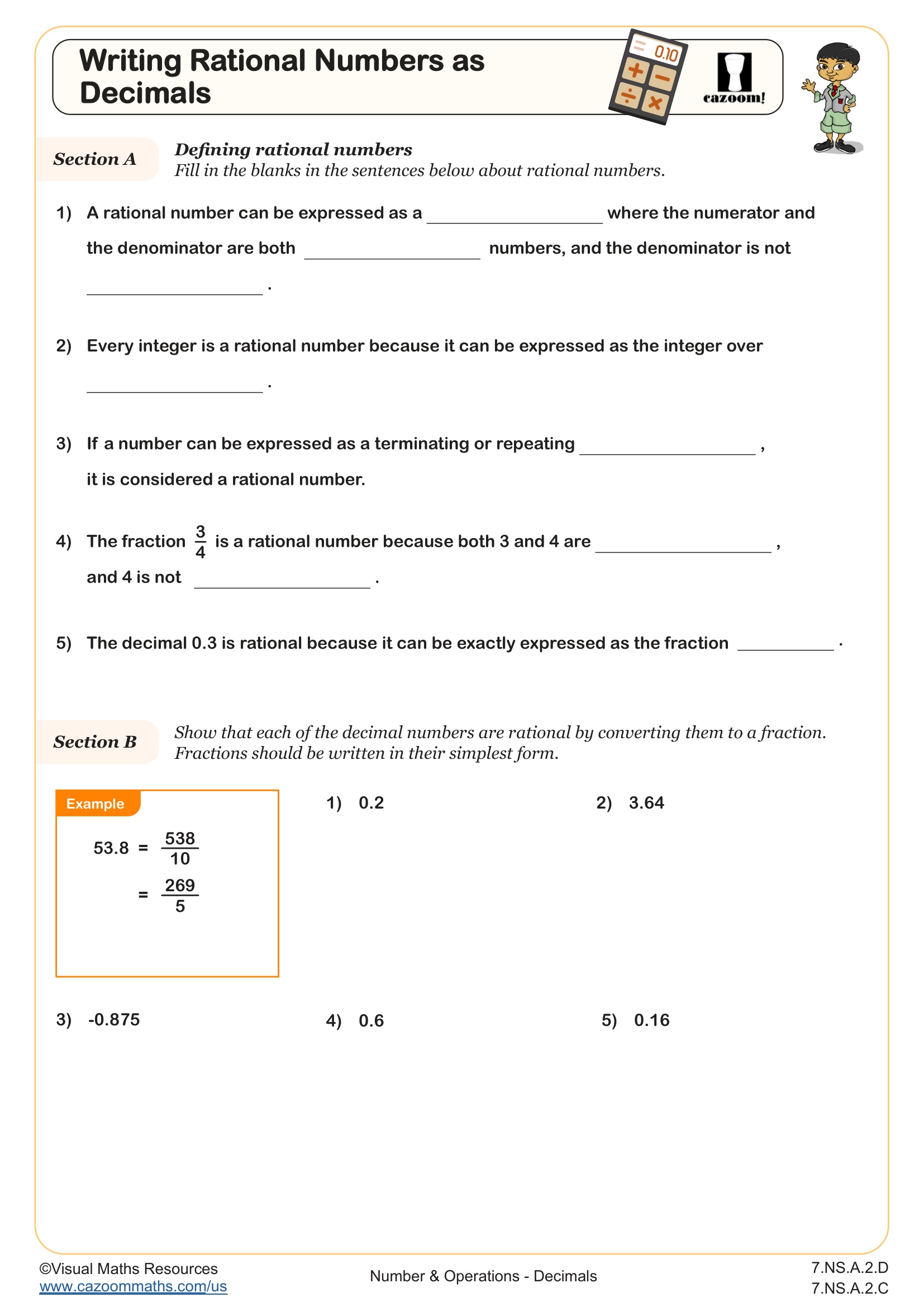
Seventh grade marks a significant transition where students move beyond basic decimal operations to work with more complex concepts. Students need proficiency in comparing and ordering decimals, converting between fractions, decimals, and percents fluently, and understanding recurring decimals. The Common Core State Standards emphasize rational number operations at this level, which includes recognizing that repeating decimals represent rational numbers that can be expressed as fractions.
A common misconception surfaces when students compare decimals like 0.5 and 0.49, with many incorrectly choosing 0.49 as larger because "49 is bigger than 5." Teachers notice this error disappears once students align decimal places or convert to equivalent fractions. State assessments regularly test decimal-to-fraction conversions and operations with decimals in word problems, so mastery at this level directly impacts test performance and readiness for algebra.
Are these worksheets appropriate for middle school students?
These worksheets target 7th grade students in middle school, typically ages 12-13, and align with the progression of rational number concepts taught during this stage. Seventh grade represents a critical year where students consolidate their understanding of the number system before transitioning to algebraic thinking in 8th grade. The focus on converting between different number representations and working with repeating decimals prepares students for solving equations and working with rational expressions.
The content builds directly on 6th grade work with multi-digit decimal operations and fraction-decimal relationships. In 8th grade, students will apply these decimal skills when solving linear equations, working with scientific notation, and analyzing functions. Students who struggle with decimal conversions in 7th grade often find themselves losing points on algebra problems the following year, making this foundational work essential for continued success in mathematics.
How do students convert repeating decimals to fractions algebraically?
The algebraic method for converting repeating decimals to fractions provides students with a systematic approach that reinforces equation-solving skills. Students set the repeating decimal equal to a variable (x = 0.333...), multiply both sides by a power of 10 to shift the decimal point (10x = 3.333...), then subtract the original equation to eliminate the repeating part (10x - x = 3, so 9x = 3, and x = 1/3). This technique works for any repeating decimal and helps students recognize the underlying structure of rational numbers.
This skill connects directly to quality control in manufacturing and engineering contexts. When machinists work with tolerances like 0.1̄6̄ inches (which equals 1/6 inch), understanding the fraction form helps them use standard measuring tools more accurately. Financial analysts also convert repeating decimals when calculating interest rates that don't terminate, ensuring precise calculations in investment models and loan amortization schedules.
How can teachers use these decimal worksheets effectively in class?
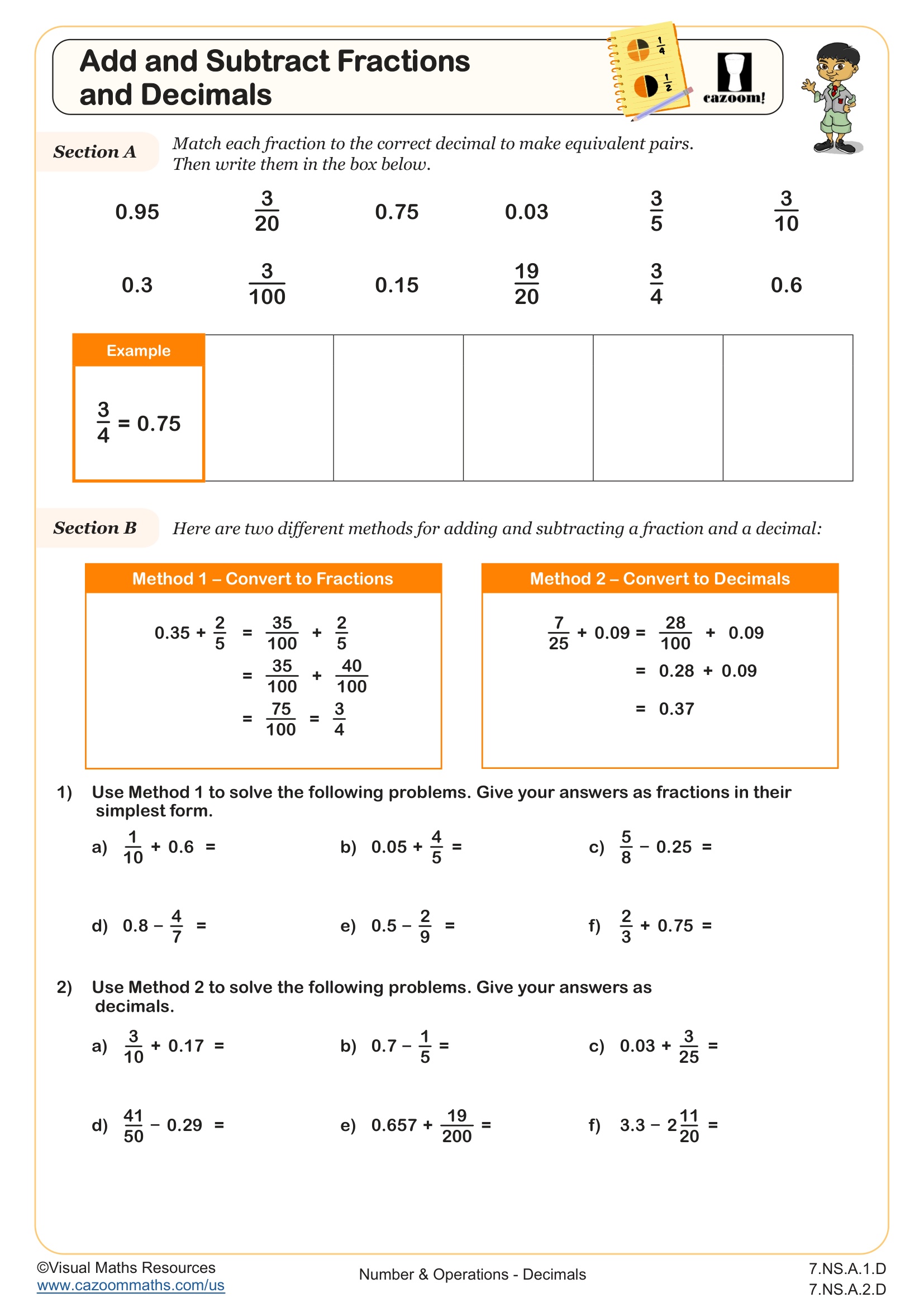
The worksheets provide structured practice with graduated difficulty that allows teachers to differentiate instruction based on student readiness. Each topic builds specific skills, from estimating shopping bills to using algebraic methods for conversions, so teachers can assign worksheets that target particular areas where students need reinforcement. The complete answer keys enable students to self-check their work during independent practice or peer tutoring sessions, building mathematical confidence and self-sufficiency.
Many teachers use these worksheets for small group intervention when formative assessments reveal gaps in decimal understanding. The estimating shopping bills worksheet works particularly well as a warm-up activity that connects to real-world contexts students understand. Teachers also assign specific conversion worksheets as homework after introducing new material, then use classroom time to address common errors revealed by the answer keys. The focused nature of each worksheet makes them effective for test review, allowing students to concentrate on their weakest areas before assessments.