7th Grade Describe and Compare Shapes Worksheets
All worksheets are created by the team of experienced teachers at Cazoom Math.
What geometric skills do students practice with describe and compare shapes worksheets?
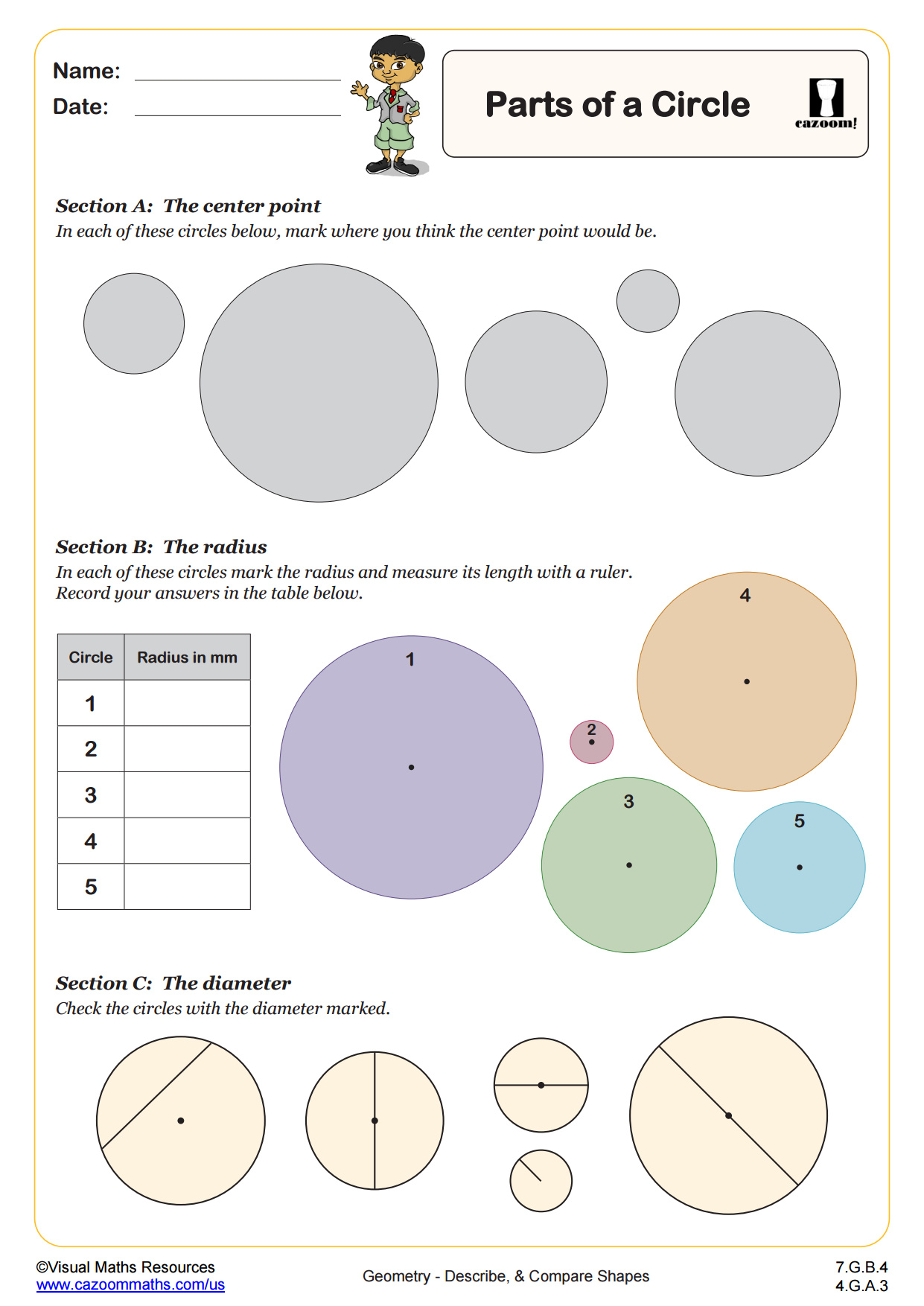
Students develop analytical skills by identifying properties of quadrilaterals, describing rotations and movements, recognizing 2D faces within 3D shapes, and labeling parts of circles. These worksheets move beyond basic identification to require comparison and justification, which aligns with middle school geometry standards that emphasize reasoning and precision in mathematical arguments.
A common error occurs when students confuse describing a rotation with describing a reflection—many will say a shape "turned" when it actually flipped across a line. Teachers often address this by having students physically trace shapes on patty paper and perform the transformations themselves, which makes the difference between rotations, reflections, and translations immediately visible and helps students develop more precise mathematical language.
What grade level are these describe and compare shapes worksheets designed for?
These worksheets target 7th grade students in middle school, where geometry shifts from simply identifying shapes to analyzing their properties and relationships. At this level, students are expected to work with more complex quadrilaterals, understand transformations in the coordinate plane, and make connections between 2D and 3D geometry that prepare them for high school proofs and spatial reasoning.
This builds directly on 6th grade work with area, surface area, and volume by adding the analytical layer of comparing properties. Students who master these comparison skills in 7th grade find 8th grade geometry much more manageable, particularly when they encounter the Pythagorean theorem, volume formulas for complex solids, and congruence relationships that require identifying corresponding parts.
How do students identify 2D shapes as faces of 3D shapes?
Students analyze three-dimensional solids to recognize that each face is a two-dimensional polygon with specific properties. For example, a rectangular prism has six rectangular faces, while a triangular pyramid has four triangular faces. This skill requires spatial visualization—students must mentally "unfold" or examine different views of a solid to identify all faces and their shapes, which standardized tests frequently assess through net diagrams and isometric drawings.
This concept connects directly to architecture and engineering, where professionals must visualize how 2D blueprints translate into 3D structures. Civil engineers designing buildings work from floor plans (2D rectangles) that become the faces of rectangular prisms, while package designers create nets (flat 2D patterns) that fold into 3D boxes—understanding this relationship helps students see why precision in identifying face shapes matters for real-world construction and manufacturing.
How can teachers use these worksheets effectively in the classroom?
The worksheets provide structured practice that helps students develop systematic approaches to comparing shapes—rather than guessing, students learn to list properties, identify similarities and differences, and use precise vocabulary. The answer keys allow teachers to quickly identify which properties students consistently overlook, such as parallel sides versus perpendicular sides in quadrilaterals, so instruction can target those specific gaps.
Many teachers use these worksheets for differentiated station work, where students who need reinforcement focus on basic property identification while advanced students tackle the transformation descriptions and quadrilateral comparisons with clues. The variety of subtopics also makes them useful for spiraled review throughout the year, as short warm-ups before related lessons, or as targeted intervention for students who struggled with geometry on previous assessments.