7th Grade Division Worksheets
All worksheets are created by the team of experienced teachers at Cazoom Math.
What division skills should 7th graders master?
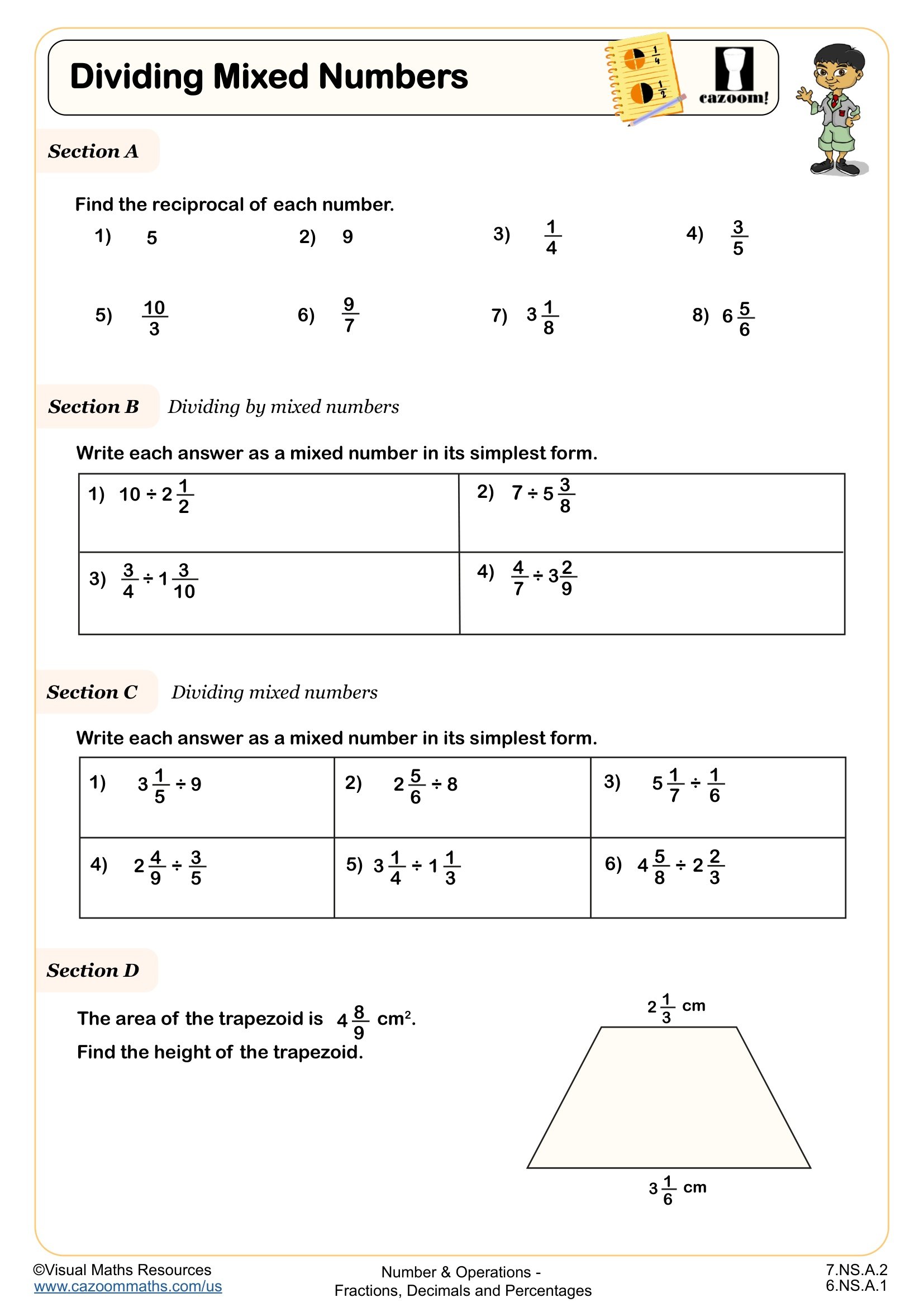
Seventh grade students should demonstrate proficiency with multi-digit whole number division, understand and apply divisibility rules for 2, 3, 4, 5, 8, and 10, and perform division operations with mixed numbers. According to Common Core State Standards (7.NS.A.2), students must apply properties of operations to calculate with rational numbers, which includes dividing fractions and mixed numbers fluently.
Many students confidently tackle divisibility rules once they recognize the patterns, such as checking the last digit for divisibility by 2 or 5, or summing digits for divisibility by 3. Teachers often see students lose points on assessments when they correctly perform long division but forget to express remainders appropriately, whether as fractions, decimals, or whole remainders depending on context. Understanding when each remainder format makes sense strengthens problem-solving skills across mathematical applications.
Are these worksheets appropriate for middle school students?
These division worksheets are specifically designed for 7th grade students in middle school, building on the foundational division skills established in 6th grade. By 7th grade, students transition from basic whole number division to more sophisticated applications involving fractions, mixed numbers, and recognizing patterns through divisibility rules.
This progression prepares students for 8th grade algebra, where division concepts appear in simplifying rational expressions and solving equations. Students who master dividing mixed numbers in 7th grade find fraction operations in algebraic contexts much more manageable the following year. The practice with divisibility rules also supports factoring skills that become central to algebra coursework, creating a bridge between arithmetic proficiency and algebraic thinking that characterizes the middle school mathematics sequence.
Why are divisibility rules important in 7th grade math?
Divisibility rules provide efficient mental math strategies for determining whether one number divides evenly into another without performing long division. These rules help students quickly identify factors, simplify fractions, and recognize patterns in number relationships. For example, knowing that a number divisible by both 2 and 3 must also be divisible by 6 streamlines problem-solving across multiple contexts.
These rules connect directly to computer science applications, where programmers use modulo operations and divisibility checks to create algorithms for everything from scheduling systems to data encryption. In STEM fields, understanding divisibility underpins concepts like frequency calculations in physics and chemical ratio problems in chemistry. When students recognize that divisibility rules represent shortcuts based on place value properties, they develop number sense that extends far beyond basic arithmetic into analytical reasoning used throughout scientific and technical careers.
How can teachers use these division worksheets effectively?
The worksheets provide targeted practice on specific division skills, allowing teachers to assign problems that match current instructional focus. With subtopics ranging from divisibility rules to dividing mixed numbers, teachers can select practice that addresses particular learning needs. The included answer keys enable students to check their own work during independent practice or allow teachers to quickly assess understanding during formative assessments.
Many teachers use these worksheets for differentiated intervention, assigning short division practice to students who need computation reinforcement while others work on mixed number division. The worksheets work well as homework to solidify classroom instruction, as warm-up activities to activate prior knowledge, or during paired work where students compare solution strategies. Teachers also find them valuable for spiral review before standardized tests, helping students maintain division fluency while learning new content throughout the school year.