7th Grade Expressions and Equations Worksheets
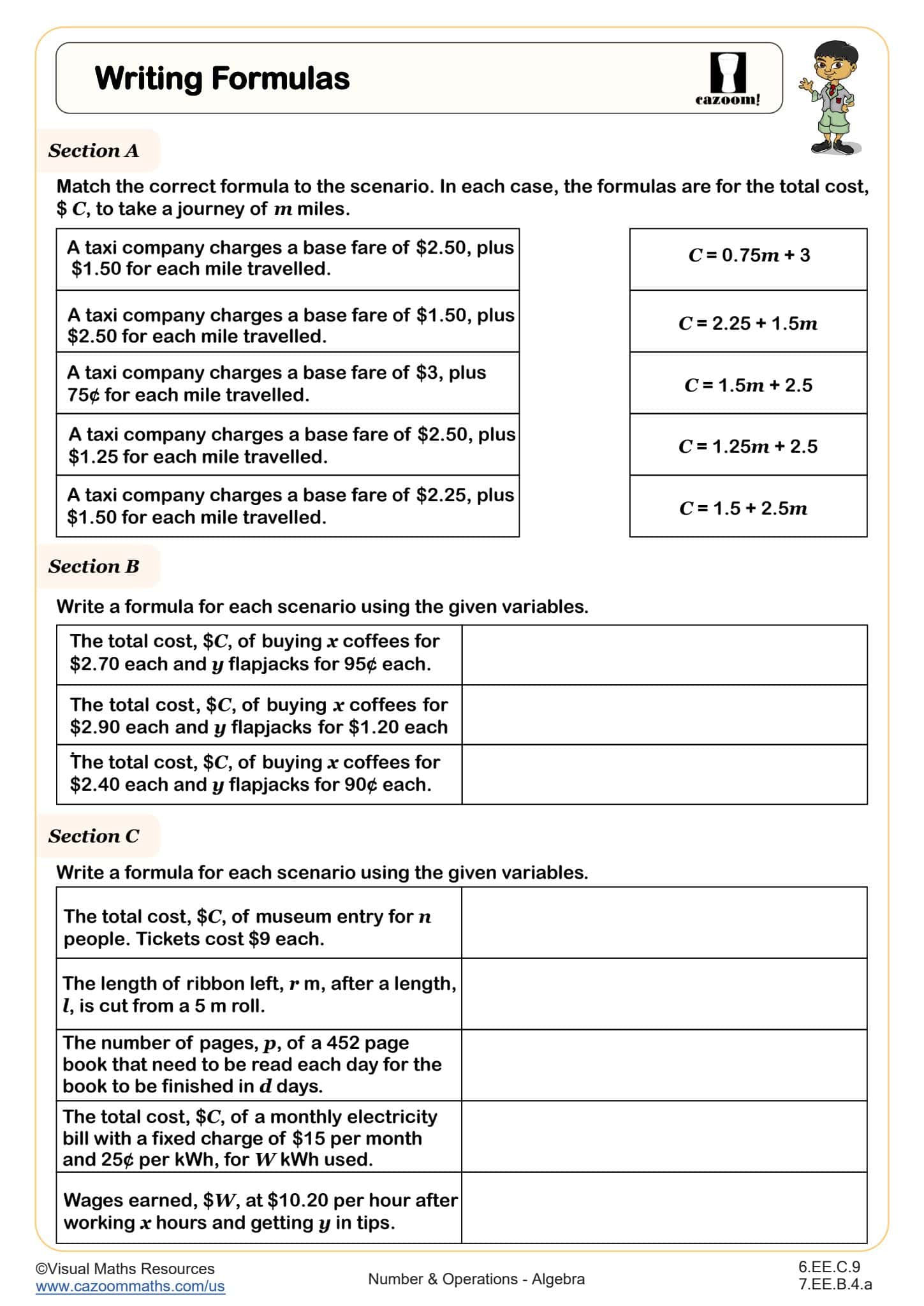
All worksheets are created by the team of experienced teachers at Cazoom Math.
What topics do 7th grade algebra worksheets typically cover?
Grade 7 algebra worksheets typically focus on expressions and equations as outlined in Common Core standards 7.EE. Students practice simplifying algebraic expressions using properties of operations, solving multi-step linear equations, and working with inequalities. These foundational skills prepare students for more complex algebraic concepts in eighth grade and beyond.
Teachers frequently observe that students make errors when combining like terms, especially when negative coefficients are involved. For example, when simplifying 3x - 2x + 5x, many seventh graders incorrectly calculate the result as 0x instead of 6x. Quality algebra grade 7 worksheets address these common misconceptions through carefully scaffolded practice problems that build conceptual understanding alongside procedural fluency.
Are these worksheets appropriate for students transitioning from 6th to 8th grade?
These 7th grade algebra materials serve as an effective bridge between 6th grade arithmetic and 8th grade advanced algebra. Sixth graders who demonstrate readiness for algebraic thinking can benefit from introductory expression work, while eighth graders needing review find the systematic approach helpful for filling knowledge gaps.
Many teachers use these resources for differentiated instruction within mixed-ability classrooms. Advanced sixth graders might work on basic expression simplification, while struggling eighth graders can revisit multi-step equation solving with the structured support these worksheets provide. The progression from concrete numerical operations to abstract algebraic manipulation requires careful scaffolding that these materials deliver effectively.
How do these worksheets help students understand the difference between expressions and equations?
Understanding the distinction between expressions and equations represents one of the most challenging conceptual hurdles for seventh grade students. Expressions represent mathematical phrases that can be simplified but not solved, while equations contain equal signs and can be solved for specific variable values.
Teachers notice that students often attempt to "solve" expressions like 2x + 3 by setting them equal to zero unnecessarily. Effective worksheets present expressions and equations side by side, asking students to identify which can be simplified versus solved. This visual comparison helps students recognize that 2x + 3 simplifies to itself, while 2x + 3 = 11 can be solved to find x = 4.
How can teachers use these worksheets most effectively in their algebra instruction?
Teachers find these worksheets most effective when used as targeted practice following conceptual instruction rather than as standalone learning tools. The answer keys allow for immediate feedback during independent work time, helping students identify and correct errors before misconceptions become entrenched.
Many educators implement a three-step approach: model the concept with concrete examples, provide guided practice using worksheet problems, then assign independent practice for homework or assessment. The downloadable PDF format enables teachers to project problems for whole-class discussion or create customized problem sets by combining sections from different worksheets to match specific learning objectives.