7th Grade Joke Day Worksheets
All worksheets are created by the team of experienced teachers at Cazoom Math.
What Makes Code Breaker Worksheets Effective for Math Practice?
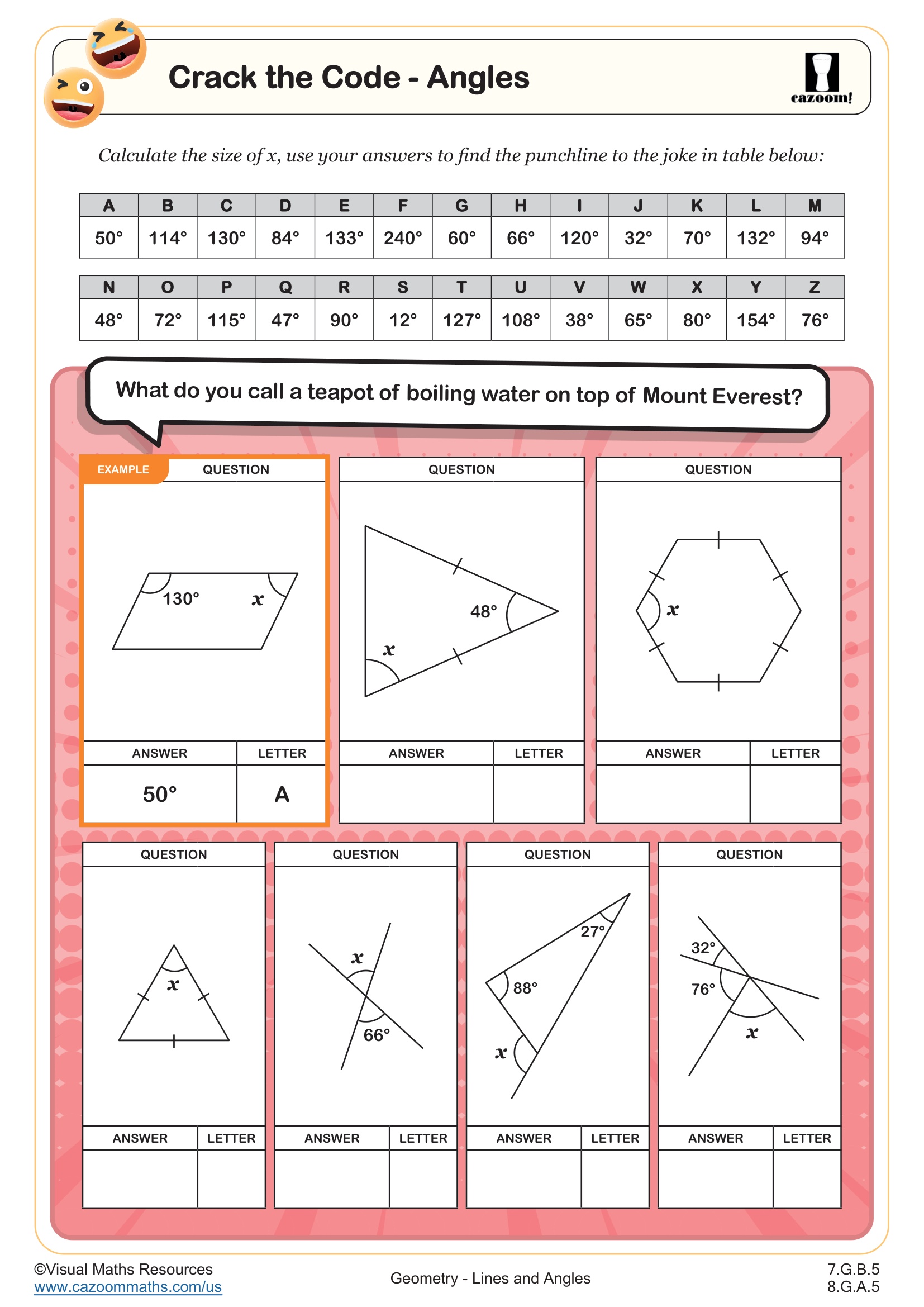
Code breaker worksheets require students to solve math problems correctly to reveal letters that spell out a joke's punchline. This format creates natural accountability because students immediately see when their answers don't produce readable text, prompting them to revisit their calculations without teacher intervention. The approach works across multiple topics including decimals, angles, graphing, and number operations, allowing teachers to review varied content through a consistent structure.
Students often make the connection between precision in their calculations and success in breaking the code. A decimal miscalculation or sign error becomes obvious when the decoded message reads as gibberish rather than the expected punchline. This immediate feedback loop helps students develop self-checking habits that transfer to standardized test situations where answer verification matters.
What Grade Level Are These Joke Day Math Worksheets For?
These worksheets target 7th grade students in middle school, addressing skills that form the foundation for algebra and geometry coursework. The content aligns with middle school standards that expect students to work fluently with rational numbers, understand angle relationships, and graph linear equations. Code breaker activities provide review and reinforcement of these concepts in a format that maintains engagement during end-of-unit practice or test preparation.
The mathematical content bridges 6th grade foundational work with decimals and basic geometry toward 8th grade algebra readiness. Students who struggled with decimal operations in 6th grade benefit from the additional practice, while the graphing and angle work prepares them for the coordinate geometry and transformational geometry they'll encounter in 8th grade. The puzzle format makes this review feel less remedial and more like an enjoyable challenge.
How Do Straight Line Graph Code Breakers Work?
Straight line graph code breakers require students to interpret linear equations, identify coordinates, calculate slopes, or determine intercepts to unlock each letter of the joke. Students might need to find the y-intercept of a given equation, match a graph to its equation, or calculate where two lines intersect. Each correct answer corresponds to a letter that gradually reveals the punchline as students progress through the problems.
This skill connects directly to real-world applications in STEM fields where linear relationships model everything from cell phone billing plans to chemical reaction rates. Engineers use linear graphs to predict load capacities, while data scientists rely on them for trend analysis. Students who can quickly extract information from linear equations and their graphs develop analytical skills that extend far beyond math class into economics, science labs, and computer programming.
How Should Teachers Use These Worksheets in Class?
The worksheets work well as both independent practice and collaborative activities. The included answer keys allow students to self-check their decoded messages, helping them identify calculation errors before moving to the next problem. Teachers can use these for differentiated instruction since students work at their own pace while staying engaged with the puzzle element that provides motivation different from traditional problem sets.
Many teachers find these worksheets valuable for early finishers, Friday review sessions, or as brain breaks between more intensive lessons. They also function well as homework assignments because the joke element gives parents an easy entry point to discuss the math with their child. Paired work often generates productive mathematical discussions as students debate solution methods when their decoded letters don't match, naturally prompting them to justify their approaches and check each other's reasoning.