7th Grade Lines and Angles Worksheets
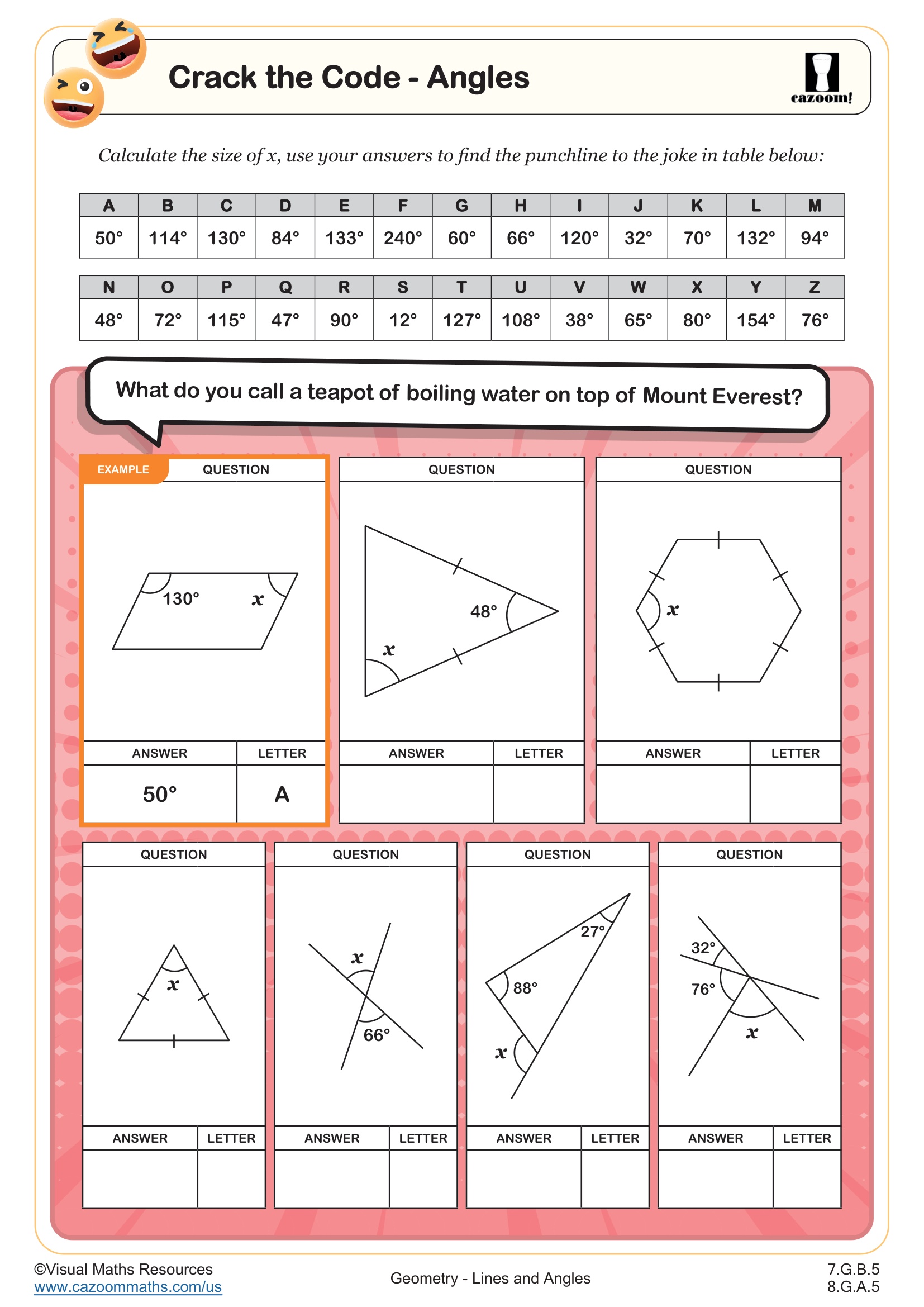
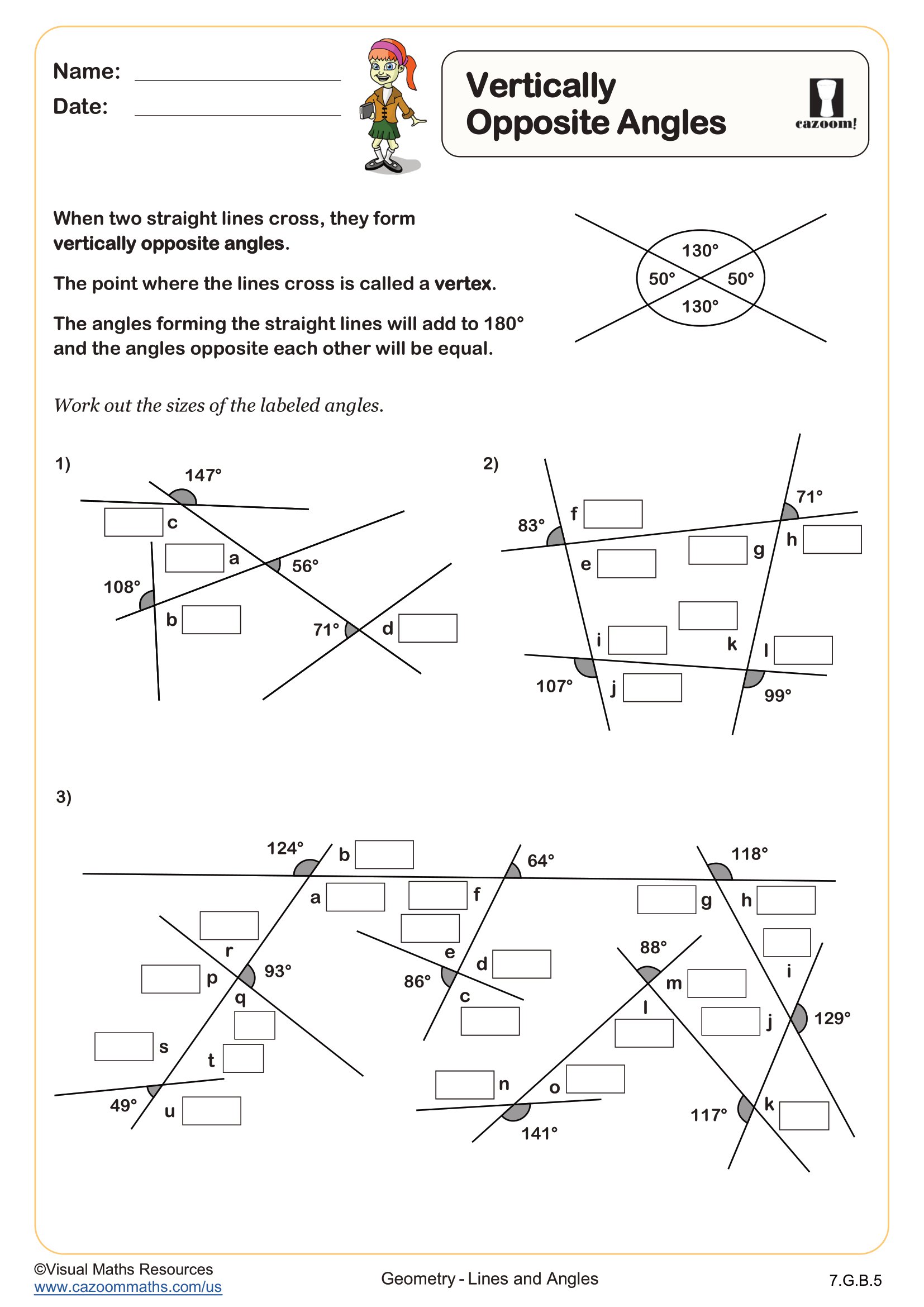
All worksheets are created by the team of experienced teachers at Cazoom Math.
What Are the Main Types of Angles Students Learn in 7th Grade?
Seventh graders work with six angle classifications: acute (less than 90°), right (exactly 90°), obtuse (between 90° and 180°), straight (exactly 180°), reflex (between 180° and 360°), and full rotation (360°). These definitions build on the angle introduction from 4th and 5th grade but now require students to measure with precision and apply angle relationships in geometric proofs and constructions.
Students often misclassify angles near boundary values, calling an 89° angle obtuse or labeling a 91° angle as acute. Teachers see the most confusion with reflex angles, which many students haven't encountered before 7th grade. Having students physically trace the rotation from one ray to another helps them visualize why a 270° angle opens the "long way around" rather than taking the shorter 90° path, cementing understanding of angle measure as rotation rather than just the space between two lines.
What Grade Level Are These Lines and Angles Worksheets For?
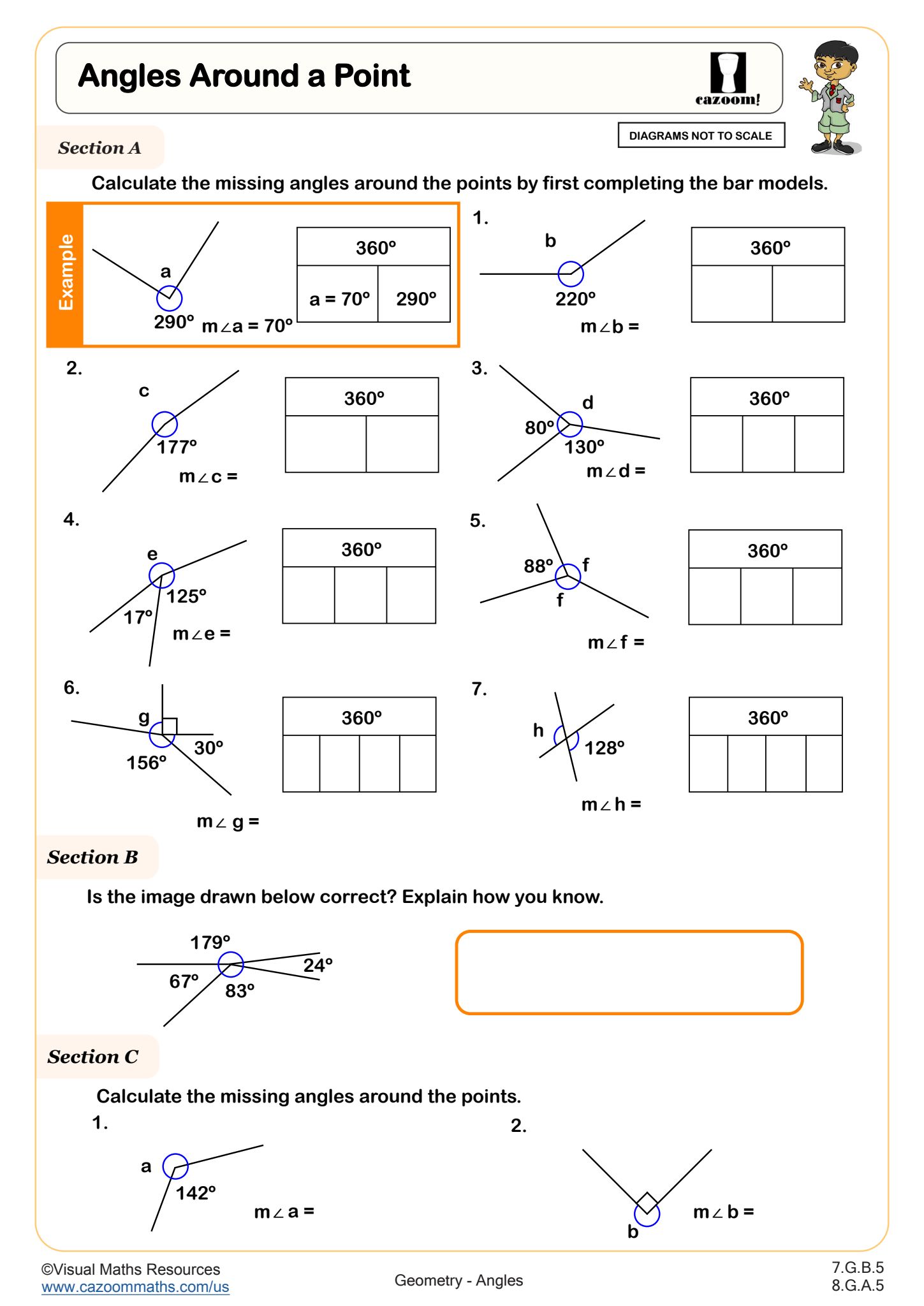
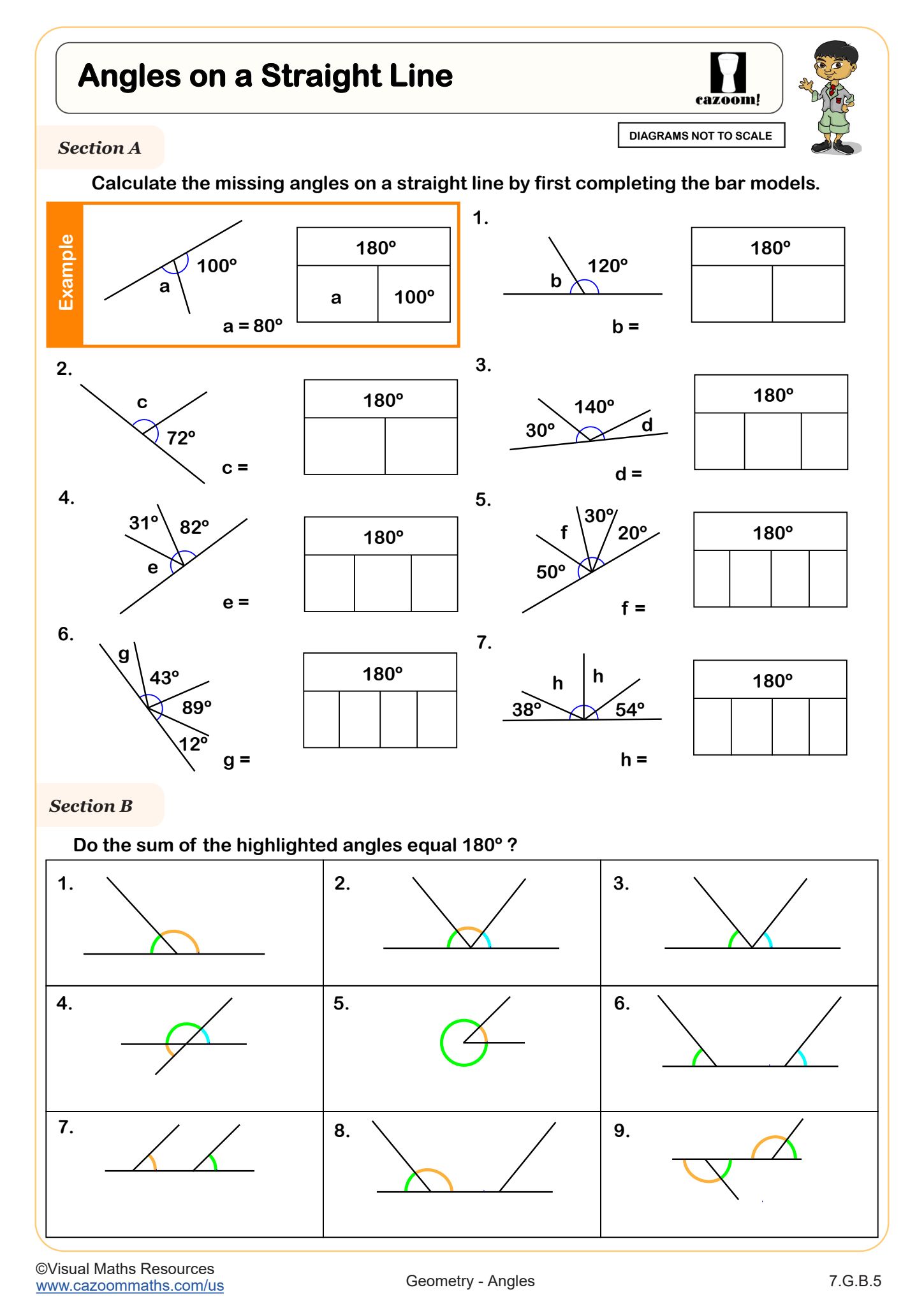
These worksheets target 7th grade students in middle school, aligning with geometry standards that bridge concrete measurement skills and abstract geometric reasoning. At this level, students move beyond simply identifying angles to analyzing angle relationships, working with complementary and supplementary pairs, and applying angle properties in multi-step problems that prepare them for high school geometry.
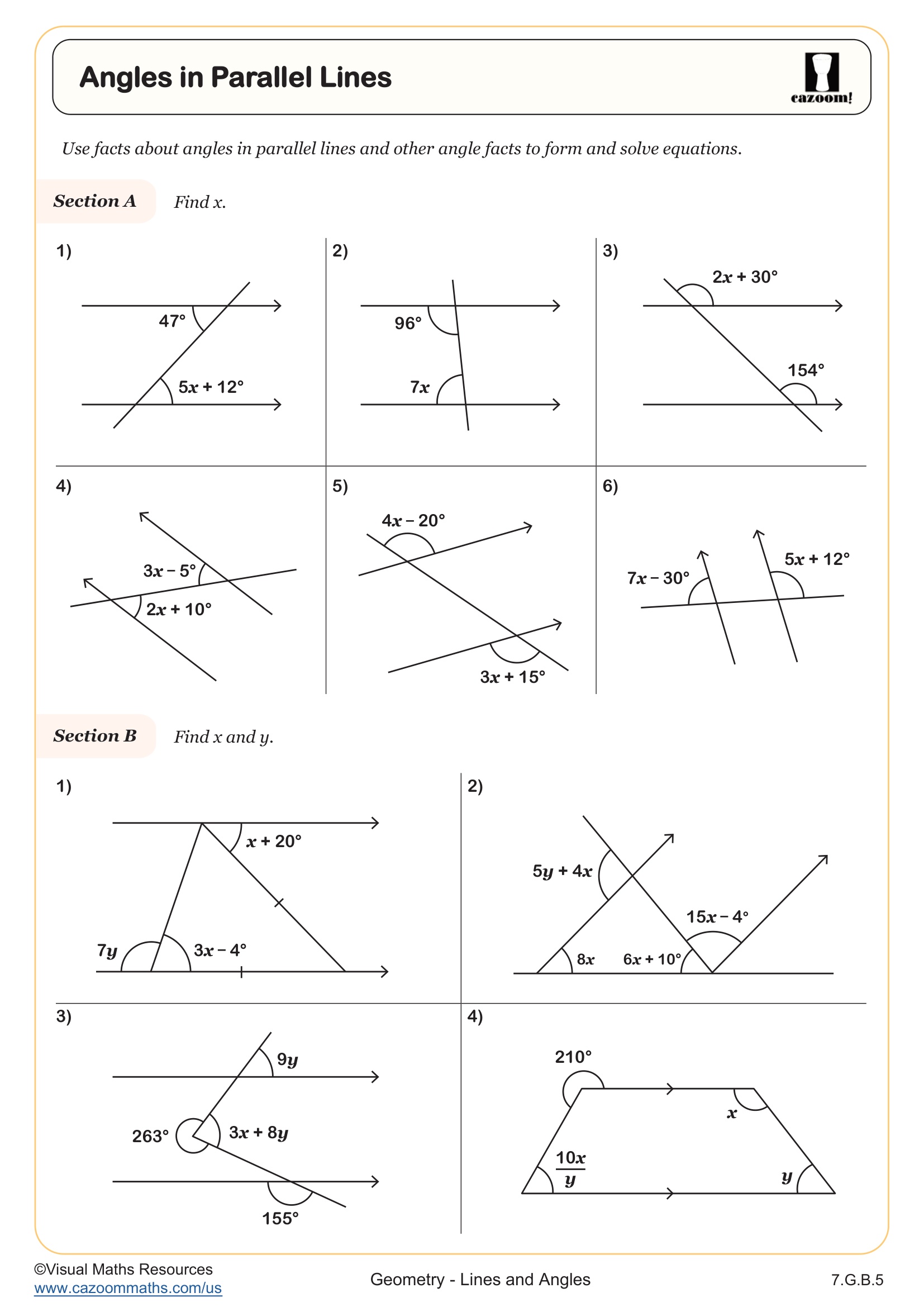
In 6th grade, students typically work with basic angle concepts and simple constructions, while 8th graders extend these skills to transformations, parallel lines cut by transversals, and triangle angle theorems. Seventh grade serves as the crucial transition year where measurement accuracy and geometric vocabulary must become automatic so students can focus on proofs and reasoning in later courses. Students who master angle notation and classification in 7th grade handle transformation geometry and coordinate proofs with significantly more confidence.
How Do Students Use Protractors to Measure Angles Accurately?
Protractor use requires three critical steps: placing the center point exactly on the angle vertex, aligning the baseline (0° mark) with one ray, and reading the correct scale where the second ray intersects the protractor's arc. Both full (360°) and half (180°) protractors appear in these worksheets, with the half protractor being more common in classroom settings. Students must determine which scale to read based on whether the angle opens clockwise or counterclockwise from the baseline.
Architects, engineers, and construction professionals use angle measurement constantly when designing structures, calculating roof pitches, or ensuring components fit together properly. A roof truss designer calculates precise angles to distribute weight safely across a building, while mechanical engineers determine gear tooth angles to ensure smooth rotation in machinery. Even small measurement errors of 2-3 degrees can cause structural problems or mechanical failures, which is why students practice reading protractors to the nearest degree and checking their measurements make geometric sense.
How Can Teachers Use These Lines and Angles Worksheets in Class?
The worksheets build skills progressively, starting with tool familiarity (printable protractors and compasses) before moving to angle identification, classification, and application problems. This scaffolding lets teachers differentiate instruction by assigning foundational sheets to students who need measurement practice while challenging advanced learners with the Crack the Code activities that integrate multiple concepts. Answer keys allow students to self-check during independent work or partner practice, promoting immediate feedback.
Teachers use these worksheets effectively for intervention groups working on measurement accuracy, as warm-up activities to reinforce angle vocabulary, or as homework assignments that don't require specialized tools since protractors can be printed at home. The variety of formats works well for stations or learning centers, where students rotate through different angle tasks. Many teachers assign the naming angles and types of angles sheets before starting a unit on geometric proofs, ensuring students have automatic recall of terminology when they encounter more complex reasoning problems.