7th Grade Place Value Worksheets
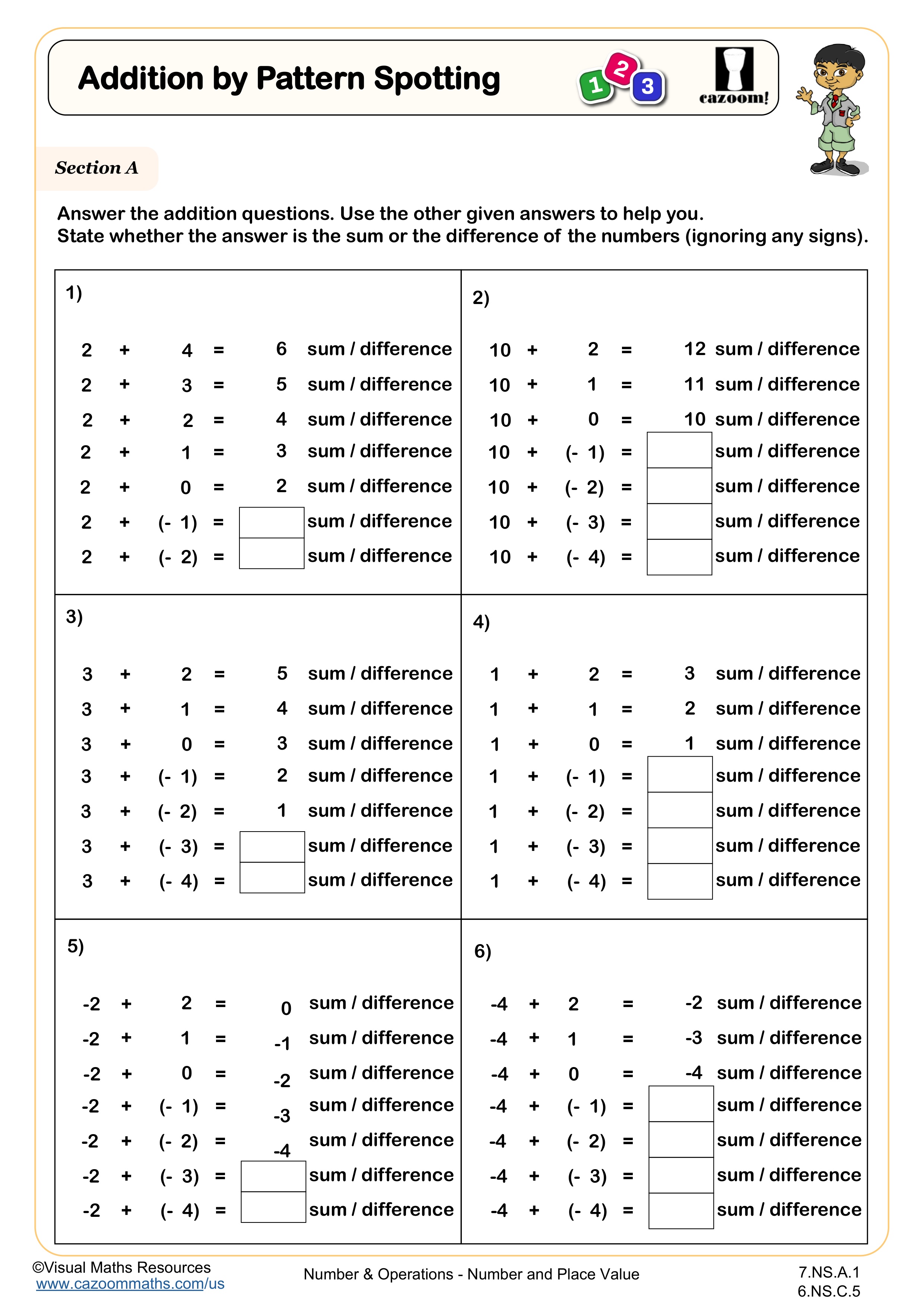
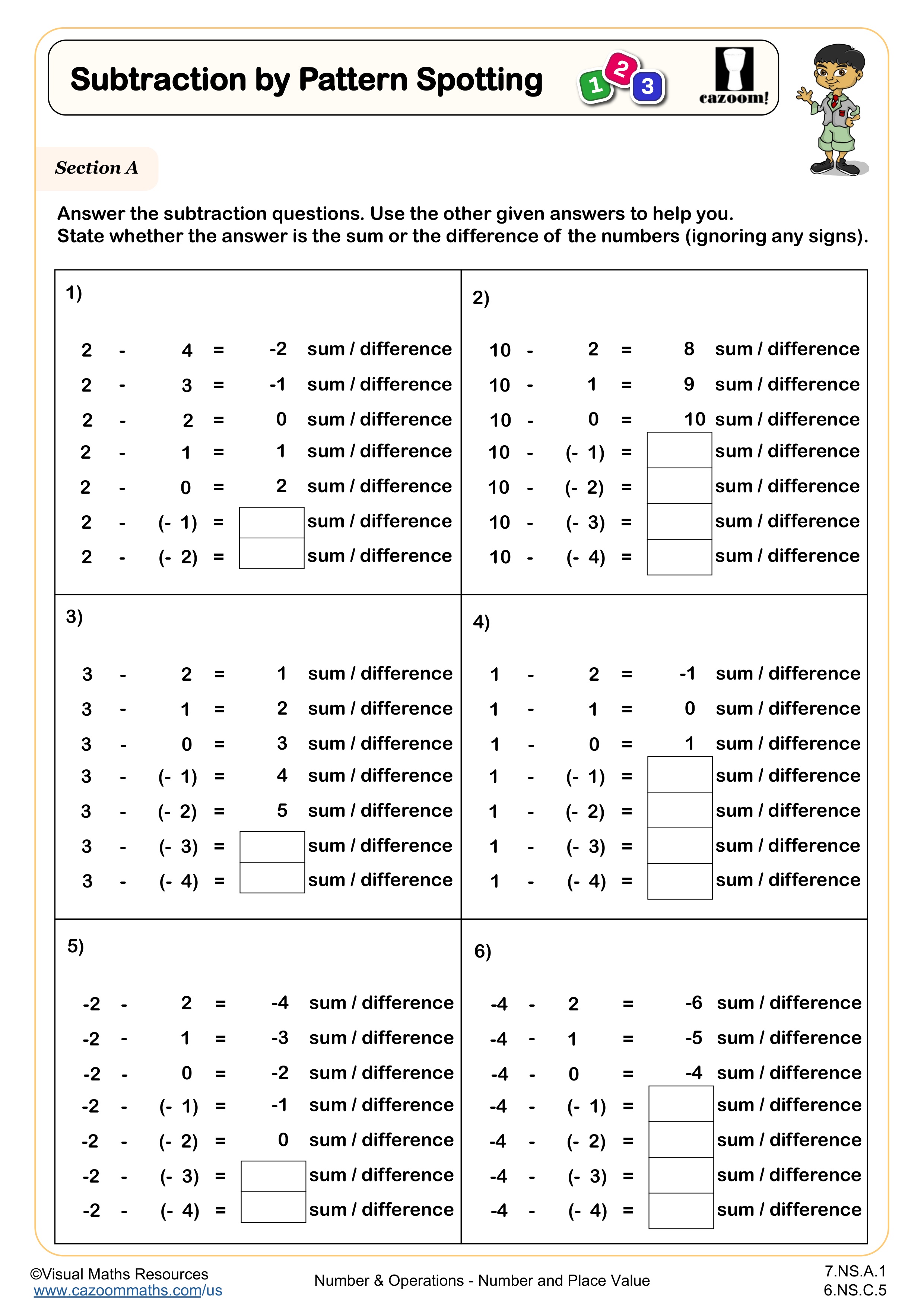
All worksheets are created by the team of experienced teachers at Cazoom Math.
Why Do 7th Graders Still Need Place Value Practice?
Seventh grade place value work focuses on solidifying understanding of large numbers, negative integers, and the numerical relationships that underpin algebra and scientific notation. While students learned basic place value in elementary school, middle school requires applying these concepts to increasingly abstract contexts, including negative numbers on coordinate planes and exponential notation in science classes.
A common misconception surfaces when students compare negative numbers: many incorrectly assume that -100 is greater than -20 because 100 is larger than 20. This reveals incomplete understanding of how place value works with negative integers. Worksheets that specifically address comparing and ordering positive and negative numbers help students visualize the number line and recognize that distance from zero determines magnitude, not the digits themselves.
What Grade Level Are These Place Value Worksheets For?
These worksheets target 7th grade students in middle school, aligning with standards that expect fluency with rational numbers and preparation for algebraic thinking. At this level, place value serves as the foundation for understanding scientific notation, working with very large and very small numbers in science contexts, and developing number sense for estimation and mental math.
The progression from 6th grade builds on work with multi-digit division and introduces more complex integer comparisons, while preparing students for 8th grade topics like laws of exponents and scientific notation. Students who master place value concepts in 7th grade find it significantly easier to understand why 10³ equals 1,000 and how powers of ten relate to decimal movement, making the transition to exponential notation more intuitive.
How Do Students Use Place Value Tables Effectively?
Place value tables organize digits by position, helping students identify the value of each digit within a number. In these tables, columns represent different powers of ten (ones, tens, hundreds, thousands, and so on), and students place digits in the appropriate columns to build or decompose numbers. This visual structure makes it easier to compare numbers by examining corresponding place values from left to right.
This skill connects directly to computer science and data analysis, where understanding place value in different number systems becomes essential. Binary code, used in all computing, relies on place value with powers of two instead of ten. Students who grasp that the digit 5 in the hundreds place represents 500 because of its position can more easily understand how the binary digit 1 in the fours place represents 4, making connections between mathematical concepts and the technology they use daily.
How Should Teachers Use These Place Value Worksheets?
The worksheets provide scaffolded practice that moves from identifying place value in tables to applying that knowledge in comparison tasks. The place value examples offer worked models that students can reference while completing independent problems, while activities like comparing numbers to 10,000 challenge students to apply their understanding in increasingly complex situations. The word search offers a low-pressure entry point for reviewing vocabulary and building confidence.
Many teachers use these worksheets during intervention blocks for students who struggle with integer operations or decimal calculations, since place value gaps often explain those difficulties. They also work well as warm-up activities, homework assignments that reinforce classroom instruction, or review materials before standardized assessments. The answer keys allow students to self-check during independent work or partner practice, encouraging metacognition and immediate error correction rather than reinforcing misconceptions.