7th Grade Space Worksheets
All worksheets are created by the team of experienced teachers at Cazoom Math.
How do space-themed math problems help 7th graders learn mathematical concepts?
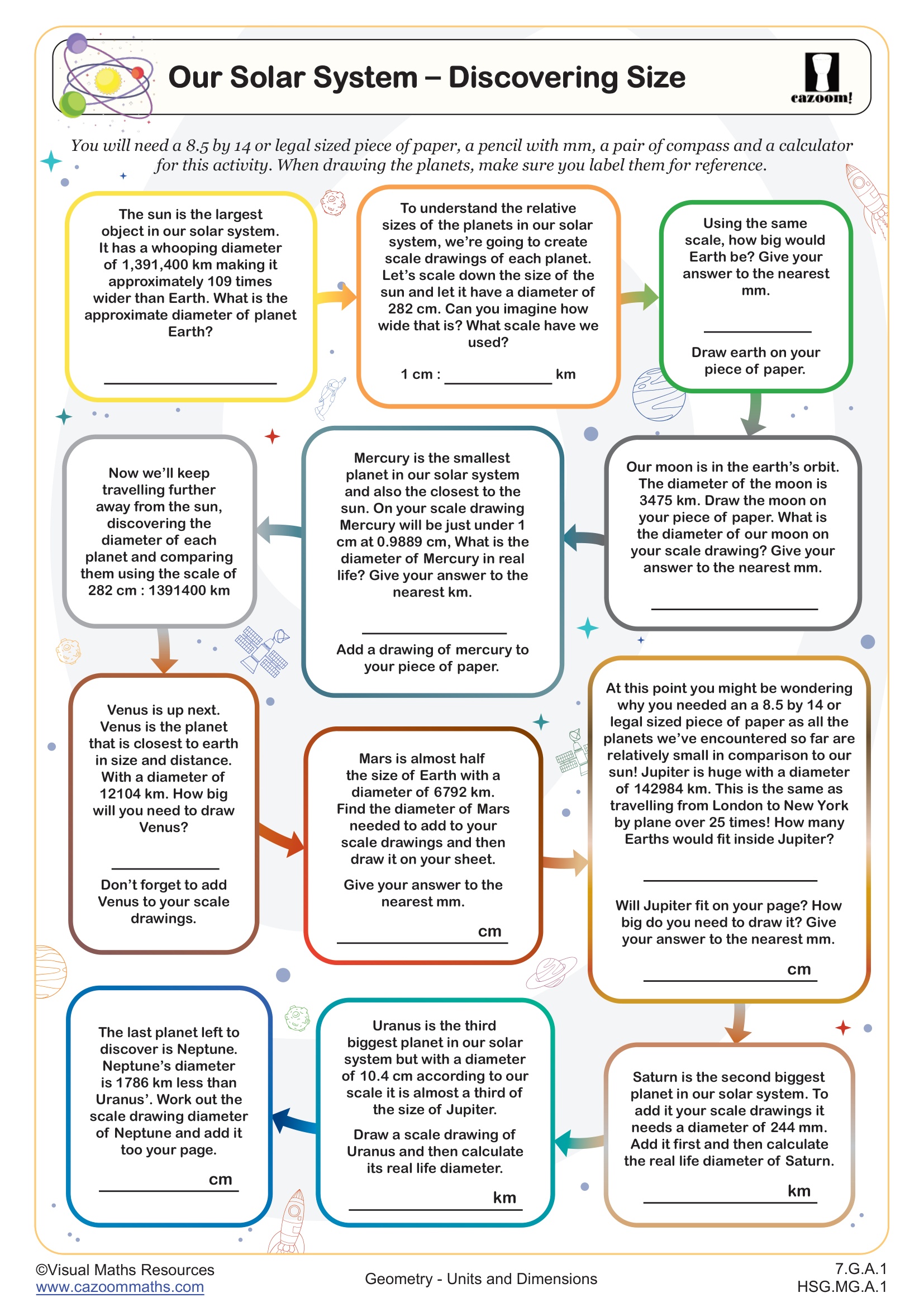
Space-themed math worksheets engage 7th grade students by connecting abstract mathematical concepts to tangible astronomical phenomena. When students calculate the scaled distances between planets or determine the dimensions of spacecraft using coordinate geometry, they practice ratios, proportions, geometric constructions, and scale factor applications within meaningful contexts. The authentic data from NASA missions and real spacecraft specifications make these problems feel relevant rather than arbitrary.
Teachers frequently notice that students retain concepts better when they've practiced them through space applications. A common breakthrough happens when students realize that the same ratio skills they use to scale down the solar system also apply to map reading, model building, and engineering blueprints. Students often lose points on standardized tests when they misapply scale factors, but practicing with planetary distances—where errors produce obviously unreasonable results—helps them develop better number sense and self-checking habits.
What grade level are these space math worksheets designed for?
These space math worksheets specifically target 7th grade students in middle school, aligning with curriculum standards that emphasize proportional relationships, geometric constructions, and multi-step problem solving. At this grade level, students have the algebraic thinking skills needed to work with scientific notation for large numbers like astronomical distances and can apply their understanding of ratios to scale models of the solar system or spacecraft.
This topic builds directly on 6th grade work with ratios and rates while preparing students for 8th grade functions and transformations. Students transitioning from 6th grade bring their ratio tables and unit rate skills, which they now apply to astronomical scales. The geometric construction work with shapes like rectangles and ellipses prepares them for 8th grade geometry, where they'll study transformations more formally. The reflection activities in these worksheets introduce transformation concepts that become central in the following year's curriculum.
Why do space worksheets include elliptical orbit calculations?
Elliptical orbit problems introduce students to geometric shapes beyond circles while teaching them that planetary motion follows mathematical patterns rather than perfect circles. Students learn to identify key features of ellipses, including foci, major and minor axes, and how these properties determine orbital characteristics. This connects 7th grade geometry standards with authentic astronomical applications, showing how mathematicians and astronomers like Johannes Kepler used geometry to describe planetary motion centuries before space travel existed.
NASA engineers and mission planners use these same elliptical orbit calculations when designing spacecraft trajectories and planning interplanetary missions. The Mars rovers, satellites orbiting Earth, and every spacecraft traveling between planets follow elliptical paths that engineers must calculate precisely. Understanding elliptical geometry helps students see how mathematical concepts discovered in the 1600s remain critical tools for modern space exploration. Students often make the connection that the same math describing planetary orbits also applies to satellite communication systems they use daily.
How can teachers use these space math worksheets in the classroom?
These worksheets provide structured practice that builds from conceptual understanding to application. Each problem sequence guides students through the mathematical thinking required for space-related calculations, with answer keys allowing teachers to quickly identify whether students struggle with the computational steps or the conceptual setup. The visual elements, like coordinate grids for spacecraft design and scale diagrams for solar system models, help students connect abstract numbers to spatial reasoning.
Many teachers use these worksheets during STEM units that integrate math and science standards, assigning them as collaborative work where students compare their scaled solar system models or debate the best coordinate approach for drawing spacecraft components. They work well as differentiation tools during ratio and proportion units—students who finish early can tackle the space applications while others complete foundational practice. The worksheets also serve effectively as review before state assessments, since they combine multiple skills (ratios, geometry, coordinate graphing) in single problems, mirroring the complexity students encounter on standardized tests.