7th Grade Substitution Worksheets
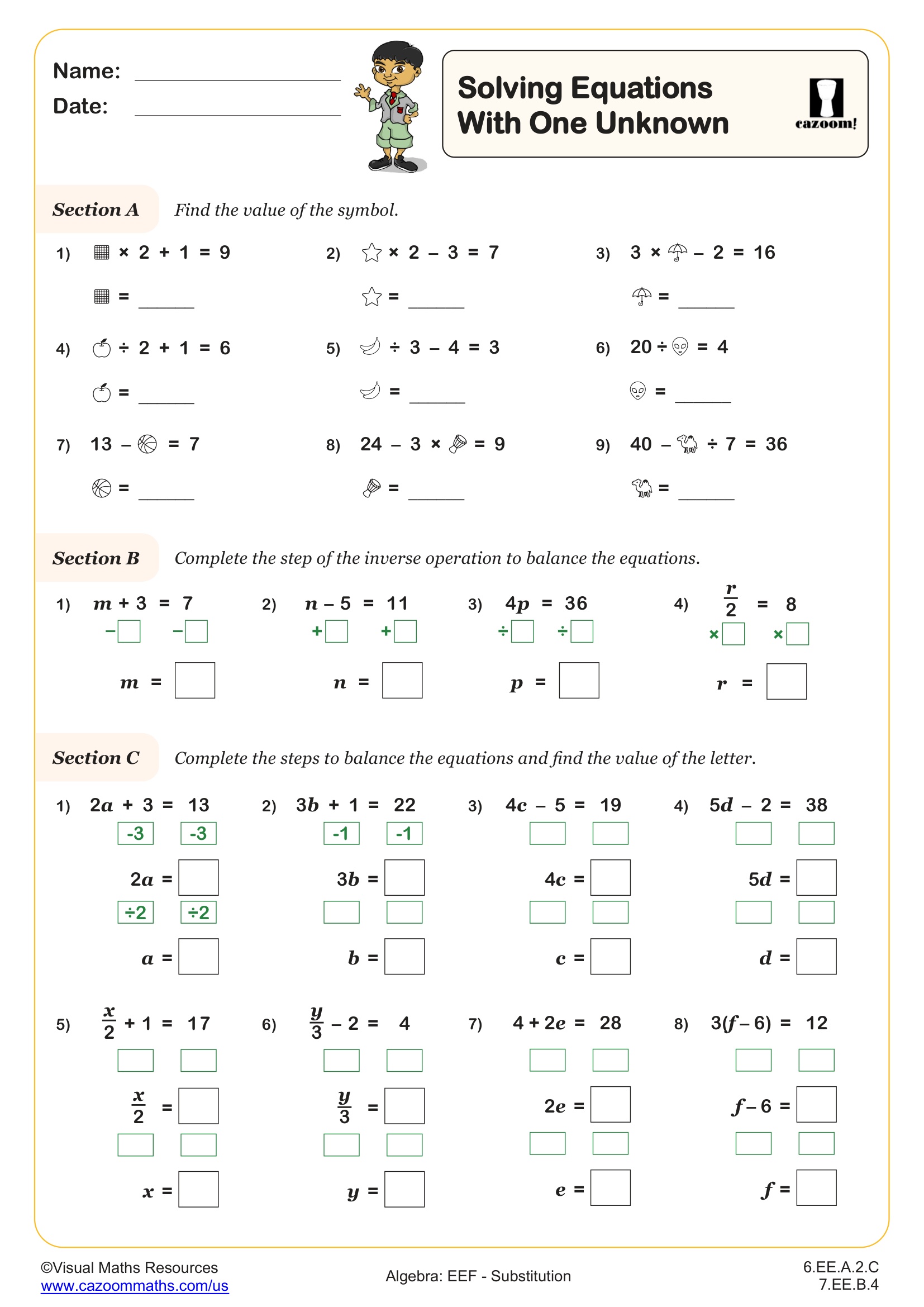
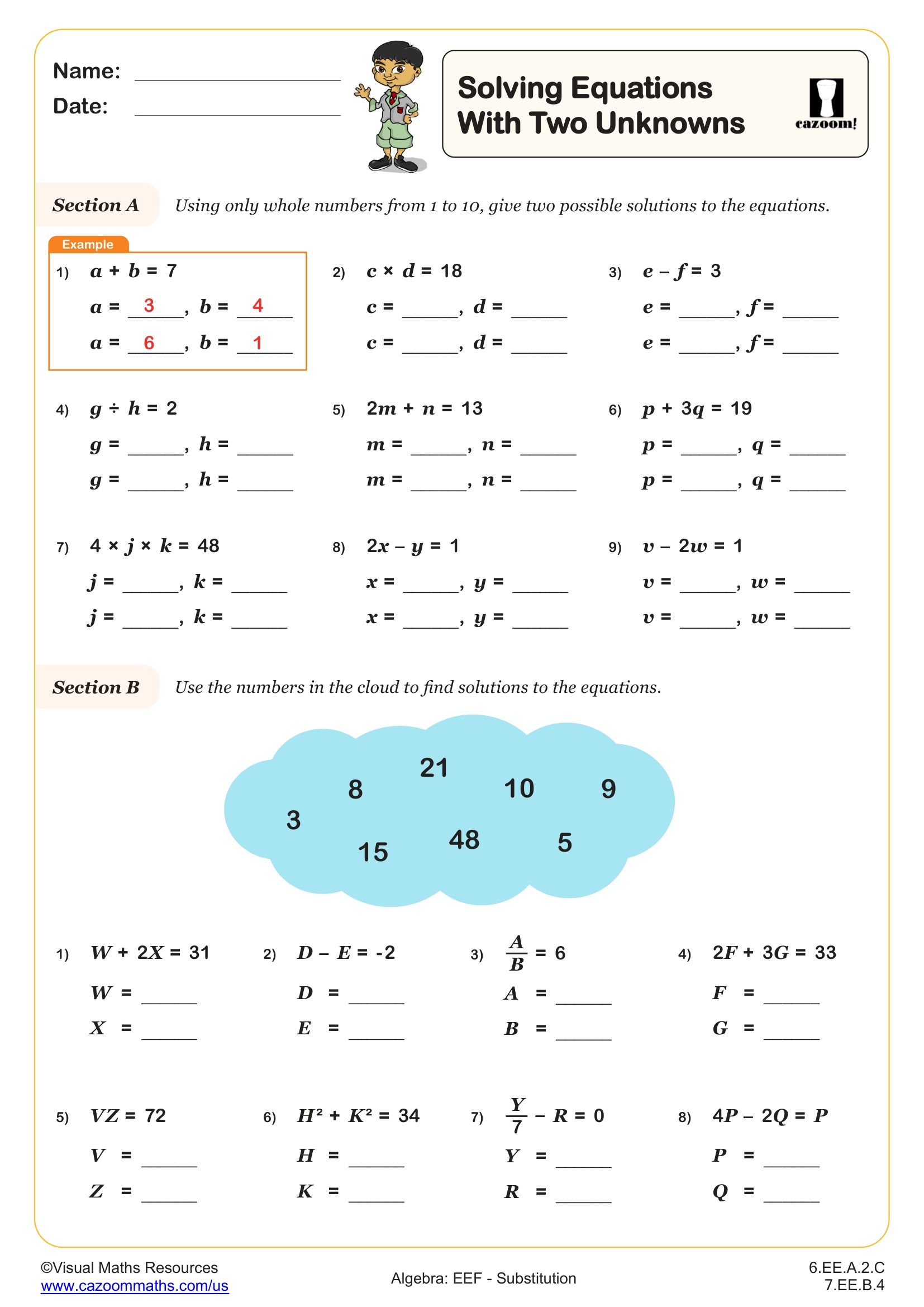
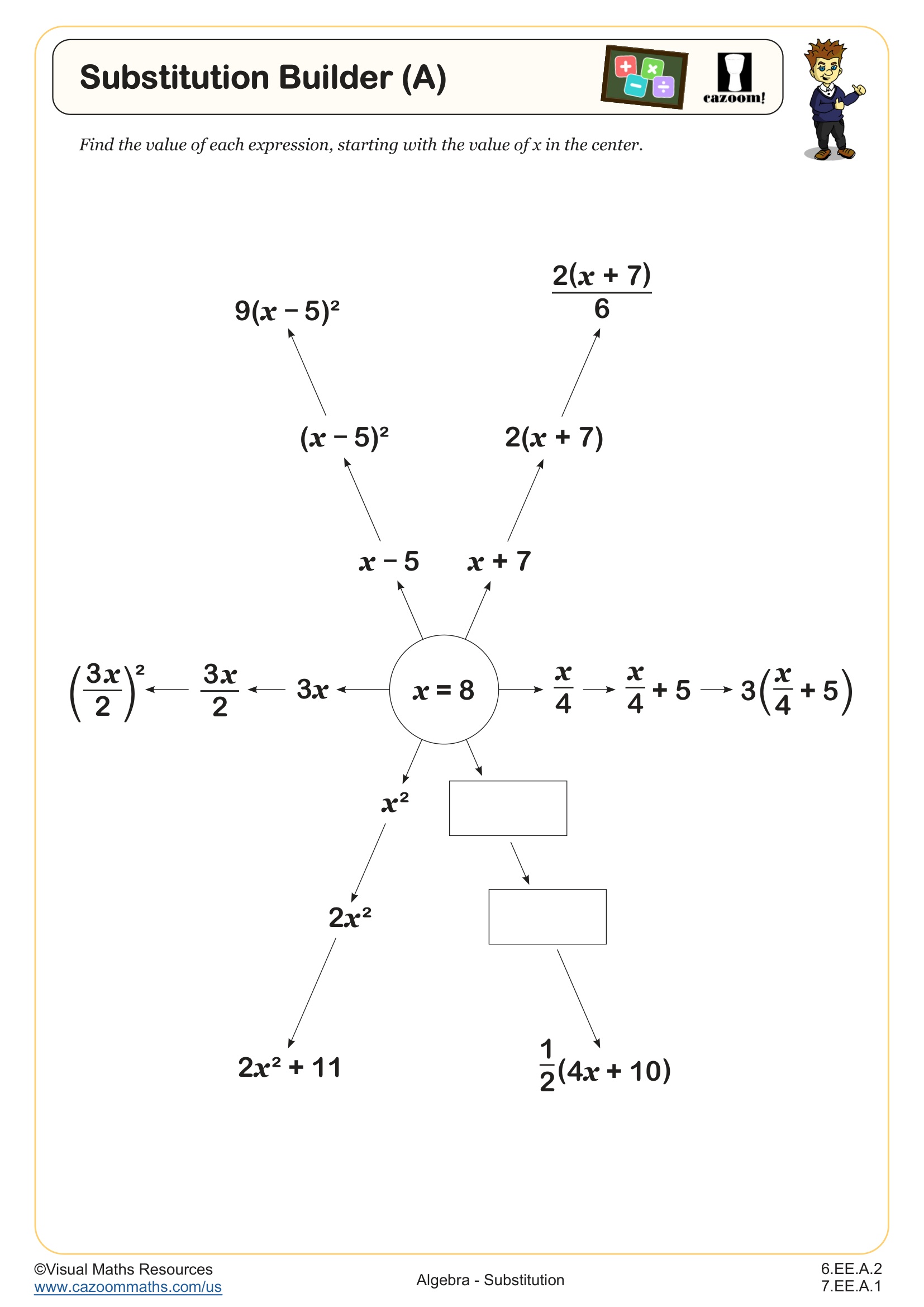
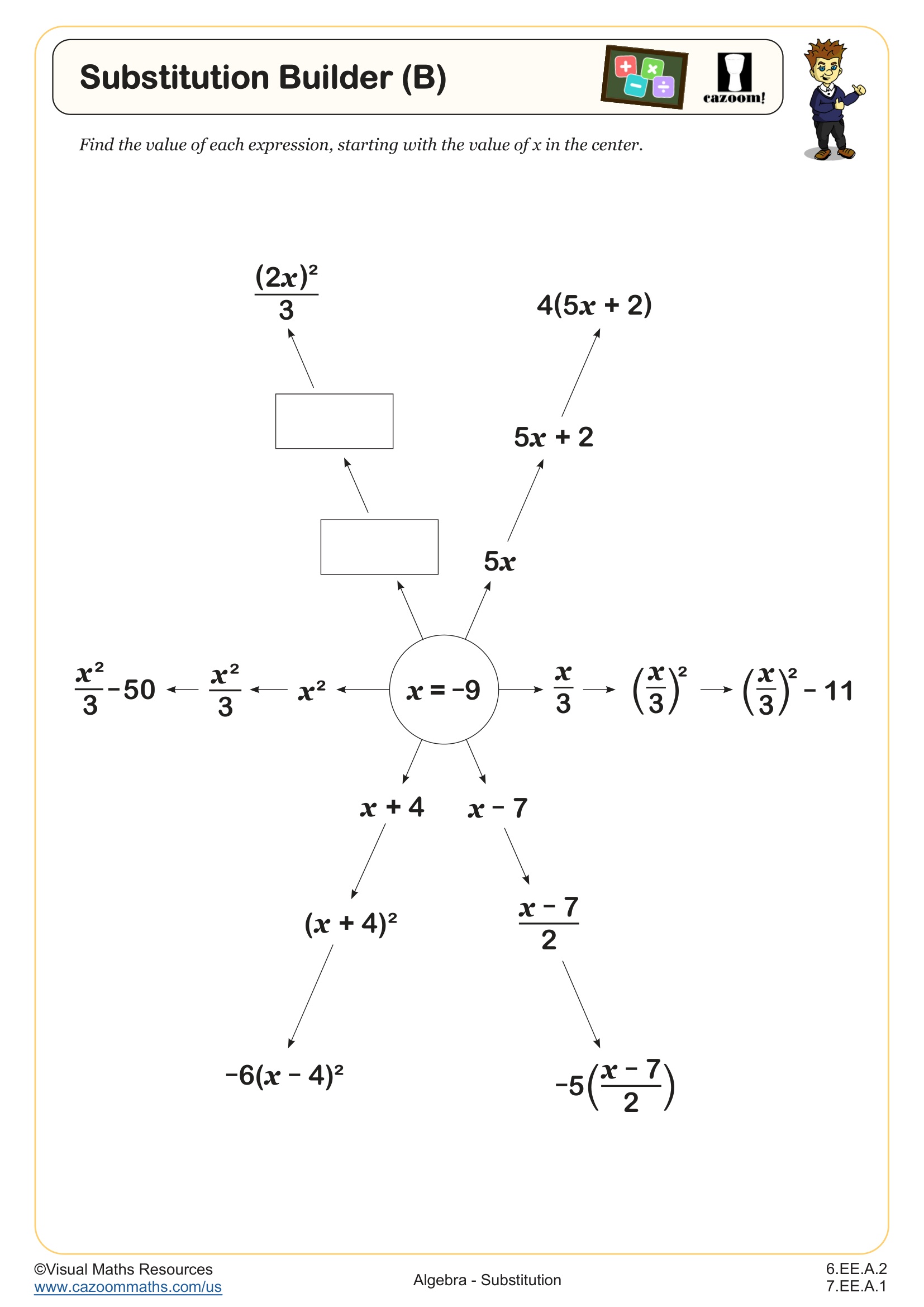
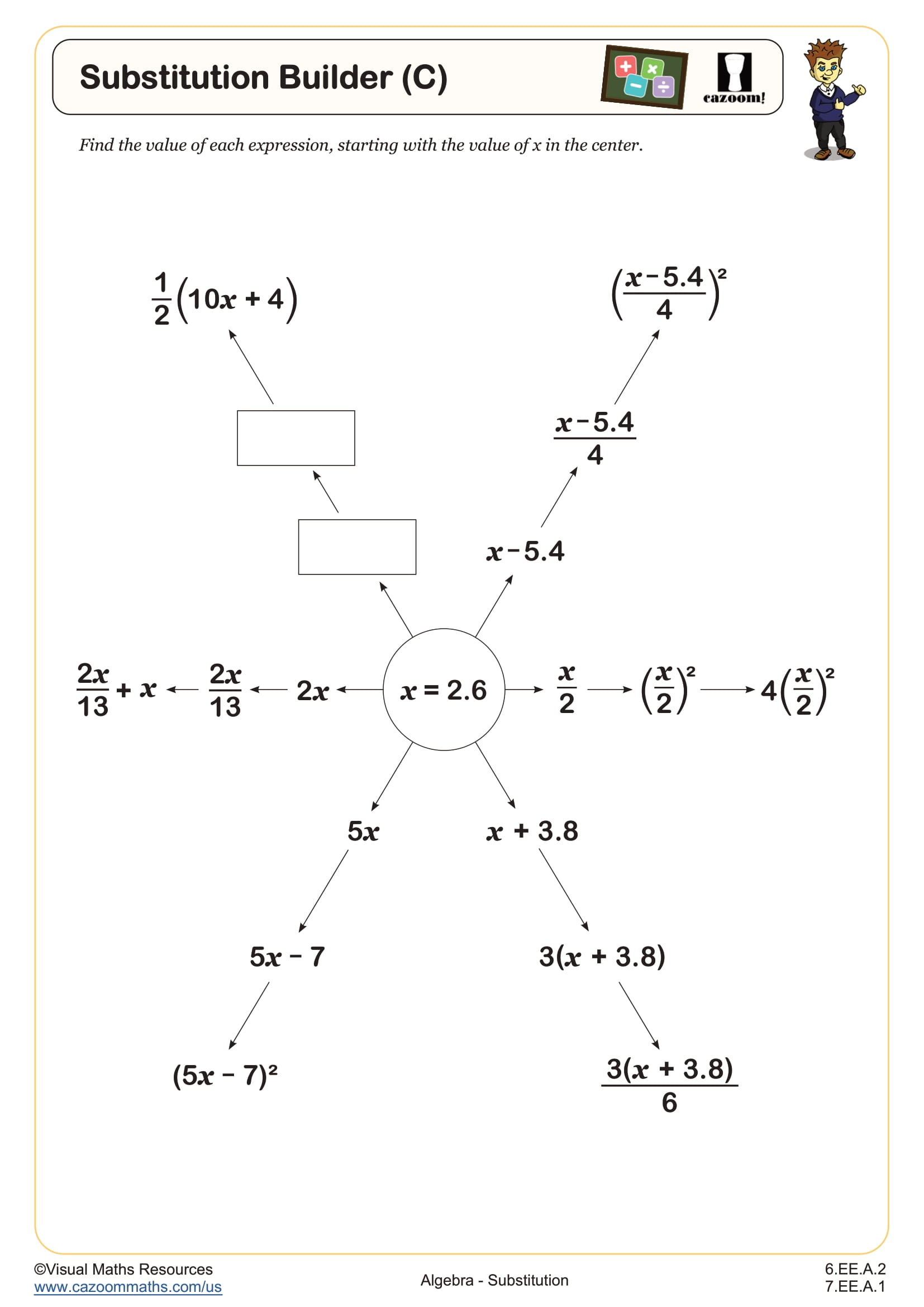
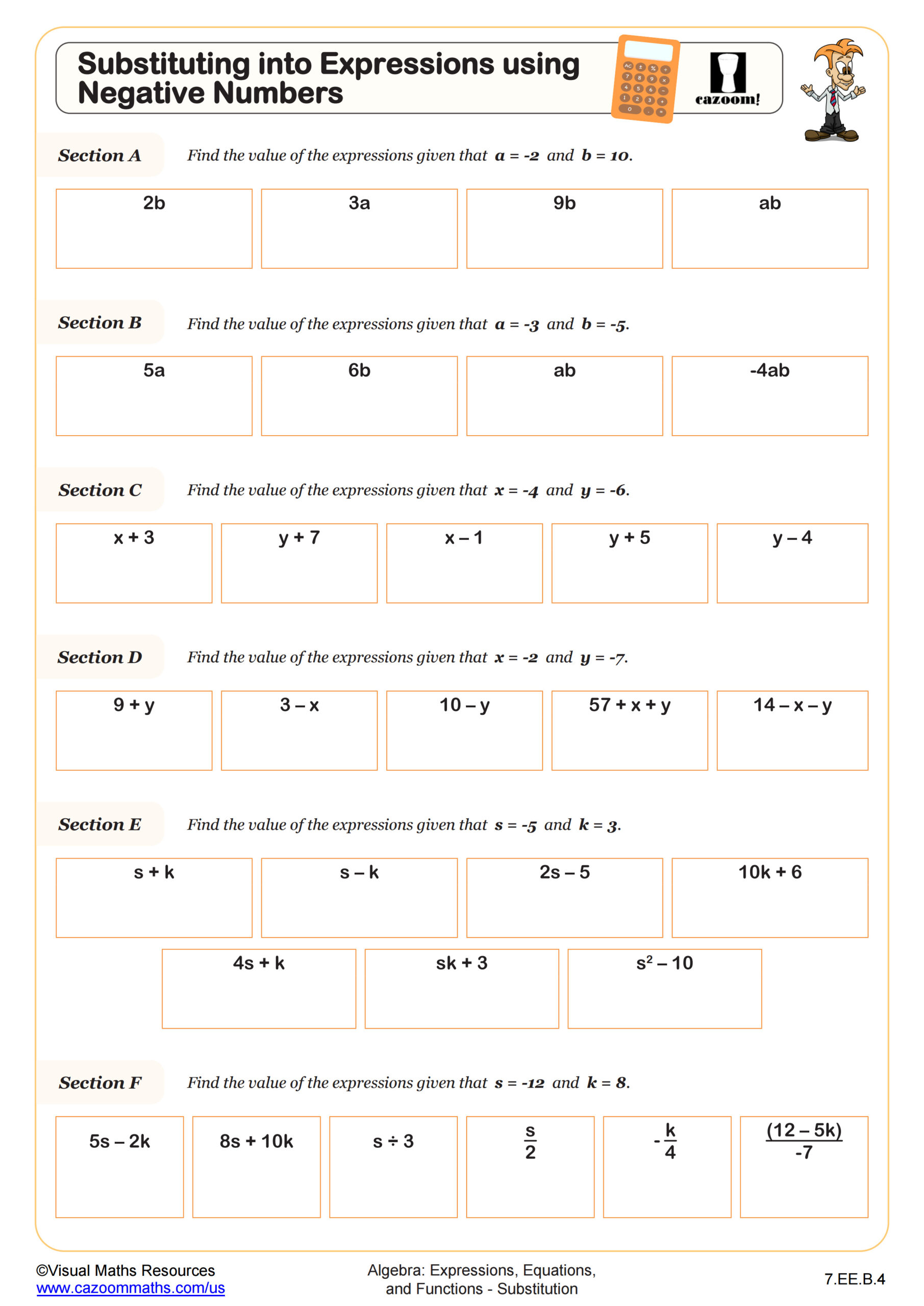
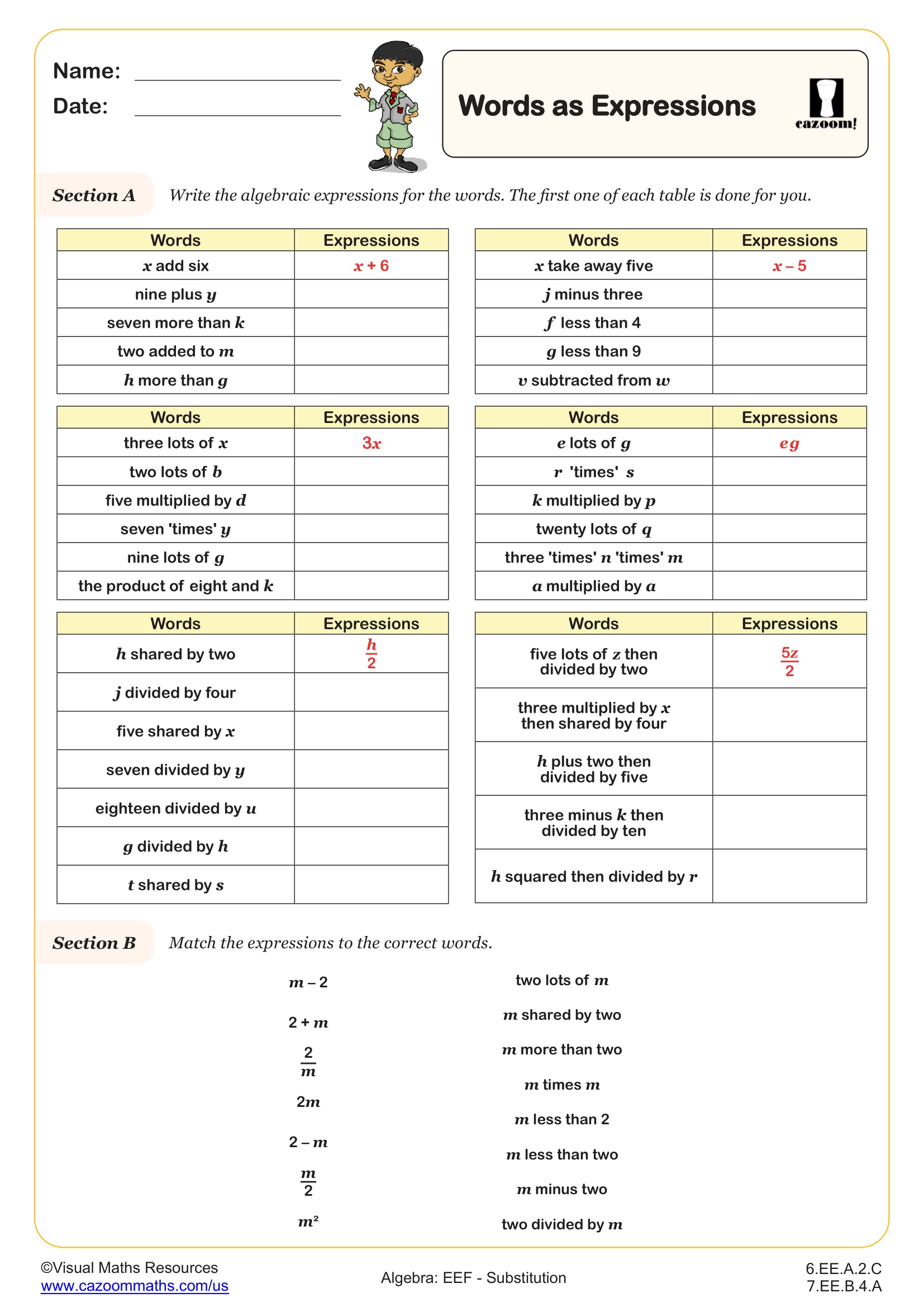
All worksheets are created by the team of experienced teachers at Cazoom Math.
What Is Substitution in 7th Grade Math?
Substitution involves replacing variables in algebraic expressions or formulas with given numerical values, then simplifying using order of operations. In 7th grade math, students work with expressions like 3x + 5 or 2a - b, substituting integers to find specific numerical results. This skill appears throughout middle school assessments and connects directly to Common Core standard 7.EE.A.1, which requires students to apply properties of operations to add, subtract, factor, and expand linear expressions.
A common error occurs when students substitute negative numbers without adding parentheses, writing 3x as 3-4 instead of 3(-4) when x = -4. This leads to incorrect answers since 3-4 equals -1 while 3(-4) equals -12. Teachers can reduce this mistake by having students write substitution as a separate step before simplifying, clearly showing the parentheses around every substituted value regardless of sign.
What Grade Level Are These Substitution Worksheets For?
These worksheets target 7th grade students in middle school, aligning with the point in the curriculum where algebraic thinking becomes more formal and abstract. Students move beyond simple arithmetic to work with variables as placeholders that represent unknown or changing quantities. This matches typical state standards and Common Core expectations for pre-algebra concepts in grade 7.
The progression builds naturally from 6th grade work with numerical expressions and introducing variables, then extends into 8th grade where substitution becomes essential for solving systems of equations and working with linear functions. Students who master substitution in 7th grade find graphing equations and understanding function notation significantly easier the following year, since they already recognize that different x-values produce different y-values through the substitution process.
How Do Students Work With Formulas Using Substitution?
Substituting values into formulas requires students to identify which variable represents which quantity, replace each variable with its corresponding number, and calculate the result following order of operations. Students practice with familiar formulas like area and perimeter, then progress to less intuitive formulas where careful tracking of multiple variables becomes essential. The worksheets include formulas with clues that guide students through matching values to the correct variables.
This skill directly supports science classes where formulas appear constantly. In physics, students substitute values into d = rt to find distance, rate, or time. In chemistry, they use formulas to calculate concentration or convert between temperature scales. Engineering and computer science both rely heavily on formula manipulation, making substitution a foundational skill across STEM fields. Students who understand substitution as "following a recipe with specific ingredients" often grasp these applications more intuitively than those who view it purely as abstract math.
How Can Teachers Use These Substitution Worksheets Effectively?
The worksheets provide scaffolded practice starting with simpler expressions and building toward multi-variable formulas and negative number substitution. Worked examples on several worksheets model the complete process, showing students how to write out substitution steps before simplifying. The visual Emoji worksheet offers an engaging entry point where students substitute values represented by images, reducing the abstraction that intimidates some learners.
Teachers find these worksheets useful for differentiated math stations where students work at different difficulty levels simultaneously. The Builder worksheets work well for intervention groups since they break down the substitution process into manageable steps. Answer keys make the worksheets practical for homework assignments, allowing students to check their work independently and identify specific problems to discuss during the next class. Many teachers use one worksheet as guided practice and assign a similar one for independent work, building student confidence through structured repetition.